Monday, June 27, 2016

FEDERICO da MONTEFELTRO's SUMMER PALACE

FEDERICO DA MONTEFELTRO's SUMMER PALACE

In Gubbio, high up on the hill just above the town hall
of the main piazza, Federico da Montefeltro built a ducal
palace from 1470-82 similar to the palace he had built in Urbino
in 1470.

The Gubbio palace is slightly smaller in scale overall but has features that the duke wished
to repeat from his usual home:  courtyard open to the sky,
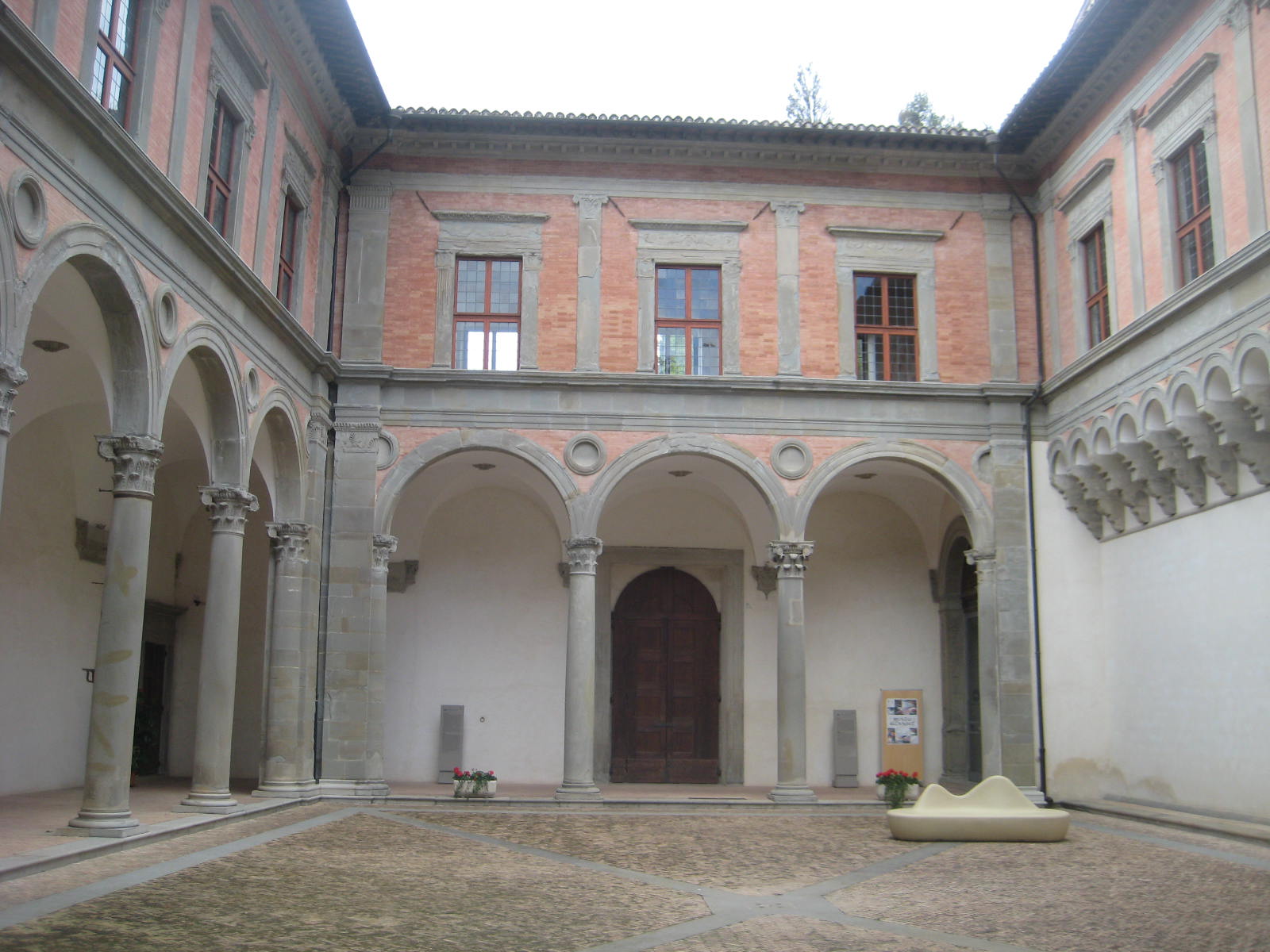
areas below the main house for gardens and horse stables,

views of the valley below,


and, most importantly of all, a studiolo with wood inlay work to
rival the studiolo inlays he commissioned for Urbino.


The raised seat of the bench here seems three-dimensional but all of it
is actually flat surface, an illusion created by the inlay workers using
dark and light woods. For more than a century it has been impossible to see
the Gubbio study room with these inlays in it because first the inlays were
sold to Prince Filippo Lancelotti in 1874 for his villa in Frascati, then in
1937 were passed on to an art dealer who transported them en masse to New York
where in 1939 they were purchased by the Metropolitan Museum.
        Now the ingenious woodworkers of Gubbio have invented
a way around that loss by recreating in full the intarsias (wood inlays)
of the Gubbio studiolo by making an exact copy of them, so that when a
viewer enters the studiolo in Gubbio now, the effect is to be reunited
with a 15th-century work of art as it would have appeared to the Duke
himself. The copy was carried out between 2003 and 2009; for more
on the copy work, see the website:Associazione Maggio Eugubino
www.maggioeugubino.com/iniziative/studiolo_eng.pdf
See also my earlier blog entry on the inlay subjects here.
        What has become very clear from the reinstallation of the
inlays in the new copy is that the Duke wanted to be able to get to
his study quickly in his summer home. His studiolo in Urbino had
been built on the second story of the palace, above the courtyard
one floor and given the balcony view over the countryside:
                          (on the facade with the two turrets, the arched balcony on the top floor
                                                 marks the studiolo location in Urbino)
In his summer place the Duke would have ridden on horseback from Urbino,
a trip which takes a car about an hour and a half today. He could have
been weary from the ride and wanting to retire. It appears that when designing
his Gubbio palace, he wished to be near his books and papers as soon as he dismounted, so the studiolo in the Gubbio palace is right on the ground floor, directly in from the front
door to the left and left again one room's length:
With this new arrangement he would not have
had to climb the stairs as he had to for the studiolo in Urbino. He could
slide in easily from horseback to study seat and feel at home again in
his wood inlay world.
            And what a self-referential world it was! Not only are his initials
set in inlay in several places, FE, for Federico

but all of the devices with which he identified himself, the codes of his family name,
are inscribed in various ways in the wood inlay work.
            We can see the ermine of purity
with the words Non Mai - Not Ever - in Italian in the banner above it (the second N is implied),
 
to reflect his longstanding fealty to whatever contract he had signed, a purity
which set him aside from other condottieri who often changed sides in battle
when paid more by the other side. He would NOT EVER alter his loyalty for
the duration of the contract.
            The whiskbrooms for the cleaning and care of horses for which he was also renowned are
displayed:
And then the references to his magnificent library in the books:

and  to his other intellectual pursuits, such as music and scientific observation:
 
His dedication to learning and erudition is represented by the Iliad passage in manuscript on
his inlay reading stand:


His armaments are also here, but they are not as prominent as they were in Urbino. They are
put away in a cupboard, partially hidden during his summer relaxation time. We can make out the
helmet, his mace, his greaves:

He seems to have shelved his battles and enjoyed the summer for reading and thinking.
Was the Duke a frustrated university professor? Having seen the futility of battle, did he rejoice in the life of the mind stimulated in his private studiolo in the comfort of his summer home, up on the hill, away from the plains of fighting, in the cool retreat from the sun of Italy that heated up armor to a state of intolerance?
          The studiolo was a small room of retreat,
but then one views the studiolo in a different way when confronted with the other unusual feature of this summer palace? The ENORMOUS BALLROOM!

There are large social rooms in the palace of Urbino, settings for the conversations in the Cortegiano by Baldassare Castiglione,

but nothing of the scale that confronts the viewer in Gubbio.

Is this room larger than the 110' X 55' X 55' room of the Banqueting House in London of 1619-22?

Larger than the double-cube room of 60 X 30 X 30 feet in Wilton House, England, of 1638, seen
above? Both of the later rooms are designed by Inigo Jones who, everyone says, was influenced by Palladio. But what if Inigo Jones was influenced by the Ducal Palace in Gubbio instead? He did visit Italy and I do not know if he saw this palace in Gubbio. But the size and simplicity of this Gubbio ballroom strike me as perfect original models for the grand rooms in the Italian style built by Inigo Jones two centuries later in England. Could Jones not have seen this large ballroom before taking the idea for a large entertainment center back to England?
      This salon/ballroom down the hall from the studiolo could have housed hundreds of guests, perhaps for meals, certainly for large dances. It had the best views over the valley from its windows fronting onto the town.

 
It would have provided a spectacular place for large-scale entertainment evenings of the sort during which Federico's wife took sick and died in the summer of 1472.
The portrait which Piero della Francesca does of her in 1472 is based on her deathmask and
the town of Gubbio is painted in the background of her image.
The white and grey turrets of the city's walls are visible as well as the road leading down the
hill to the town's entrance, as though the viewer were coming from Urbino to Gubbio with
the Duke. Behind Battista is also the suggestion of a lake or river. She had gone in the cold
water of the Raggio River during the day on the night she died. She had feasted with friends
afterwards in the valley, then complained of a headache and rode back to the palace on
horseback to go to bed.

           Battista Sforza, the Duke's wife, had given birth in Gubbio to their son in January. She had survived childbirth and she had not properly recovered even by July. Some scholars have thought she had weakened her constitution after the birth of her son by doing perilous barefoot penances in gratitude to God and the saints for having given her a son. (See the 2009 book on Battista by Mazzanti.)The Duke was not in Gubbio and rushed back to her to embrace her before she died, but he felt guilty for her death, which may explain his desire to memorialize her in the portraits painted by Piero:  to see her one more time and keep her alive a little longer; his own face looking at hers reinforces the idea of his desire to see her eternally.


The Latin inscription in the past tense on the back of her portrait confirms the portrait as posthumous.

She was in the Gubbio Palace when she died. Her body was taken on the journey back to Urbino
and for the wakes she was dressed in the nun robes of the Saint Clares. Perhaps her own love of entertainment was taken into account in the building of the summer palace, and the Duke acceded to the large social space to please her, not ever imagining the palace might be the site of her death.
What a light-filled arena in which to socialize! She ended her life well, as the
Latin inscription says:  "OVE MODVM REBVS TENVIT SECVNDIS./ CONIVGIS MAGNI DECORATA RERVM./ LAVDE GESTARVM VOLITAT PER 0RA./ CVNCTA VIRORVM."
English: “She who observed modesty in success flies on all men’s lips, honoured by the praise of her great husband’s exploits.”  She is a tribute to her husband, but her own qualities are praised, too. All of the accolades that poured in to the Duke after her death speak of an enormous affection for this
gracious and capable young woman (26 years old.)
         If we take into account the fact that Battista died in the Gubbio summer palace, the Duke's studiolo, which is completed after her death, makes more sense. It is not just a retreat for a scholar, the Gubbio study, but the retreat for a mourning widower. The armor is put away and the Iliad passage is about death.

Thursday, March 31, 2016

DONATELLO'S CANTORIA - THE SCROLL


DONATELLO'S CANTORIA - THE SCROLL

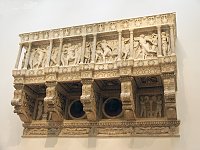
The Italian Renaissance sculptor, Donatello, begins work on his Cantoria (the word means singing gallery, but the object being sculpted is an organ cover) in 1433, two years after Luca della Robbia had begun his. As we mentioned in the previous blog, both works were made for the Cathedral of Florence as part
of the decoration near the altar above the sacristy doors.

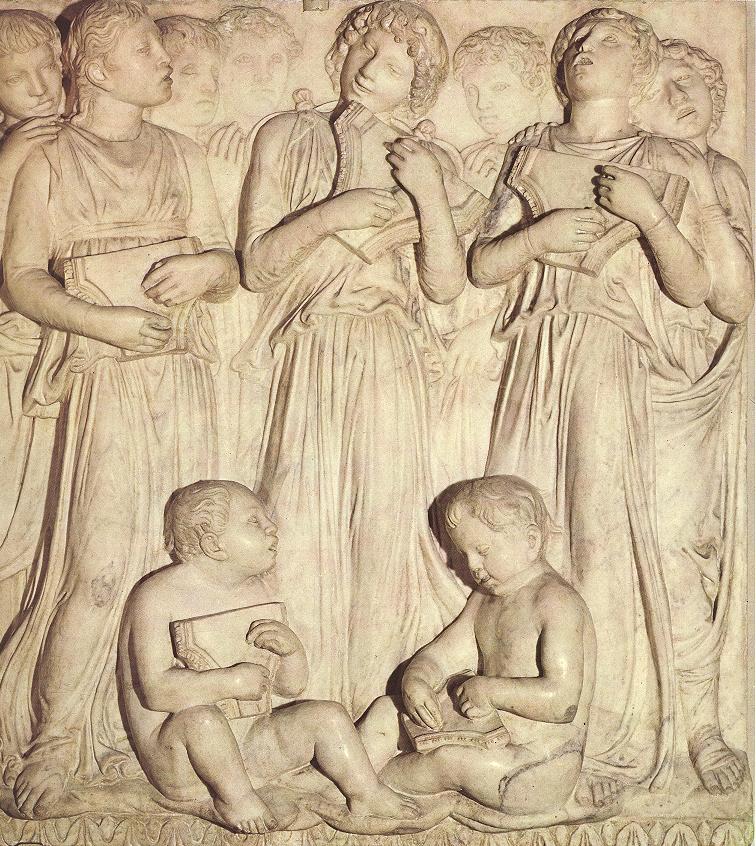
Luca's Cantoria (near above) dates from 1431-1438 while Donatello's(top photo) is started 1433 and finished later in 1439. Part of the reason Donatello begins later is that in the early 1430's he is at work on another project in the nearby town of Prato. Since there are similarities in his Prato pulpit and the Cantoria for the Duomo of Florence, it bears looking at the sculptures that Donatello did for that town.
Prato has a small Duomo of regular shape to which was added an outdoor pulpit in the 1430's designed by Michelozzo, with sculpted bas-reliefs by Donatello.  The circular motifs of the pulpit and its canopy mirror the object that was meant to be displayed on this balcony: the belt of the Virgin Mary handed down to St. Thomas and brought to Prato in the 12th century by the wife of a Prato merchant. On four special feast days during the year the belt is brought out to the pulpit and shown to the public:

The belt is a Medieval piece of green leather that could have fit neatly around the waist of a young woman.

While the belt itself is hard to see from down below, the circular pulpit with dancing putti gives the sense of a round belt with notches attached to the corner of the church. Since the Virgin's belt is the prime sacred relic owned by this town, the pulpit functions as a permanent display on the days when the real belt is kept inside the church. The main architectural feature of the Prato Duomo looks like a belt mid-way up the body of the building. The architectural and sculptural appendage on the exterior advertises the town's relic held in the interior.


            The real bas-reliefs that Donatello carved are kept now in the cathedral museum, while the outdoor ones are replicas. But a visitor to the museum can see closeup the dancing putti that Donatello carved before he started the Cantoria. And, just as Luca della Robbia is influenced by Donatello in his Cantoria, Donatello is influenced by Luca as well; the artistic exchange during this period must have moved both ways. Donatello's putti are framed within seven separate units on the pulpit:


Within each area framed by the two fluted pilasters, children dance and carry tambourines and pipes, staffs, and generally jump around joyously, each small group in a small square.


Each square has figures who move within it and these groups do not overlap with the unit next to them, much as the contained groups in Luca della Robbia's Cantoria remain within their squares:

Donatello must have been dissatisfied with the rhythmic stop and start of this containment in Prato because when he comes to do his Cantoria for the Florence Duomo, he places the two architectural elements (in this case, the colonnettes) in front of the dancers so that for the viewer their joyous movement continues behind the columns and around the entire organ gallery in one sweeping motion:


Compared with its immediate predecessor, the effect is monumentally different: Instead of stop/motion/stop from left to right, the rhythm is step/step/step/step and the movement begins on the right end panel and ends on the left end panel. The effect in Donatello's Cantoria is continuous motion from one end to the other.

Donatello also realized something that Luca never did, that in order to show believable motion in figures, you must carve them in step sequence. Donatello understood the principle behind Disney animation five centuries before the twentieth, and within his own century several decades before Botticelli understood it and produced it in his works.  How does Disney animation show up in Donatello's Cantoria?

It is displayed in the figures on the front of the Cantoria. The larger space between the pairing of the colonnettes has one figure that stands out in highest relief.


Beginning with the first large gap in the front right, the angel or putto (child with wings) who is set out in highest relief steps on his right foot and swings his left foot up behind him as he moves forward:
 
In the next large gap between the colonnettes to the left, the largest and most deeply carved figure steps on his left foot and swings his right foot behind:


 The third left gap holds a figure who steps with right foot, his left behind, imitated by the child behind him:

The last gap at the left end shows a figure facing back to where the other figures have come, lifting up arms and stopping the movement with right foot bearing the weight:


The rhythm of this step sequence is from right to left:  step right, step left, step right, stop. The effect for the viewer is of ONE figure running in space, stepping right, stepping left, stepping right, and stopping. The step sequencing works much like Disney cels in that when the steps are read in sequence and the cels put together, the viewer is captivated by the motion through space of a single
figure in the dance. Donatello wanted to convey continual movement and he knew that he could do that by repeating one figure in stepping sequence: right, left, right, stop.


       What about the side panels? To begin the motion he carves two putti on the right side panel who run left under an arch formed by trumpets: the first steps with left foot, the second with right.


The left side panel continues and ends the movement of the whole of the Cantoria, with another trumpet arch and a figure coming forward on the right foot, running in a left direction.


If you join the side panels with the front ones, the direction of the dance is right to left, but the step sequencing works best on the front. The effect of the side panels, though, is to keep the motion going right to left even with the stopping figure in the last panel.


What glorious movement he creates, a running from right to left, a thrilling tumult of joy, with major figures stepping in sequence, surrounded by minor figures in lower relief playing tambourines or holding up wreaths, or smiling with wings.


While Luca della Robbia produces a Cantoria with the words and exact corresponding images
for Psalm 150, 


Donatello produces a Cantoria with the spiritual underpinnings of those words and instruments.
 

The 1446 document that mentions Donatello's last payment refers to "omne compensum in predictis spiritellis et duas testas." (every compensation for the abovesaid "spirits" and two heads.)  It is no wonder that "spiritellis" are referred to in the documents about Donatello's Cantoria and not in those for Luca's. Luca gives us the letter of the law, the letter of the words and their exact meaning. Donatello gives us the spirit of the law, the spirit of abandoned joy that is present in the same Psalm 150. He shows us the gladness of heart emitted in dance and happy faces and demonstrates the pure and innocent release of the body felt in thanking and praising God for life and for his firmament. A wild unleashing of physical energy and the sheer outpouring of running for joy that we experience perhaps most intensely in youth is what Donatello is able to convey through his stepping angels ("spiritellis.")
           As we said in the last entry about Della Robbia's Cantoria in this blog, Luca presents his Psalm as a codex, a book with individual pages that relate directly to the text.


Donatello presents his Psalm as a scroll, that runs, like the original language of the Psalm 150, Hebrew, from right to left in one continuous motion:   12-13th-century Torah scroll, Univ. of Bologna


Below the scroll top Donatello places two bronze heads of prophets (the "testas" of the documents) to remind us of the ancient traditions which brought us the Psalm:

The codex and the scroll, the very ways in which the Scriptures were conveyed from ancient times to the 15th century, are the forms of these two Cantorie, and are the forms displayed on the end panels of Luca's Cantoria:


Both Cantorie in their original locations in the Duomo were high enough off the ground that viewers had to lift their heads to see the carvings.


The praise of God by human beings in joyful song and dance is sculpted in slow and fast rhythms to give a sense of the musical variation that would have been part of the sacred performances in the Duomo given from these Cantorie and below them. That these images still move the viewer emotionally is a testament to the sculptors' ability to mirror the world of people they saw around them, and is a reminder that our joy in living and thanking is still worth lifting up.