Showing posts with label INTARSIA. Show all posts

Monday, June 27, 2016

FEDERICO da MONTEFELTRO's SUMMER PALACE

FEDERICO DA MONTEFELTRO's SUMMER PALACE

In Gubbio, high up on the hill just above the town hall
of the main piazza, Federico da Montefeltro built a ducal
palace from 1470-82 similar to the palace he had built in Urbino
in 1470.

The Gubbio palace is slightly smaller in scale overall but has features that the duke wished
to repeat from his usual home:  courtyard open to the sky,
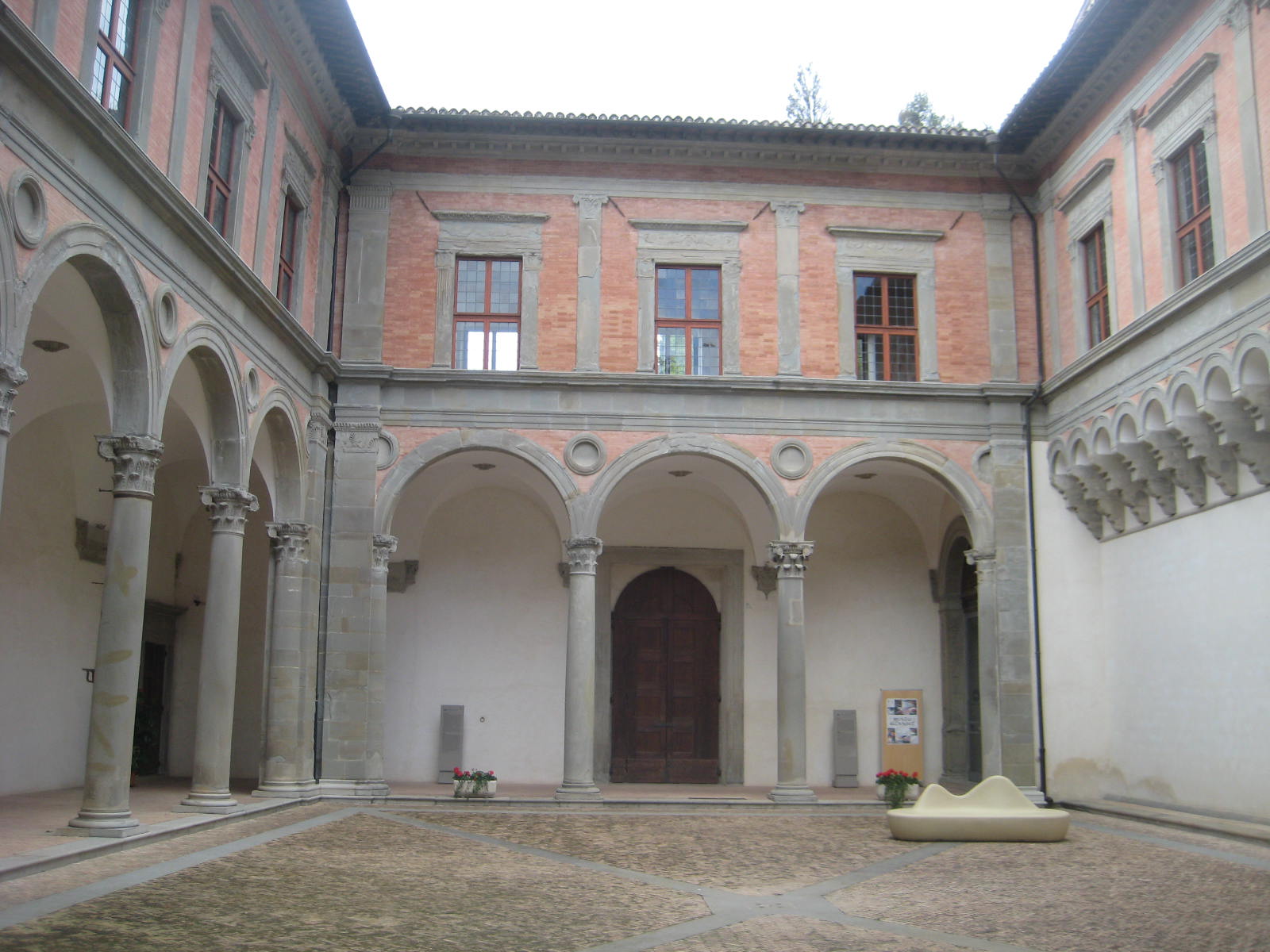
areas below the main house for gardens and horse stables,

views of the valley below,


and, most importantly of all, a studiolo with wood inlay work to
rival the studiolo inlays he commissioned for Urbino.


The raised seat of the bench here seems three-dimensional but all of it
is actually flat surface, an illusion created by the inlay workers using
dark and light woods. For more than a century it has been impossible to see
the Gubbio study room with these inlays in it because first the inlays were
sold to Prince Filippo Lancelotti in 1874 for his villa in Frascati, then in
1937 were passed on to an art dealer who transported them en masse to New York
where in 1939 they were purchased by the Metropolitan Museum.
        Now the ingenious woodworkers of Gubbio have invented
a way around that loss by recreating in full the intarsias (wood inlays)
of the Gubbio studiolo by making an exact copy of them, so that when a
viewer enters the studiolo in Gubbio now, the effect is to be reunited
with a 15th-century work of art as it would have appeared to the Duke
himself. The copy was carried out between 2003 and 2009; for more
on the copy work, see the website:Associazione Maggio Eugubino
www.maggioeugubino.com/iniziative/studiolo_eng.pdf
See also my earlier blog entry on the inlay subjects here.
        What has become very clear from the reinstallation of the
inlays in the new copy is that the Duke wanted to be able to get to
his study quickly in his summer home. His studiolo in Urbino had
been built on the second story of the palace, above the courtyard
one floor and given the balcony view over the countryside:
                          (on the facade with the two turrets, the arched balcony on the top floor
                                                 marks the studiolo location in Urbino)
In his summer place the Duke would have ridden on horseback from Urbino,
a trip which takes a car about an hour and a half today. He could have
been weary from the ride and wanting to retire. It appears that when designing
his Gubbio palace, he wished to be near his books and papers as soon as he dismounted, so the studiolo in the Gubbio palace is right on the ground floor, directly in from the front
door to the left and left again one room's length:
With this new arrangement he would not have
had to climb the stairs as he had to for the studiolo in Urbino. He could
slide in easily from horseback to study seat and feel at home again in
his wood inlay world.
            And what a self-referential world it was! Not only are his initials
set in inlay in several places, FE, for Federico

but all of the devices with which he identified himself, the codes of his family name,
are inscribed in various ways in the wood inlay work.
            We can see the ermine of purity
with the words Non Mai - Not Ever - in Italian in the banner above it (the second N is implied),
 
to reflect his longstanding fealty to whatever contract he had signed, a purity
which set him aside from other condottieri who often changed sides in battle
when paid more by the other side. He would NOT EVER alter his loyalty for
the duration of the contract.
            The whiskbrooms for the cleaning and care of horses for which he was also renowned are
displayed:
And then the references to his magnificent library in the books:

and  to his other intellectual pursuits, such as music and scientific observation:
 
His dedication to learning and erudition is represented by the Iliad passage in manuscript on
his inlay reading stand:


His armaments are also here, but they are not as prominent as they were in Urbino. They are
put away in a cupboard, partially hidden during his summer relaxation time. We can make out the
helmet, his mace, his greaves:

He seems to have shelved his battles and enjoyed the summer for reading and thinking.
Was the Duke a frustrated university professor? Having seen the futility of battle, did he rejoice in the life of the mind stimulated in his private studiolo in the comfort of his summer home, up on the hill, away from the plains of fighting, in the cool retreat from the sun of Italy that heated up armor to a state of intolerance?
          The studiolo was a small room of retreat,
but then one views the studiolo in a different way when confronted with the other unusual feature of this summer palace? The ENORMOUS BALLROOM!

There are large social rooms in the palace of Urbino, settings for the conversations in the Cortegiano by Baldassare Castiglione,

but nothing of the scale that confronts the viewer in Gubbio.

Is this room larger than the 110' X 55' X 55' room of the Banqueting House in London of 1619-22?

Larger than the double-cube room of 60 X 30 X 30 feet in Wilton House, England, of 1638, seen
above? Both of the later rooms are designed by Inigo Jones who, everyone says, was influenced by Palladio. But what if Inigo Jones was influenced by the Ducal Palace in Gubbio instead? He did visit Italy and I do not know if he saw this palace in Gubbio. But the size and simplicity of this Gubbio ballroom strike me as perfect original models for the grand rooms in the Italian style built by Inigo Jones two centuries later in England. Could Jones not have seen this large ballroom before taking the idea for a large entertainment center back to England?
      This salon/ballroom down the hall from the studiolo could have housed hundreds of guests, perhaps for meals, certainly for large dances. It had the best views over the valley from its windows fronting onto the town.

 
It would have provided a spectacular place for large-scale entertainment evenings of the sort during which Federico's wife took sick and died in the summer of 1472.
The portrait which Piero della Francesca does of her in 1472 is based on her deathmask and
the town of Gubbio is painted in the background of her image.
The white and grey turrets of the city's walls are visible as well as the road leading down the
hill to the town's entrance, as though the viewer were coming from Urbino to Gubbio with
the Duke. Behind Battista is also the suggestion of a lake or river. She had gone in the cold
water of the Raggio River during the day on the night she died. She had feasted with friends
afterwards in the valley, then complained of a headache and rode back to the palace on
horseback to go to bed.

           Battista Sforza, the Duke's wife, had given birth in Gubbio to their son in January. She had survived childbirth and she had not properly recovered even by July. Some scholars have thought she had weakened her constitution after the birth of her son by doing perilous barefoot penances in gratitude to God and the saints for having given her a son. (See the 2009 book on Battista by Mazzanti.)The Duke was not in Gubbio and rushed back to her to embrace her before she died, but he felt guilty for her death, which may explain his desire to memorialize her in the portraits painted by Piero:  to see her one more time and keep her alive a little longer; his own face looking at hers reinforces the idea of his desire to see her eternally.


The Latin inscription in the past tense on the back of her portrait confirms the portrait as posthumous.

She was in the Gubbio Palace when she died. Her body was taken on the journey back to Urbino
and for the wakes she was dressed in the nun robes of the Saint Clares. Perhaps her own love of entertainment was taken into account in the building of the summer palace, and the Duke acceded to the large social space to please her, not ever imagining the palace might be the site of her death.
What a light-filled arena in which to socialize! She ended her life well, as the
Latin inscription says:  "OVE MODVM REBVS TENVIT SECVNDIS./ CONIVGIS MAGNI DECORATA RERVM./ LAVDE GESTARVM VOLITAT PER 0RA./ CVNCTA VIRORVM."
English: “She who observed modesty in success flies on all men’s lips, honoured by the praise of her great husband’s exploits.”  She is a tribute to her husband, but her own qualities are praised, too. All of the accolades that poured in to the Duke after her death speak of an enormous affection for this
gracious and capable young woman (26 years old.)
         If we take into account the fact that Battista died in the Gubbio summer palace, the Duke's studiolo, which is completed after her death, makes more sense. It is not just a retreat for a scholar, the Gubbio study, but the retreat for a mourning widower. The armor is put away and the Iliad passage is about death.

Tuesday, August 27, 2013

RENAISSANCE INTARSIA - D - Gubbio

RENAISSANCE INTARSIA - D - Gubbio

When Duke Federico da Montefeltro had finished decorating his study in Urbino, he sent his workers over to his summer palace at Gubbio (a hill-town southwest of Urbino).
 
They (Francesco di Giorgio, Giuliano and Benedetto da Maiano, and perhaps Baccio Pontelli) in 1476 created a wood inlay studiolo for him there very like the study in Urbino.
This studiolo is no longer in Gubbio, however; the wood inlay part of it has been transported to the Metropolitan Museum of Art in New York City.  (See the museum's website and Olga Raggio's terrific pdf article posted there, or look at Luciano Cheles' Urbino studiolo book that includes Gubbio.)
          What I would like to explore here is how Gubbio fits into the chronology of one-point perspective inlay experimentation. After the Florentine sacristy intarsia is produced in 1436, the intarsia artists become more and more sophisticated in their ability to render trompe l'oeil (illusionistic) scenes on the walls so that, by the time the study in Urbino is completed, in 1476, they have a repertoire of lattice-work doors, cupboards with shelves and objects, benches, and even landscape glimpses that appear to mirror reality with one-point perspective.
 
With their increased skill comes confidence. The Gubbio studiolo is smaller, tidier, and more refined in its imagery than the Urbino study.

It includes a mazzocchio (hat-form) on a bench, musical instruments in the cupboards (cittern and drum), the garter of the Order of the Garter (a knighthood granted to Federico in 1474), scientific and writing implements, and even an attempt to render a ceramic mug in wood inlay (on left upper shelf.)


The benches are given more prominence here than in Urbino. The wall surface is entirely flat, but the illusion is that the benches project out from the wall of the picture plane. Mr. Theodore (Ted) Low, Director of the Education Department at the Walters Art Gallery in Baltimore, Maryland, used to say that, when he worked at the Met and led a tour into the Gubbio room, that inevitably someone would try to sit down on the benches in the study

and fall to the floor because there are no real benches, just the intarsia illusion of them. His story certainly speaks to the realistic quality of the wood inlay perspectives. The fictive light casting a shadow on the legs of the benches (in reality just darker wood set into the inlay) makes the bench appear to respond as a real bench would to light, even with the shadow changing direction slightly for refraction.
In this study are also sections of the benches where the sitting surface seems to be lifted up with lattice grillwork underneath.The illusion would have been even more believable when there was real light coming from the window of the palace into the room:


The benches in Gubbio are certainly good examples of FORWARD SPACE in inlay work, but, as in Florence and Urbino, the intarsia workers want new challenges, and the benches are something they already know how to do.
      The new problem the artists pose for themselves in Gubbio relates directly back to the Florentine sacristy candlestick that projected forward from the picture plane. In Gubbio the object they choose to set into FORWARD SPACE is a triangular-shaped lectern with specific printed pages of a book on it. The lectern is placed standing on one of the benches with its octagonal base forward of the cupboards.


The illusion is that the lectern rests on the bench; the shadow the lectern casts gives substance to the fictive air between the pole and the back wainscoting of the wall. When we look at the triangular top of the lectern, where the book rests and which has an open hole for reading rulers, the wood inlay illusion is not consistent, though. Instead of being placed forward of the wainscoting, the book and its support appear to slide back into the cupboard behind the lattice-work doors. What has happened to the intensely perfect one-point perspective of the rest of the study?
       The words written on the book pages of the lectern are a clue. The book is Vergil's Aeneid, 10: 635-84 and the pages displayed describe the death of Pallas, a beautiful youth who fought for Troy:
    Every man's last day is fixed.
    Lifetimes are brief and not to be regained,
    For all mankind. But by their deeds to make
    Their fame last: that is labor for the brave.
                   (Raggio, p.31, trans. R. Fitzgerald,1990, p.310)
These are words chosen deliberately to praise Federico and his deeds as well as the labor of the intarsists themselves.
The memento mori of Vergil's text reminds the viewer that everyone's life passes quickly and that great deeds (such as the creation of the studiolo) are needed to ensure that fame lives beyond death. The round mirror hanging above the lectern has an inscription, "G BALDO DX", the name of Federico's son, Duke Guidobaldo, his heir. The words set out on the fictive lectern reveal to the viewer that the end of the great era of intarsia work has come with the death of Federico, its patron. Federico dies in Ferrara in 1482 and these additions to the room were probably added after his death, not by request of his son, who was only 11 in that year, but probably by the request of Federico's closest advisor, the count Ottaviano Ubaldini della Carda. (Raggio, p.33). The lectern with Latin inscription replaces the lit candle of the Florentine sacristy with a similar object on similar stand. Instead of a positive eternal light for sacred services, though, the lectern provides an image of the inevitability of human death. The great deeds of Vergil's fame are visible in the work required to make a fictive lectern out of colored pieces of wood. The intarsists place wood words to speak of Federico's eternal fame, but as they do, they also leave a lasting impression of their own talent.
If we were unsure that the end of the wood inlay study were spelt out in this image, the exit door from the study would put the cap in place:


The book on the bench is closed rather than open, the musical instruments hung up, and the lute and collar of Ermine stick out of the cupboard door like tongues from the last gasp of an open mouth:


These afterthoughts are the end glimpses the viewer has of the study upon exiting. The art of one-point perspective for wood inlay studioli dies with Federico in 1482, even if the studiolo in Gubbio takes a few months more to be finished. The intarsia workers know they have exhausted the challenges along with the patronage. The illusions they have created for Urbino and Gubbio have reached a climactic finale that is never to be repeated. The developments begun in the Florentine sacristy are finished in Gubbio.
       After the Gubbio palace, the use of one-point perspective in wood inlay moves back into an ecclesiastical setting, into choir stalls produced in churches in the Italian peninsula, and never again do we have intarsia work on a scale or in such a creative burst as in Federico's two rooms.
       Like the musical instruments in wood inlay, an intimation of a lingering note remains. At first there seems to be a possible reference to the Christian faith in a small Tau cross hanging from one of the cupboards. Since the tau cross is associated with St. Francis and Francis is said to have tamed a wolf in Gubbio, the object may obliquely refer to that legend. But the object portrayed, after closer examination, is a tuning key for the harp, so the Christian reference is as slight as its shadow behind, and the tuning note that is meant to be literally hanging in the air is from secular music rather than church music.


The rest of the study is filled with other images of the secular life of the palace; Federico's belief in the rational life, an intellectual life constructed after reading many texts from the classical past, is apparent in both studies, but most emphasized in Gubbio. While in Urbino there were still painted portraits of popes on the wall, in Gubbio, they are eliminated. The paintings that originally hung on the walls in Gubbio are of female figures of the Liberal Arts bowed to by knights who pay them homage.  Even the Latin inscription on blue background that winds around the area above the cupboards and ties the entire study together is a humanistic or pagan caption for the images of the Liberal Arts above it; it is devoid of Christian reference:
    
 "See how the eternal students of the venerable mother, men exalted in learning and in genius, fall forward, as supplicants with bared neck and flexed knee, before the face of their parent. Their reverend piety prevails over justice and none repents for having yielded to his foster mother." (Raggio, p. 31)


The female figure in each painting here is one of the Liberal Arts: Logic, Rhetoric, and Music, respectively. They are female because the noun in Italian is feminine: la dialettica, la retorica, and la musica. The men paying homage by kneeling on steps before the women (who are seated on thrones and seem to have crowns) are courtiers from the court of Federico, including Federico himself in Dialettica.  (Three paintings are lost - grammar, geometry, and math, two (music and rhetoric) are dispersed to London (National Gallery), and two (dialectic and astronomy) were destroyed in Berlin during WWII.
        The message Federico conveys in these paintings and in the Gubbio intarsia cupboards is unusual in the period in which he lived: men should honor and treasure classical learning exclusively; enrichment and survival of the soul can be provided through the areas of knowledge passed down to us from the classics only. No reliance on Christian stories or saints here. In the privacy of his own home, he feels free to express an almost heretical view:  knowledge of secular music, grammar, mathematics, and geometrical logic are essential to the life of the mind; piety should reside in those areas of "human" specialty, the trivium and quadrivium, the liberal arts. The trivium consisted of la grammatica, la retorica, and la dialettica (grammar, rhetoric, and dialectic (logic)). The quadrivium consisted of: l'aritmetica, l'astronomia, la geometria, and la musica (math, astronomy, geometry, and music). 
        Secular thought is celebrated here in his shrine to ancient wisdom. The duke presents for his young son as well as for himself, a vision of classical education within a study that stands witness to the power of human creation. Theology has no place in the paintings or cupboards.  Federico was captivated by the rational process of one-point perspective and his one-point perspective art here includes geometry, astronomy, rhetoric, math, and music. This Renaissance duke was sure that the logic of classical learning displayed in the Gubbio intarsia was no illusion.