Showing posts with label PAINTING. Show all posts

Wednesday, March 8, 2017

THE CORAL OF IT ALL! - PART II

THE CORAL OF IT ALL! - PART II

The last blog entry discussed the importance of Mediterranean red coral in two paintings of Ghirlandaio and Mantegna. The corals in both those works served as apotropaic objects in religious contexts. In neither work, however, was the coral worn as an apotropaic amulet by the people depicted in the work. In this blog we will provide a partial list (and the images from the list) of Jesus wearing a necklace of coral in paintings of the Madonna and Child from 1300-1500 in Italian painting.


Partial list of coral images in chronological order:

1332 –     Ambrogio Lorenzetti, Madonna and Child (Siena altarpiece), Uffizi Gallery, Florence.
1360 –     Allegretto Nuzi, Madonna and Child and Angels, Petit Palais Museum, Avignon
1410’s-    Giovanni dal Ponte, Madonna and Child and Saints, University of Texas at Austin Gallery
1426 –     Masaccio – Madonna and Child, Uffizi.
1459-60- Schiavone – Madonna and Child with Fruit, Walters Art Gallery, Baltimore, Md.
1460-70- Piero della Francesca –Senigallia Madonna and Child, National Gallery of the Marches, Urbino
1472-74- Piero della Francesca - Brera Altarpiece, now in Milan, Brera Gallery
1500 -     Pordenone, Madonna Enthroned with Child,Springfield Art Museum, Springfield, MA.


MEDIEVAL EXAMPLES:
1332 - Ambrogio Lorenzetti, Altarpiece of St. Proculus, Madonna and Child, Uffizi Gallery,Florence:
The Christ child in the central panel of this triptych wears a necklace with coral amulet to protect him from evil; since the child is regarded as God, it seems odd that he should need protection, but the artist is conveying the human side of Christ's nature by showing him wearing what children in 14th-century Siena would have worn as infants. Given the hardness of coral, it is quite possible that these infant necklaces were used as teething rings to help children soothe teething pain as well.
         
1360 –     Allegretto Nuzi, Madonna and Child and Angels, Petit Palais Museum, Avignon
The child here wears a horn necklace of the type we showed at the beginning of the last blog entry.
The sweet tenderness exhibited between mother and child here parallels the protection given to the
child in the coral necklace. In antiquity coral was thought to be the hardened blood of Medusa who
died in the sea when Perseus killed her. Since Medusa was thought herself to turn to stone those who looked at her, her blood was then given the attribute of being able to fend off evil; in the transformation of myth into Christian belief, the blood of Christ takes on the same attribute. The association of coral with Christ is repeated in altarpieces of this sort until we forget to question why Christ needs the protection.

1410’s-    Giovanni dal Ponte, Madonna and Child and Saints, University of Texas at Austin Gallery

While Giovanni dal Ponte is painting in the 15th century, I have catalogued him with the other medieval painters because his style is still rooted in the 14th century. Here the child sits on his mother's lap and blesses the viewer directly while wearing a coral necklace and holding a goldfinch. The drinking of Christ's blood reenacted in every mass in the drinking of the wine is repeated visually in this altarpiece in the blood red of the coral that has the shape of blood dripping and in the red cap on the head of the goldfinch, a bird that was said to have received the red color when it removed a thorn from Christ's crown of thorns.

RENAISSANCE EXAMPLES:
1426 - Masaccio – Madonna and Child, Uffizi; small portable altarpiece belonging to a cardinal,
whose coat of arms is on the back of the panel.
Since the mother in this painting seems to be taking the child's temperature with serious intent, her two fingers block where the coral would normally be seen; the necklace is slung over to the shoulder of the child and the coral rests almost on the arm so the viewer can see it.


1459-60- Schiavone – Madonna and Child with Fruit, Walters Art Gallery, Baltimore, Md.
The child here bends over to hear the music played by the two child angels and they all look as if they
have played themselves to sleep. The cartellino below the pedestal identifies the artist as a pupil of
Squarcione.


1460-70- Piero della Francesca –Senigallia Madonna and Child, National Gallery of the Marches, Urbino                                    

Here the coral necklace is quite large in relation to the child; he looks out at the viewer and blesses him/her. One wonders if the viewer is then the sin from which the child needs protection.

1472-74- Piero della Francesca - Brera Altarpiece, now in Milan, Brera Gallery

We have discussed this painting in another blog entry. The child lies as if already sacrificed, eyes closed and body in a reclining position that resembles a Pieta with his mother. The coral is pulled by gravity down the body to remind us of his later death. The coral here is attached to another apotropaic object, perhaps a rabbit's foot on the same string of coral beads?
Duke Federico da Montefeltro's hands point to the child and the coral as he prays to the Madonna
for his own child and own dead wife, Battista. The painting originally hung in the church of San Bernardino degli Zoccolanti near Urbino where the duke and his family are buried. The coral here 
is meant to protect Duke Federico's heir and only son, who is more vulnerable without his mother alive.
                
1500-Pordenone, Madonna Enthroned with Child,Springfield Art Museum, Springfield,MA 
The child here holds the coral as though conscious of the sacrifice he will have to make later in
his life. Both mother and child are solemn and look forward but beyond the viewer as if in deep thought about the future tragedy. The crown on the Madonna's head emphasizes her role as Queen of Heaven. But even as Queen she can only do so much to prevent the later Crucifixion of her son.

These, then, present several examples of coral worn by the Christ Child, but there are also examples of Madonna and Child paintings where no coral is worn by the child, so he doesn't seem to have always been painted like an Italian child of similar age.
 

Masolino and Masaccio, Uffizi                     Piero della Francesca, Madonna and Child with Four
Altarpiece, 1424                                            Angels, 1460-70,Clark Art Institute,Williamstown, MA

In these two Renaissance examples the child is naked and without protective necklace. Does the choice of apotropaic amulet, then, rest with the patron of the work? And does the coral reduce
or enhance the power of Christ's sacrifice in these altarpieces? While it does help to make the child
seem real, it also suggests that the child needs the force of mythological belief to promote his survival.

Tuesday, March 7, 2017

THE CORAL OF IT ALL! PART I

THE CORAL OF IT ALL! PART I

Red coral is often painted into Renaissance paintings. We have examined the coral necklace in
Ghirlandaio's portrait of Giovanna degli Albizzi of 1488 in another blog entry, where the coral hangs like a string of rosary beads behind the head of the deceased woman as a symbol of her religious purity and the beauty of her soul.

We have also discussed the apotropaic function of the coral here. It hangs as a barrier to protect her
in the after-life. This young woman had died in childbirth in 1488. The portrait was painted by Ghirlandaio as a memorial to her virtue and as a vessel for sending her off into the unknown of death. She is accompanied by a Book of Hours (a prayer book), her finest clothes and jewellery, and a Latin inscription that says that no painting can depict the beauty of her inner life. All of the objects in her painting might be read as attributes of her personality, an extension of her within the picture plane. The coral necklace could certainly be read as another symbol of her wealthy life, a rich piece of jewellery, like her brooches. But it is painted in not hanging on her neck, but hanging above her Book of Hours, as another way, together with prayer, of warding off evil for her after death. It is a religious protective amulet.
        Why should we assume the coral is there to ward off evil? Italians believe, even today, that coral
has the capacity to protect young children, and people in general, from the dangers of the evil eye, the
"malocchio." Gifts of coral jewellery, sometimes in the shape of a horn, are given to newborns as a form of shield.
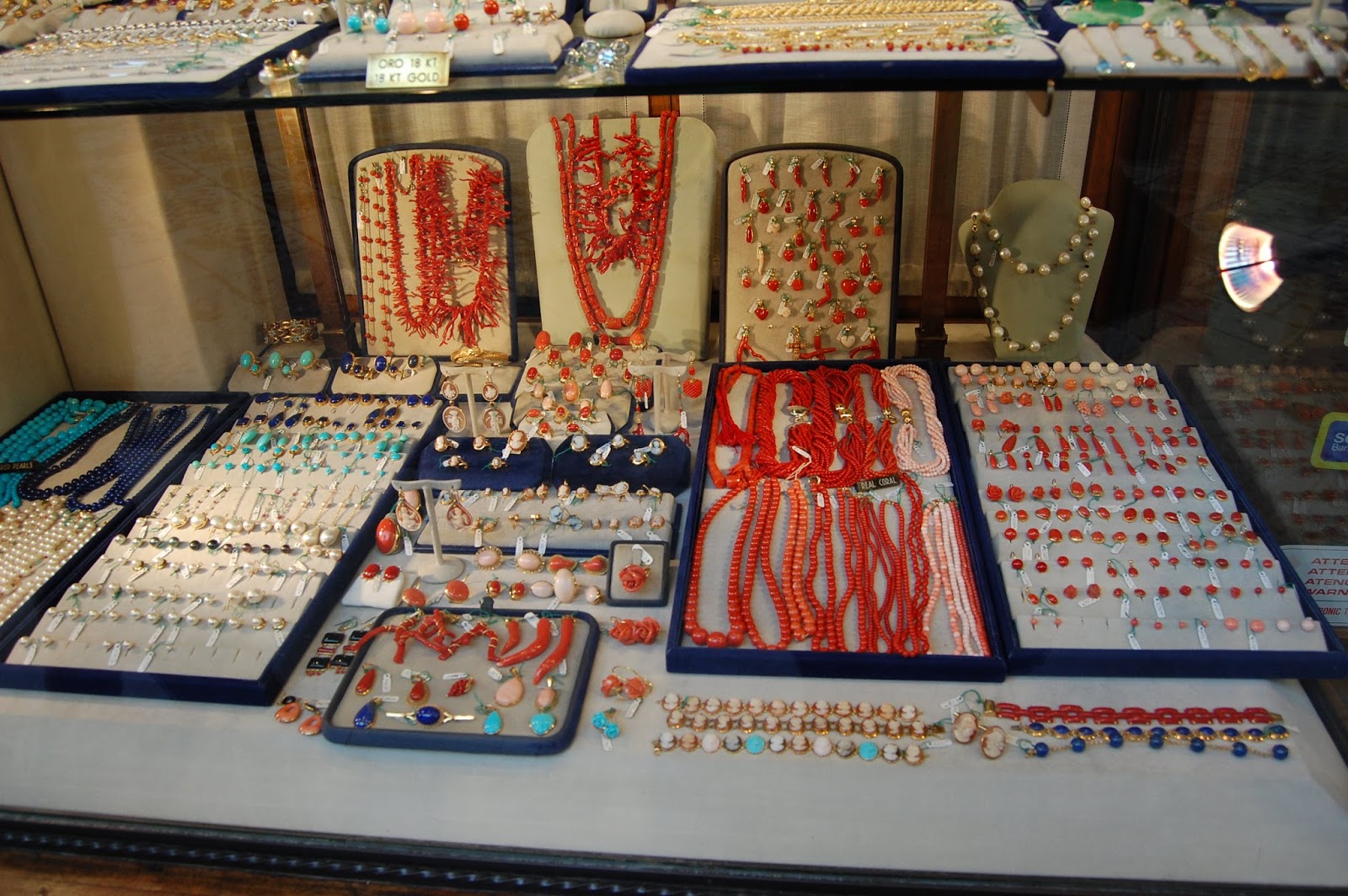
The Italian tradition of giving coral pendants to protect from evil continues even today in 2017. Coral horns, bracelets, necklaces are all part of the artistic jewellery still sold today on the Ponte Vecchio in Florence.


        While coral reefs in the Mediterranean Sea were abundant in the 1400-1500's, they have now been fished almost to extinction there in the shallow waters. According to Professor Sandy Tudhope, the Head of School of Geosciences at the University of Edinburgh in Scotland, conservationists are trying to save the Mediterranean coral beds that have been overfished.  Professor Tudhope works on coral in the Indian Ocean and has found the coral animals there are bleaching, turning white, because of the warming temperatures of the oceans. He gives lectures about the dangers of coral extinction on the planet from the rise in sea temperature. He has explained that the coral he works on is different from the red coral in the Mediterranean Sea. The Mediterranean Sea coral is a type that has "fused-spicule skeletons." Instead of bleaching when it dies, these "fused-spicule" skeletons retain pigments even after being fished out of the sea. Which explains why the coral jewellery sold on the Ponte Vecchio in Florence, Italy, is so bright red, and why the coral specimens that are painted into the Renaissance paintings are so bright red.
            One of the best examples of red coral in the Quattrocento (1400's) is found in a painting by Mantegna called the Madonna of the Victory, Madonna della Vittoria, a painting of 1496, originally in Mantua but now in the Louvre in Paris.

The coral here is hanging above the head of the Madonna in an altarpiece painted for a duke of Mantua, Francesco Gonzaga.
Francesco kneels in the painting to the lower left of the Madonna and prays to her in thanks for having given him a victory against the French in 1495.
 
This battle, known as the Battle of Fornovo, after the town where the battle took place in Northern Italy, was considered a water battle because the French tried to cross the Taro River there.
It was such a major battle that it warranted being included in the Vatican Gallery of Maps in the frescoes there painted in 1580 by Ignazio Danti.

Military historians now view this battle as a draw rather than a victory for Francesco because, although the Italians captured more prisoners, they also lost more men than the French. For Duke Francesco, however, the battle ended the conflict with the French and forced them out of the peninsula and back up into France. So his commissioning of the altarpiece is understandable.  He is grateful to the Madonna that he survived the battle and grateful that the French, under Charles VIII, have left to return home.
            In the painting he kneels before her and looks up at her in the niche. Behind him from left to right stand four warrior saints, MICHAEL, ANDREW, LONGINUS, and GEORGE.
Michael has a sword, Andrew a cross, Longinus a red spear, and George a broken lance. To the right below the Madonna kneels Mary's cousin, St. Elizabeth, and her son, John the Baptist, who holds a banner that reads: Ecce angus dei qui tollis peccata mundi (Behold the lamb of God who takes away the sins of the world.) John points up to Christ as that lamb.
The round medal below the Madonna's feet reads: REGINA CELI LAET ALLELUIA (Queen of Heaven Rejoice Alleluia.) And below that is a fictive bas-relief of Adam eating the apple given him by Eve.
The original sin of Adam and Eve is set directly below the body of Christ and the coral which hangs
above the throne of Mary.
The connection between Old Testament story and Jesus of the New Testament is lined up here literally. The original sin which forces Adam and Eve out of Eden is redeemed by the death of Christ
as an adult. Christ is essentially the protection against evil for Francesco, for all the saints gathered in this sacred conversation, and for the 15th-century, or modern, viewers of the altarpiece. The coral hangs above as a reminder of the blood of his sacrifice; the coral's branches look like blood spilling out into separate pools, and the coral is the same color as blood.
The coral also stands as a symbol of water, highlighting the location of the battle victory. But the old superstition about coral warding off evil persists even in this pious religious work. Mantegna makes a perforated apse chapel behind the coral through which we see the sky, one of the artist's pictorial inventions that gives the illusion that the architecture has windows covered with fruit and foliage with birds perching on the sills.

By painting the foliage and birds the artist reinvents the architectural structure of the fictive apse in the altarpiece. His windows open to the sky turn the stone man-made structure back into a structure built by nature.
           The coral that hangs here is a fused-spicule skeleton type coral, according to Professor Tudhope, and it retains its red coloring even out of the sea. The coral piece is left intact to show its original shape and texture as a sea animal. To either side of the central piece of coral are strings of coral beads that decorate the apse like sides of a coral triangle and lead the viewer's eye straight up to the large foreshortened shell from which emerges the mass of red coral.
Even though the battle being commemorated took place in the River Taro and not the sea, the coral still represents the water and the fact that the battle was not just land-based. The apotropaic importance of the coral seems at odds with the importance of Jesus' sacrifice, but mythology is blended with Christian belief to reinforce the power of the Madonna's child to fend off evil and protect the believer. The spiky coral looks like a thorn bush of natural defense. That it resembles
the twisting of the serpent around the tree of knowledge in the Garden of Eden scene below it
is appropriate. Francesco has warded off the French evil eye with the help of the Madonna and her
son's sacrifice in the form of petrified blood, a vestige of battle wear in a most graphic form.


Sunday, October 16, 2016

CASTAGNO'S NICCOLO DA TOLENTINO


CASTAGNO'S NICCOLO DA TOLENTINO

In the last blog we talked about Uccello's fresco of the condottiere John Hawkwood (1436) in the
Florentine Cathedral aisle. To the left on the same wall, and twenty years later, in 1456, Andrea del Castagno (1419-1457) painted a fresco
of another condottiere, Niccolo da Tolentino.
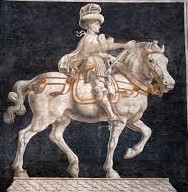
The 1456 fresco was meant to serve the same purpose as the fresco by Uccello, a painted equestrian statue over a bier standing in for an actual funerary monument for the condottiere (general of a private army.) Niccolo Mauruzi da Tolentino lived from 1350 to 1435 and is buried beneath the fresco in the church.
Instead of the green color for faux bronze, Castagno paints the equestrian statue as though it were marble, and the bier beneath made of the same material.

The Latin inscription follows the laudatory formula used in the Uccello inscription but does not have an ancient precedent:

LATIN AS ON THE fictive plaque here (some letters inside other letters):
                                                HIC QVEM SVBLIMEM IN EQVO
                                                PICTVM CERNIS NICOLAVS TOLENTINAS
                                                EST INCLITVS DVX FLORENTINI EXERCITVS.
LATIN more familiar to us today:
                                                 HIC QUEM SUBLIMEM IN EQUO
                                                 PICTUM CERNIS NICOLAUS TOLENTINAS
                                             EST INCLITUS DUX FLORENTINI EXERCITUS.
ENGLISH translation (mine):
                                                 Here you can see painted high above on horseback
                                                 Niccolo da Tolentino,
                                                 Honored Leader of the Florentine Army.

The bier has two bookend fictive marble soldiers, each holding a coat-of-arms; the left one holds that of the city of Florence, the right one, the family coat-of-arms of Niccolo.
The bier seems to rest on a marble bench under which stands a fictive sculpted marble shell, perhaps a reference to his victory near the Arno River.

Niccolo da Tolentino lived in a period (1350-1435) that overlapped with the life of the man painted next to him, John Hawkwood (c. 1320-1394). Both were condottieri, men who led private armies and made contracts (condotte) with Italian city-states to protect them with their private armies, hence the name "condottieri." Both wear the hat common to representations of condottieri in the Renaissance, a hat that was usually red but made to look like green bronze in the Uccello painting and to look like white marble in the Castagno painting. Both men had reputations for being good commanders and both were hired by the Florentine Republic to defend the city: Hawkwood, from 1377 to his death in 1394, Tolentino in 1425 and again in 1431 and 1432.
          But while Hawkwood is known as an able general and city defender, a role he held during many attacks on Florence over a 17-year period, Tolentino is praised and honored by the city because of his leadership in one important battle, the Battle of San Romano in 1432. Florence in that year is in conflict with Siena, and the armies of both cities range over the Tuscan and Umbrian countryside, avoiding each other and occasionally engaging in warfare. After skirmishes and successfully hiding from each other for months, the two armies eventually meet at the town of San Romano, on the Arno River plain, halfway between Florence and Pisa. The battle lasts two days, after which both sides claim victory, the Florentines saying they won because they took more prisoners. They were grateful to the general of their forces, Niccolo da Tolentino, and when he returned to the city, he was feted in the Cathedral. He was subsequently given a state funeral when he died in 1435, and his heirs were promised a marble equestrian statue monument to him to be placed in the Cathedral. By 1456 the promise was reduced to another fictive monument painted in fresco on the wall of the Cathedral.

THREE THINGS TO NOTE ABOUT THESE TWO FRESCOES OF CONDOTTIERI:

1) STYLE DIFFERENCES
2) HORSE'S EYE
3) ANIMATION          

1) STYLE DIFFERENCES - The location of painted generals on horseback side by side, or back to back, on the same wall of the Florentine Cathedral left aisle makes the viewer look at them for comparison. They are the same subject, same height, similar plain color background, and similar bier structures with Latin inscriptions. The horse and riders face the same direction and the horse in each case lifts one hoof. What is different is the artist who painted them and the year they were painted.
But Uccello is still alive when Castagno paints his marble condottiere, and, in fact, had had his own chance in the years 1438-1455
to paint Niccolo da Tolentino in the Battle of San Romano, in a three-part series painted for the Salimbeni family in Florence and later bought by Lorenzo the Magnificent for his bedroom in Palazzo Medici. 

In the top panel (now in London's National Gallery) Uccello paints Niccolo as the main protagonist of the drama of the battle. Here he wears the perfunctory red hat of the condottiere while riding a white horse.

The second panel, in the Uffizi, depicts a second stage of the battle, where Niccolo's face is covered by armor and he uses a lance to thrust a Sienese opponent back on his white horse:

He does not appear in the third panel (in the Louvre), where the Florentines win the victory. The condottiere in this panel is Micheletto Attendolo, whose flag bears the unicorn, his coat-of-arms.
But perhaps because Uccello had already painted Niccolo in two of these panels, he is not commissioned to paint him in the fresco next to John Hawkwood.
           If you place these condottieri side by side, however, it is clear to the viewer that Castagno has a very different style from that of Paolo Uccello.

Uccello's interest is in perspective and wide planes of color that seem to abstract the beast and his rider, making his image staid and stiff (although perhaps more appealing to viewers today.) Castagno's interest is in movement and ornament and making his horse and rider seem alive on the plinth. He has a sculptor's feeling for the muscles and bones in the horse and rider and uses shadows to convey realistic anatomy. We see bulges on the legs and head of the horse for muscles in motion. Castagno's condottiere and horse seem to be about to ride off the plinth and into real space. The horse turns his head to look at the viewer, Niccolo's cloak flies back behind him as if caught up in the wind created by the horse moving forward, the ties on the cloak sling back behind the neck as if picked up by air, and the tail of the horse is knotted in curved sweeps of horsehair. Even the horse's trappings are lifted up in foreshortened view to give the impression that the horse and rider are in motion.
The baton is held by the general at arm's length, another projection of movement forward. The soldiers holding the coats-of-arms turn in space to add motion to the whole, while the ribbons extending in S patterns next to the Latin plaque echo the ribbons of the cloak above. In comparison the Uccello seems stiff, unyielding, and trapped in an unmoving form.
          We could say some of the differences may be attributed to the reputations of the two generals themselves, Hawkwood known for his ability to delay battle and Tolentino known for his active role in the thwarting of the Sienese army in the battle. But it is also true that attention to anatomy, movement, and interest in ornament, along with chiselled contours for every element, are characteristics we find in any painting by Andrea del Castagno, while the need to abstract surfaces to planes of color and the reduction of hard-edged curves and corners, are characteristics of Paolo Uccello as an artist. These two paintings are perfect examples of what style is, when applied to individual artists.

Which brings us to point 2) EYE OF THE HORSE
If you look at the eye of the horse in each fresco, you will notice a great difference. Uccello's horse looks forward in profile and ahead toward the altar in the church.

  Castagno's horse turns his head to the right and looks directly at the viewer.
The eerie experience inside the Cathedral when you look at this eye is that it follows you, no matter where you move in front of the fresco. If you back down the aisle to the left, the eye looks at you; if you proceed further down the aisle to the Uccello fresco, Castagno's horse's eye is still looking at you as you move. The artist has made a connection between viewer and painter, between viewer and condottiere through the illusion of a horse who commands the prospect in front of him no matter where you stand in church. A pictorial feat that is a Renaissance coup repeated by other artists such as Mantegna later. It is a tour de force by the painter that he can make the viewer even 600 years later respond to the eye of the horse he has painted in 1456.

3) ANIMATION -  The lifelike quality of the horse and his eye in the Castagno portrait brings us to the last point. Not only has Castagno made Uccello's horse and rider liven up, but he has chosen a different hoof on his horse than the hoof on Uccello's horse to lift to give the viewer a sense of animation on the walls of the Cathedral.

If you think of the horse as the same horse, the rider the same rider, the back horse in the parade lifts his left foot, the front horse lifts his right foot; it is as though one horse is moving in dressage mode through space along the aisle of the Cathedral, left up, right up, left right, clop, clop. It is as though we are made as viewers to hear the sound of the animation of a single horse as it proceeds
on its way down the aisle toward the altar of the Cathedral. Castagno has purposely not repeated the same leg lifted by the horse in the Uccello fresco. He wants us to imagine these horses moving in sequence, like a Disney cel in animation for modern movies, as they carry their condottieri in parade dress toward the center of the Cathedral for the honors they are to receive from the city they saved from peril. The closest thing to indoor movie theater projection a Florentine could get in the 15th century.