Showing posts with label GHIRLANDAIO. Show all posts

Tuesday, February 27, 2018

Gozzoli and the young Ghirlandaio

Gozzoli and the young Ghirlandaio

When Benozzo Gozzoli was painting the wall of the third king in the Medici Chapel between 1459-61, he painted himself for a second time in the procession. His face is above the figure of the falconer and behind a white horse.


Wrapped in a white and blue turban this time, he lifts up his right hand in an awkward position,
with the two middle fingers touching and the two outer fingers splayed apart with the thumb out.
Some art historians have said he is saying with this gesture that he is completing the work "with
his own hand," "da sua mano proprio," but I think the gesture is so specific that it must refer to something more than that. His self-portrait here looks just like his portrait right across the chapel from it, and I think he is


acknowledging the work he has finished up to this point, i.e., three walls completed, and two
more (the altar walls) to go. His serious expression denotes his conscientious undertaking of this project for the Medici family. He is letting them know that he takes his contract to heart and is bound to finish two more walls in the smaller room of the altar. His serious face is also warning the Medici to complete their side of the bargain, too, i.e., to remember to pay him.
He then does complete the side walls in the altar alcove of the chapel; they are the last to be
painted, probably between 1461 and 1463; he did some of the work himself, certainly the angels kneeling whose halos have the Latin of the Gloria written on them:


The angels stand or kneel or fly in the clouds above a landscape of trees, cypresses, duck ponds, villages, and villas.     Kneeling Pink angel on left side:

                                      Kneeling Angels on right side:


Closest to the altar and the back wall, behind the kneeling angels, are several curious angel figures who appear to be by a different painter. (These are not the angels who stand and sing the Gloria.) These angels gather roses and stems behind fences that have caught the rose bushes and held them. Upon closer inspection the angels behind the fences are using the roses to form into "ghirlande," garlands. These garlands are meant to decorate the altar where the Virgin kneels with her child and they are rose garlands because roses are the symbols of love, especially the love of the Virgin herself.

One of the angels on the left is accompanied by a peacock, the symbol of eternity, but both are engaged in the process of wrapping roses around a wire or wood frame to make pink rose garlands whose ends can be seen to be held up by other angels at the border of the back scene. See the yellow outlines of the garlands in these superimpositions:


Each of the gatherers has a set of colored wings, a gold foreshortened halo, and a flowing cape on top of the filmy angel dress. Two pick out the roses to be wound into the garlands, the others gather greens and roses into their gowns or assist in holding up the wound flowers. In the right side image, the angel in red holds up the frame to
which will be attached the gathered flowers.

For most viewers these particular angel figures at the back would be hardly noticeable, but they present so many similarities to figures painted later by another major painter, that we must point out the coincidences:
1) THE PEACOCK is in such a peculiar stance with tail spread out and head in profile, exactly as
the peacock appears in Domenico Ghirlandaio's painting of one in his 1480 Last Supper in Ognissanti.
 
 
Identical positions, identical underdrawing? 

2) ANGELS -Then two other angels also are repeated in Ghirlandaio frescoes later:
the angel in white with right hand lifted up is the figure of Abundance in Santa Maria Novella (1485-90):
 
and the angel in blue with roses held in the dress fabric reappears in Ghirlandaio's Salome in the Banquet of Herod in Santa Maria Novella (both step forward with left foot.)

 3) BLOCK ALTAR with sheep atop (painted above the door to the chapel) by Gozzoli is repeated painted above the Last Supper of Ghirlandaio's in 1473 in Badia a Passignano:
 
And if that were not enough connections between the two painters, watch what Ghirlandaio does
when he is asked to paint the Adoration of the Magi in the Life of Mary in his Santa Maria Novella
frescoes of 1485-90. Instead of camels in the procession in the upper right, he paints in the prominent animal
in Lorenzo dei Medici's zoo, the giraffe, with handlers who look much like those with the camels in Gozzoli's procession:

Could Domenico Ghirlandaio have been Gozzoli's assistant towards the end of the Medici Chapel
project? He is born Domenico Bigordi and Vasari claims he is trained by Baldovinetti, but as a fresco painter, he is making clear references to Gozzoli's work in his own, and his skill as a fresco painter could be explained by his having been trained by Gozzoli in Palazzo Medici-Riccardi. He is 13 by 1461, the age for a young apprentice. It could also explain why he received the nickname "Garland maker," not the reason Vasari gives in his second  edition of the Lives in 1568, that his father made silver garland jewellery for the heads of young women in Florence. His appellation would make more sense if he were the young apprentice responsible for painting the "Garland-makers" in the Gozzoli scenes near the altar. "Grillanda" is garland in Italian, and "Garland-maker" is Ghirlandaio. 
If he is the young painter not only of the garlands in the Medici Chapel but of the angels who are garland-makers, it would be reasonable to assume he was given the nickname of "GARLAND-MAKER," GHIRLANDAIO, by the artist in charge of the workshop or by the other apprentices in the workshop. This assumption would explain why several of the figures in this scene on both walls are transposed literally into later paintings by the master when he is in full command himself in the frescoes that gave him fame in Passignano and Santa Maria Novella in Florence. 
It would also explain why he paints in 1485 a self-portrait as a shepherd in the Nativity scene for Santa Trinita and points to a garland that looks just like the garlands in the Medici Chapel
frescoes, this time painted to look like a carved ancient garland on a sarcophagus just behind the
Christ Child.

He is pointing to his nickname, the name with which he became well-known as a painter; it is his way
of writing his signature, just as painting his self-portrait on the right is also a signature.
It might also explain why Ghirlandaio is offered the commission for the Santa Fina Chapel
in the Collegiata of San Gimignano in 1470, 

just as Gozzoli is finishing his fresco of Saint Sebastian in the same church.
The older master of the Medici Chapel helps his younger pupil to get work to help advance his career. He knows the "GARLAND-MAKER" will one day be a greater painter than himself. And, in fact, it is GHIRLANDAIO, not GOZZOLI, who, in 1482, is asked to go to Rome to paint the most important
commission of the day, some of the Vatican Sistine Chapel frescoes.
And it is Ghirlandaio's skill there that is then transferred to his pupil, Michelangelo, who finishes the Chapel with ceiling and altar wall frescoes that become more famous than any of his predecessors.
And isn't Michelangelo looking at Ghirlandaio's Cain and Abel in Passignano and reversing the
figures in his Creation of Adam?
The influence of one painter is passed down to another, who, in turn, passes it down to his more
famous pupil. Gozzoli's little "garland-maker" is taught well by his mentor and, he, in turn, teaches his own little "divine fresco-maker," "Il Divin Michelangelo," the terms of the trade.


Tuesday, March 7, 2017

THE CORAL OF IT ALL! PART I

THE CORAL OF IT ALL! PART I

Red coral is often painted into Renaissance paintings. We have examined the coral necklace in
Ghirlandaio's portrait of Giovanna degli Albizzi of 1488 in another blog entry, where the coral hangs like a string of rosary beads behind the head of the deceased woman as a symbol of her religious purity and the beauty of her soul.

We have also discussed the apotropaic function of the coral here. It hangs as a barrier to protect her
in the after-life. This young woman had died in childbirth in 1488. The portrait was painted by Ghirlandaio as a memorial to her virtue and as a vessel for sending her off into the unknown of death. She is accompanied by a Book of Hours (a prayer book), her finest clothes and jewellery, and a Latin inscription that says that no painting can depict the beauty of her inner life. All of the objects in her painting might be read as attributes of her personality, an extension of her within the picture plane. The coral necklace could certainly be read as another symbol of her wealthy life, a rich piece of jewellery, like her brooches. But it is painted in not hanging on her neck, but hanging above her Book of Hours, as another way, together with prayer, of warding off evil for her after death. It is a religious protective amulet.
        Why should we assume the coral is there to ward off evil? Italians believe, even today, that coral
has the capacity to protect young children, and people in general, from the dangers of the evil eye, the
"malocchio." Gifts of coral jewellery, sometimes in the shape of a horn, are given to newborns as a form of shield.
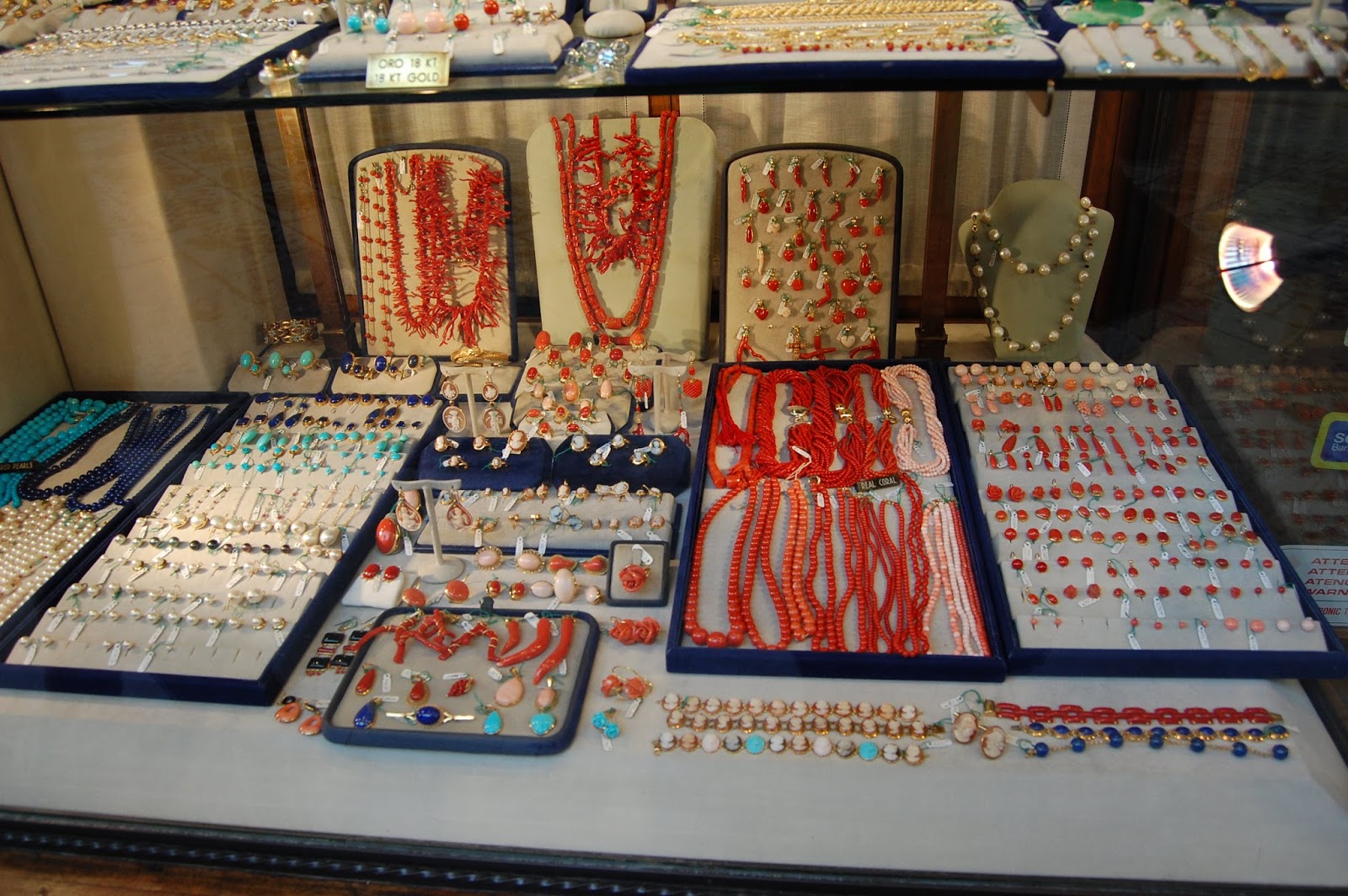
The Italian tradition of giving coral pendants to protect from evil continues even today in 2017. Coral horns, bracelets, necklaces are all part of the artistic jewellery still sold today on the Ponte Vecchio in Florence.


        While coral reefs in the Mediterranean Sea were abundant in the 1400-1500's, they have now been fished almost to extinction there in the shallow waters. According to Professor Sandy Tudhope, the Head of School of Geosciences at the University of Edinburgh in Scotland, conservationists are trying to save the Mediterranean coral beds that have been overfished.  Professor Tudhope works on coral in the Indian Ocean and has found the coral animals there are bleaching, turning white, because of the warming temperatures of the oceans. He gives lectures about the dangers of coral extinction on the planet from the rise in sea temperature. He has explained that the coral he works on is different from the red coral in the Mediterranean Sea. The Mediterranean Sea coral is a type that has "fused-spicule skeletons." Instead of bleaching when it dies, these "fused-spicule" skeletons retain pigments even after being fished out of the sea. Which explains why the coral jewellery sold on the Ponte Vecchio in Florence, Italy, is so bright red, and why the coral specimens that are painted into the Renaissance paintings are so bright red.
            One of the best examples of red coral in the Quattrocento (1400's) is found in a painting by Mantegna called the Madonna of the Victory, Madonna della Vittoria, a painting of 1496, originally in Mantua but now in the Louvre in Paris.

The coral here is hanging above the head of the Madonna in an altarpiece painted for a duke of Mantua, Francesco Gonzaga.
Francesco kneels in the painting to the lower left of the Madonna and prays to her in thanks for having given him a victory against the French in 1495.
 
This battle, known as the Battle of Fornovo, after the town where the battle took place in Northern Italy, was considered a water battle because the French tried to cross the Taro River there.
It was such a major battle that it warranted being included in the Vatican Gallery of Maps in the frescoes there painted in 1580 by Ignazio Danti.

Military historians now view this battle as a draw rather than a victory for Francesco because, although the Italians captured more prisoners, they also lost more men than the French. For Duke Francesco, however, the battle ended the conflict with the French and forced them out of the peninsula and back up into France. So his commissioning of the altarpiece is understandable.  He is grateful to the Madonna that he survived the battle and grateful that the French, under Charles VIII, have left to return home.
            In the painting he kneels before her and looks up at her in the niche. Behind him from left to right stand four warrior saints, MICHAEL, ANDREW, LONGINUS, and GEORGE.
Michael has a sword, Andrew a cross, Longinus a red spear, and George a broken lance. To the right below the Madonna kneels Mary's cousin, St. Elizabeth, and her son, John the Baptist, who holds a banner that reads: Ecce angus dei qui tollis peccata mundi (Behold the lamb of God who takes away the sins of the world.) John points up to Christ as that lamb.
The round medal below the Madonna's feet reads: REGINA CELI LAET ALLELUIA (Queen of Heaven Rejoice Alleluia.) And below that is a fictive bas-relief of Adam eating the apple given him by Eve.
The original sin of Adam and Eve is set directly below the body of Christ and the coral which hangs
above the throne of Mary.
The connection between Old Testament story and Jesus of the New Testament is lined up here literally. The original sin which forces Adam and Eve out of Eden is redeemed by the death of Christ
as an adult. Christ is essentially the protection against evil for Francesco, for all the saints gathered in this sacred conversation, and for the 15th-century, or modern, viewers of the altarpiece. The coral hangs above as a reminder of the blood of his sacrifice; the coral's branches look like blood spilling out into separate pools, and the coral is the same color as blood.
The coral also stands as a symbol of water, highlighting the location of the battle victory. But the old superstition about coral warding off evil persists even in this pious religious work. Mantegna makes a perforated apse chapel behind the coral through which we see the sky, one of the artist's pictorial inventions that gives the illusion that the architecture has windows covered with fruit and foliage with birds perching on the sills.

By painting the foliage and birds the artist reinvents the architectural structure of the fictive apse in the altarpiece. His windows open to the sky turn the stone man-made structure back into a structure built by nature.
           The coral that hangs here is a fused-spicule skeleton type coral, according to Professor Tudhope, and it retains its red coloring even out of the sea. The coral piece is left intact to show its original shape and texture as a sea animal. To either side of the central piece of coral are strings of coral beads that decorate the apse like sides of a coral triangle and lead the viewer's eye straight up to the large foreshortened shell from which emerges the mass of red coral.
Even though the battle being commemorated took place in the River Taro and not the sea, the coral still represents the water and the fact that the battle was not just land-based. The apotropaic importance of the coral seems at odds with the importance of Jesus' sacrifice, but mythology is blended with Christian belief to reinforce the power of the Madonna's child to fend off evil and protect the believer. The spiky coral looks like a thorn bush of natural defense. That it resembles
the twisting of the serpent around the tree of knowledge in the Garden of Eden scene below it
is appropriate. Francesco has warded off the French evil eye with the help of the Madonna and her
son's sacrifice in the form of petrified blood, a vestige of battle wear in a most graphic form.