Tuesday, March 7, 2017

THE CORAL OF IT ALL! PART I

THE CORAL OF IT ALL! PART I

Red coral is often painted into Renaissance paintings. We have examined the coral necklace in
Ghirlandaio's portrait of Giovanna degli Albizzi of 1488 in another blog entry, where the coral hangs like a string of rosary beads behind the head of the deceased woman as a symbol of her religious purity and the beauty of her soul.

We have also discussed the apotropaic function of the coral here. It hangs as a barrier to protect her
in the after-life. This young woman had died in childbirth in 1488. The portrait was painted by Ghirlandaio as a memorial to her virtue and as a vessel for sending her off into the unknown of death. She is accompanied by a Book of Hours (a prayer book), her finest clothes and jewellery, and a Latin inscription that says that no painting can depict the beauty of her inner life. All of the objects in her painting might be read as attributes of her personality, an extension of her within the picture plane. The coral necklace could certainly be read as another symbol of her wealthy life, a rich piece of jewellery, like her brooches. But it is painted in not hanging on her neck, but hanging above her Book of Hours, as another way, together with prayer, of warding off evil for her after death. It is a religious protective amulet.
        Why should we assume the coral is there to ward off evil? Italians believe, even today, that coral
has the capacity to protect young children, and people in general, from the dangers of the evil eye, the
"malocchio." Gifts of coral jewellery, sometimes in the shape of a horn, are given to newborns as a form of shield.
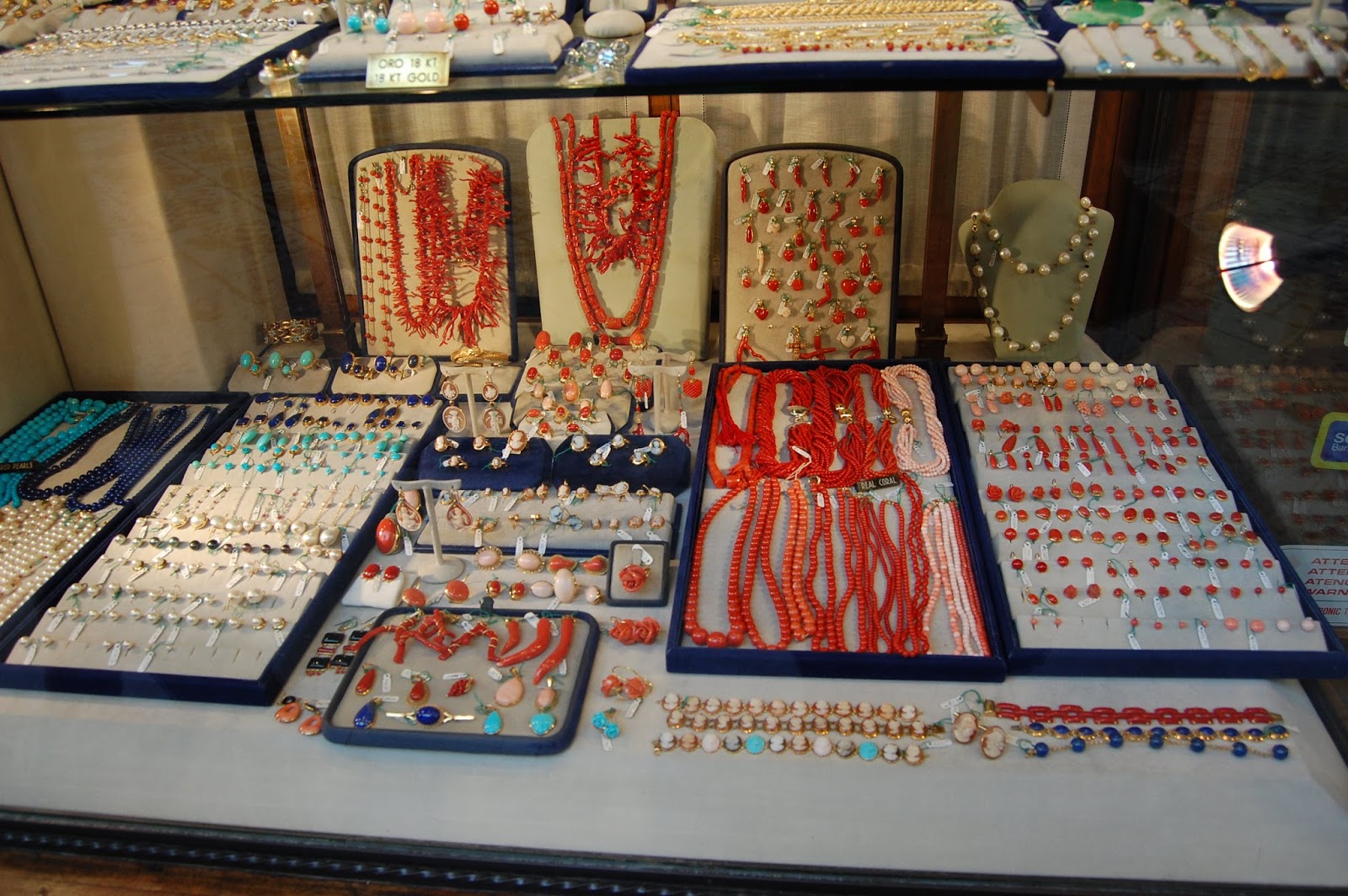
The Italian tradition of giving coral pendants to protect from evil continues even today in 2017. Coral horns, bracelets, necklaces are all part of the artistic jewellery still sold today on the Ponte Vecchio in Florence.


        While coral reefs in the Mediterranean Sea were abundant in the 1400-1500's, they have now been fished almost to extinction there in the shallow waters. According to Professor Sandy Tudhope, the Head of School of Geosciences at the University of Edinburgh in Scotland, conservationists are trying to save the Mediterranean coral beds that have been overfished.  Professor Tudhope works on coral in the Indian Ocean and has found the coral animals there are bleaching, turning white, because of the warming temperatures of the oceans. He gives lectures about the dangers of coral extinction on the planet from the rise in sea temperature. He has explained that the coral he works on is different from the red coral in the Mediterranean Sea. The Mediterranean Sea coral is a type that has "fused-spicule skeletons." Instead of bleaching when it dies, these "fused-spicule" skeletons retain pigments even after being fished out of the sea. Which explains why the coral jewellery sold on the Ponte Vecchio in Florence, Italy, is so bright red, and why the coral specimens that are painted into the Renaissance paintings are so bright red.
            One of the best examples of red coral in the Quattrocento (1400's) is found in a painting by Mantegna called the Madonna of the Victory, Madonna della Vittoria, a painting of 1496, originally in Mantua but now in the Louvre in Paris.

The coral here is hanging above the head of the Madonna in an altarpiece painted for a duke of Mantua, Francesco Gonzaga.
Francesco kneels in the painting to the lower left of the Madonna and prays to her in thanks for having given him a victory against the French in 1495.
 
This battle, known as the Battle of Fornovo, after the town where the battle took place in Northern Italy, was considered a water battle because the French tried to cross the Taro River there.
It was such a major battle that it warranted being included in the Vatican Gallery of Maps in the frescoes there painted in 1580 by Ignazio Danti.

Military historians now view this battle as a draw rather than a victory for Francesco because, although the Italians captured more prisoners, they also lost more men than the French. For Duke Francesco, however, the battle ended the conflict with the French and forced them out of the peninsula and back up into France. So his commissioning of the altarpiece is understandable.  He is grateful to the Madonna that he survived the battle and grateful that the French, under Charles VIII, have left to return home.
            In the painting he kneels before her and looks up at her in the niche. Behind him from left to right stand four warrior saints, MICHAEL, ANDREW, LONGINUS, and GEORGE.
Michael has a sword, Andrew a cross, Longinus a red spear, and George a broken lance. To the right below the Madonna kneels Mary's cousin, St. Elizabeth, and her son, John the Baptist, who holds a banner that reads: Ecce angus dei qui tollis peccata mundi (Behold the lamb of God who takes away the sins of the world.) John points up to Christ as that lamb.
The round medal below the Madonna's feet reads: REGINA CELI LAET ALLELUIA (Queen of Heaven Rejoice Alleluia.) And below that is a fictive bas-relief of Adam eating the apple given him by Eve.
The original sin of Adam and Eve is set directly below the body of Christ and the coral which hangs
above the throne of Mary.
The connection between Old Testament story and Jesus of the New Testament is lined up here literally. The original sin which forces Adam and Eve out of Eden is redeemed by the death of Christ
as an adult. Christ is essentially the protection against evil for Francesco, for all the saints gathered in this sacred conversation, and for the 15th-century, or modern, viewers of the altarpiece. The coral hangs above as a reminder of the blood of his sacrifice; the coral's branches look like blood spilling out into separate pools, and the coral is the same color as blood.
The coral also stands as a symbol of water, highlighting the location of the battle victory. But the old superstition about coral warding off evil persists even in this pious religious work. Mantegna makes a perforated apse chapel behind the coral through which we see the sky, one of the artist's pictorial inventions that gives the illusion that the architecture has windows covered with fruit and foliage with birds perching on the sills.

By painting the foliage and birds the artist reinvents the architectural structure of the fictive apse in the altarpiece. His windows open to the sky turn the stone man-made structure back into a structure built by nature.
           The coral that hangs here is a fused-spicule skeleton type coral, according to Professor Tudhope, and it retains its red coloring even out of the sea. The coral piece is left intact to show its original shape and texture as a sea animal. To either side of the central piece of coral are strings of coral beads that decorate the apse like sides of a coral triangle and lead the viewer's eye straight up to the large foreshortened shell from which emerges the mass of red coral.
Even though the battle being commemorated took place in the River Taro and not the sea, the coral still represents the water and the fact that the battle was not just land-based. The apotropaic importance of the coral seems at odds with the importance of Jesus' sacrifice, but mythology is blended with Christian belief to reinforce the power of the Madonna's child to fend off evil and protect the believer. The spiky coral looks like a thorn bush of natural defense. That it resembles
the twisting of the serpent around the tree of knowledge in the Garden of Eden scene below it
is appropriate. Francesco has warded off the French evil eye with the help of the Madonna and her
son's sacrifice in the form of petrified blood, a vestige of battle wear in a most graphic form.


Wednesday, March 1, 2017

MONET's SELF-PORTRAIT hidden in his WATERLILIES

MONET'S SELF-PORTRAIT hidden in his WATERLILIES

Monet's two oval-shaped rooms filled with his Nympheas (Waterlilies) paintings (1918-27) in the Orangerie in Paris at first glance appear to have no human figures except the visitors looking at the panels.

The second room has three paintings that show the dark shadows of willow trees on the water line:
Some might wish to read those dark, thick trunks as human imprints on the waterscapes, but, in truth, the surfaces on these canvases are filled with the colors of light, clouds, waterplants, and flowers.


But in the FIRST ROOM of the WATER LILIES as you enter from the lobby,


approximately at the spot on the left wall marked by the arrow above, you will find a face hidden in the cloud reflections of the pond:
just to the left of the man standing in the photo below and to the left of the large dark mass of foreboding water depth:
It is the facial signature of the artist, who is following in the tradition of self-portraiture for painters, established by Masaccio, over on the right. (See my blog entry on Masaccio and the tradition of self-portraiture for painters.) If you compare photographs of Monet near the end of his life and the closeup of this section of the cloudscape in the Waterlilies, there is a wonderful similarity of form:
 
The artist paints himself into the painting with his long scraggly white beard, with darker greys near the mouth for the darker parts of the mustache and beard that have not yet turned white. The right eye appears larger as the left eye does in the photo. It is as if Monet were looking in a mirror to replicate himself. The lids above the eyes are darkened, too, and there is a suggestion in the painted version of the furrowed lines between the eyebrows. 
          Here is the artist himself, staring lucidly out into the light, out into eternity, presenting himself as the author of the works in the two rooms, inserting himself into the cacophony of paint he has used to create cloud reflections on the surface of the pond water. In the whole vision of the pond his eyebrows and lids become waterlily pads, and his beard is a mass of colored mixtures with white, pink, and gray strokes. He wishes his face to remain hidden in a totality that is not meant to be about him or about any human beings. As we have said in another blog entry, he wanted to paint infinity in two rooms specifically designed to imitate the scientific symbol of infinity. He places himself in the swirl of that infinity forever. He consciously inserts his own right to authorship in a painting collection meant to evoke a garden of beauty without human figures. Even his ear is a small projection on the right in the blackness that covers the canvas on the right in this first wall painting in the series.
Perhaps the dark mass to the right of this self-portrait is meant to pull his face forward out of the depths while at the same time evoking the dark unknown of death. (Monet dies in 1926 just a few months before the rooms are finished being installed in 1927)
                                    
He suspends himself, as he does his water lilies, between the sky and the water, in a cloud-like formation that keeps him aloft in space, even as he displays his skill at painting the beauty he sees on the earth.


Tuesday, February 28, 2017

MONET'S GARDEN in PARIS: The Orangerie WATERLILIES

MONET'S GARDEN in PARIS: THE ORANGERIE WATERLILIES

In the wonderful L'Orangerie Gallery in Paris

are two oval rooms filled with waterlily paintings (Nympheas in French) designed by Claude Monet explicitly for those spaces. 
Monet intended the figure 8 of these rooms to remind the viewer of the symbol for infinity:   ∞  .
He expressly asked for the natural light to flood in through the ceilings in order to reinforce his
notion that the paintings represented light moving from east to west during the course of two days.
                                         ROOM 1
ROOM 2


The paintings were conceived of as an ""illusion of an endless whole, of a wave with no horizon and no shore," as Monet put it. 

Here you can see how one room leads seamlessly to the next so that the viewer feels the flow of the
water and the paintings' color from one oval to the other, certainly the wave that Monet was describing.
         When we look closely at any of the curved panels (4 in each room), we become aware of the
lack of horizon in all of them.
The viewer latches onto the white waterlilies as a way of grounding him/her/self in the vast expanse of the ponds depicted. 

There are actually three different surfaces that Monet conveys in these curved waterscapes:
1)   SURFACE OF THE WATER: where the white waterlilies grow
2) DEPTHS OF THE WATER:  where the dark green reeds grow
and
3) REFLECTIONS OF THE SKY AND AIR ABOVE THE WATER: where the clouds float.
The waterlilies hover between the sky and the depths of the water in a fairy-tale world of
turquoise and deep blue and white. The viewer floats, too, from panel to panel, suspended from gravity even when sitting to look at the paintings, so powerful is the sensation of being freed from the
earth. Monet's desire to convey infinity is accomplished beautifully in these two interwoven rooms of water. His prescience about the quality of space travel is here.
       Just as we become aware of the suspension of gravity, the weightlessness of the universe in
these rooms of color, we are also made aware at the same time of the changing nature of light over the course of various days. 
Thus, the light turquoise and pink of early morning:
and the amber sunset tones of dusk when the light starts to fade:
Monet had been working on paintings of his water-lily pond in Giverny from the 1890's, soon after he had moved to the property west of Paris. But in 1918 he realized that the France as a country needed to recover from the Great War of 1914-18, and as part of the healing process, he offered to paint these rooms for the nation. With the help of Prime Minister Clemenceau, who had become a friend of Monet's, the project was carried out over many years, and was finally installed properly in 1927,
months after the artist's death in 1926. Like Beethoven, whose deafness did not keep him from hearing inside his brain the music he composed, Monet did not have to see these paintings completely in place to know the effect that they would have on the viewers of them.

The sheer visual pleasure that he produces with the combinations of pinks and greens and deep purples and blues is as nourishing and healing as he intended them to be.


The viewer can submerse him/herself in the water as if swimming, or can smell the fragrance of the lilies or feel the soft touch of their petals.


The viewer can fly among the clouds reflected on the pond's surface and become one with the colors in a sky that knows no national boundaries or languages.
   While Paris as a city during Monet's lifetime (1840-1926) is growing as an urban center with the improvements to avenues, building facades, and park life begun during Haussmann's renovations under Napoleon III, the life of the countryside is more appealing to Monet. He continues to paint
a plein air, out of doors, from the 1890's until the end of his life in his rural setting in Giverny, about 50 miles outside of Paris. His awareness of the nurturing needed for the nation to recover from war,
though, enabled him to transport, through oil paint on canvas, his garden in Giverny, into the very heart of the capital city. Monet's garden walk continues Haussmann's idea about urban living that every city dweller needs to be within 10 minutes of a park to live happily in a city.  But Monet goes beyond that and uplifts the urban inhabitant and city visitor to a garden where belief in reality is suspended in a world of color and light, flowers, and clouds, air, and water.
His notion of infinity is one of continuous nurturing through beauty. The movement of light through
two days repeats without end from one oval to the other and the viewer is transported with the light
over,
in, and
above the water.