Monday, March 28, 2016

ALBERTI'S FACADE for SANTA MARIA NOVELLA


ALBERTI'S FACADE FOR SANTA MARIA NOVELLA


Leon Battista Alberti (1404-1472) was a writer and architect in the 15th century who knew many of the major artists by name and who influenced many of them with his treatises on Painting, Architecture, and Sculpture (Della Pittura 1435, De Re Aedificatoria 1452, and De Statua 1462.) The introductory paragraph to his Italian Treatise on Painting dedicates the volume to Filippo Brunelleschi and lists four other artists: Donato (Donatello), Nencio (Lorenzo Ghiberti), Luca (Della Robbia), and Masaccio. He calls each of them either by first name or by nickname. This familiarity or intimacy implies to the reader that these men are his Florentine family since he was illegitimate and his own family had been exiled until they returned to Florence in 1428:
"Ma poi che io dal lungo essilio in quale siamo noi Alberti invecchiati, qui fui in questa nostra sopra l'altre ornatissima patria ridutto, compresi in molti ma prima in te, Filippo, e in quel nostro amicissimo Donato scultore e in quegli altri Nencio e Luca e Masaccio, essere a ogni lodata cosa ingegno da non posporli a qual si sia stato antiquo e famoso in queste arti" 
"But then, since I have returned from that long exile in which we Alberti have long grown old, to a homeland that is more decorated than others, I have understood in many but most of all in you, FILIPPO, and in that closest friend of ours, DONATO the sculptor and in those other friends, NENCIO and LUCA and MASACCIO, that every praiseworthy artistic thing has been superseded from what was understood to be ancient and famous in our arts."(trans. mine)

He understands and is able to convey in writing the innovations which have taken place in Florence in architecture, painting, and sculpture just in the years 1400-1435.  Brunelleschi's Dome was nearly completed, Donatello was working on the Cantoria with Luca, Ghiberti was starting on the second set of Baptistery panels, and Masaccio had finished the Brancacci Chapel.
             How important for him, then, to contribute to the excitement of this artistic revolution! In 1470 he designs a major Florentine church facade, two years before the end of his life. He creates the facade of Santa Maria Novella. It is rightly called the FIRST RENAISSANCE CHURCH FACADE in Western art history.
Since Alberti had taken holy orders and served several popes in Rome before making this facade, it is tempting to find in it the influence of ancient Roman architecture. Certainly the rounded arches he would have seen in the Colosseum


and the pediment in buildings like the Pantheon and the Temple of Fortuna Virilis:

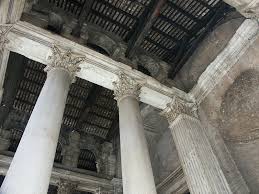
 The Corinthian capitals are used in the Pantheon, too, next to rounded niches.
 
And the marble facing for temples he could have viewed on what remained of Augustus' Temple of Mars Ultor.
                                                   

But Alberti, it seems to me, was looking much closer to home for his architectural influences and much closer in time than to ancient Roman      buildings.


The most important model for his facade is up on the hill above Florence in the 11th century Romanesque church facade of San Miniato al Monte (1060-62.)


How many elements are the same in both churches!  
1)  Both are built as though two temple fronts, one set on top and inside of the other:
 

San Miniato, 1060-62,yellow inside green      Santa Maria Novella, 1470
                                                                              blue inside purple
2) Both use green and white inlay marble for decorative effects and both have engaged (attached to the wall) green marble Corinthian columns:
 

San Miniato green and white marble              Santa Maria Novella, green and
                                                                              white marble

3) Both use rounded arches in the lower level as visual support for the upper level.
 

One variation: in Santa Maria Novella the arches on the very lowest level are pointed, remnants from the parts of the Gothic facade and Gothic funerary niches that Alberti had to incorporate into his structure.

 
 San Miniato has no such incorporation since its facade is produced before the Gothic era.
4) Both utilize roundels in their design:
San Miniato                                                                        Santa Maria Novella


5) Both have references to Christ in the decoration. In San Miniato a cross is inscribed in the inlay and Christ appears in the central mosaic blessing Mary, his mother, and the local martyr, San Miniato:
In Alberti's church the reference is found in the child's face inscribed in the sun inlay at the top inside the pediment and in the cross at the top of the church:
 
These references make clear that these are not pagan temples of worship but Christian since Christ is known as the light of the world.

BUT THERE IS ONE MAJOR DIFFERENCE that sets Alberti's church apart from the Romanesque model and marks it as a RENAISSANCE building. Whereas the patron or patrons who paid for the facade of San Miniato remain anonymous, Alberti proudly announces his patron's name on the facade of this temple and ADVERTISES his BUSINESS! How is that possible on a Christian church facade?
The Latin inscription running along the architrave between pilasters and pediment reads as follows:

Latin on the facade: JOHANES ORICELLARIUS PAV F ANSAL MCCCCLXX
FULL LATIN:         Johannes Oricellarius              Paulus Filius        Anno Salvator MCCCCLXX

TRANSLATION: GIOVANNI RUCELLAI        SON Of PAOLO  in the year of our LORD 1470

Santa Maria Novella was Giovanni Rucellai's parish church and he had hired Alberti in 1446 to produce a facade for his own private palace in Florence around the corner and down the street:

On his palace facade he had inserted the symbol of the spinnaker sail, the sign that his shipping business was prosperous because his ships were fast.


The same symbol is placed on the Loggia next to the palace, also designed by Alberti. In the Loggia the spinnaker is alternated with rings that have shoots of feathers, symbols of the Medici (Rucellai's son married Lorenzo the Magnificent's sister in 1461 and the Loggia was used for the celebration.)   

The spinnaker sail with its ropes is repeated over and over again on the facade of Santa Maria Novella, to remind us of the greatness of the patron and to remind us how the facade was paid for:


And, as if that weren't enough self-glorification, the Medici rings with feathers are repeated as well in the inner band of the central entrance archway in green and white inlay and in white bas-relief below:

While Alberti may have chosen Florentine Romanesque architecture in the Baptistery and San Miniato to adorn his patron's facade, his Latin inscription with its reference to Giovanni Rucellai has its precedence in the Latin inscription set out by Hadrian on the facade of the Pantheon in Rome (125 A.D.).


Hadrian's inscription reads: "Marcus Agrippa made this in the third year of his consulship," a bit of an architectural joke since there had been a previous temple on the site built by Marcus Agrippa but the building on which the inscription stands is designed by the emperor Hadrian himself.
Alberti's Rucellai is not fooling anyone with his own name's inclusion in the Latin of his parish church.


He wants us to remember whose son he is, what year he paid for the church facade and what enabled him to afford to pay for it:
Alberti's name is not mentioned, but he gives his own creativity a whirl in the wonderful daisy-wheel inlay decorations that form the smooth transition between the two temples:
He knows how blessed he is to have a patron of such means and a place of such great location to advertise!

Sunday, March 27, 2016

DONATELLO and MICHELANGELO's MADONNAS

DONATELLO and MICHELANGELO'S MADONNAS


How much Michelangelo's Madonna of the Stair (1490-92), now in the Casa Buonarroti in Florence, resembles Donatello's Madonna of the Clouds (1425-35) now in the Boston Museum of Fine Arts! Donatello (1386-1466) carved his bas-relief  from a block of Carrara marble, as did Michelangelo (1475-1564.) The dimensions of the two works are similar. Donatello's bas-relief is about 13 inches by 16 inches, Michelangelo's is 22 by 16 inches. Donatello's is a square shape, while Michelangelo's is a vertical scene in a rectangle.
       Both are images of the Madonna seated with the Christ Child on her lap. She is draped in cloth in both with her head covered as she clasps the child to her bosom.
 

In both her head is enveloped by a halo.


Curiously, she is nearly barefoot in both, with her feet peeking out from under the long drapery of her gown. Donatello gives her sandals but Michelangelo leaves her without them.


 She looks out beyond the Child in both, and in both she is accompanied by other children or angels.


     Both are good examples of the use of various layers of carving depth to convey space and both utilize a technique referred to as "rilievo schiacciato," very flattened low-relief carving, a display of skill by the carvers. A good example of rilievo schiacciato is in the face of the angel next to the feet in the Donatello piece.
"Schiacciato" means squished; in Florence bakeries you can buy a piece of "schiacciata," a square piece of flattened or pressed bread. The head of the angel here appears barely rising out of the background; it is close to the "picture plane" of the carved scene. The sculptor's ability to render an entire face in depth with the three-dimensionality of the chin and the hair with such slight carving of the material is what even Vasari refers to as "marvelous."
          In both there is a suggestion of a cross shape, a reference to the end of Christ's life in a bas-relief of the beginning of his life. It is a common Renaissance trope to include the alpha and omega of Christ's life in sculpted or painted images of him. In Donatello's carving the cross is implied in the way the child's body folds into the mother's leg. What seems at odds in the Donatello image is
 

the fact that the Madonna here is shown in heaven without a throne or crown. She is often depicted as Queen of Heaven, but here she has Jesus as a young boy and yet she herself has already ascended into heaven, up above the clouds. This is not a common subject in Italian art of the 15th century; Jesus has a halo, but if the Madonna has already been "assumed," i.e., taken up to heaven, her child would have predeceased her and would be older.


Michelangelo's image is also odd. In his the cross shape is formed by the stair bannister and the arms of the children.


               We do not know the reason for either work. Vasari, in his 1551 Life of Donatello, says that Donatello carved some pieces in marble and bronze for the Pazzi garden. " SONO IN DETTO LUOGO  MADONNE DI MARMI E DI BRONZI DI BASSO RILIEVO, ET ALTRE STORIE DI MARMI, DI FIGURE BELLISSIME E DI SCHIACCIATO RILIEVO MARAVIGLIOSE.(There are in said place [the Pazzi Garden] Madonnas of marble and bronze in bas-relief, and other stories in marble of beautiful figures and in marvelous "schiacciato" relief.- trans. mine) This notation from Vasari would seem to refer to the carving in the Boston MFA and another bas-relief of the Madonna and Child (sometimes called the Pazzi Madonna, now in Berlin).
Both of these carvings could be included in Vasari's description since he purposely uses the plural, MADONNE di MARMI (Madonnas made of marble). As we know that Donatello made the Pazzi family's coat of arms, the twin dolphins, for their family palace in Florence and for the Pazzi chapel next to Santa Croce, it is not unreasonable to think that the Boston Madonna was made for the Pazzi. 
         But Vasari himself changes his mind about these bas-reliefs mentioned. In his Life of Donatello in the 1568 edition he says, "Sono in detto palazzo de’ Medici Madonne di marmo e di bronzi di basso rilievo, et altre storie di marmi di figure bellissime e di schiacciato rilievo maravigliose."(In the Medici Palace there are Madonnas of marble and bronzes in bas-relief, and other stories in marble with beautiful figures and made in wonderful "schiacciato" relief.-trans. mine) Vasari also talks in this second edition about the close relationship between Cosimo Medici  (the Elder) and Donatello, so close that Donatello is eventually buried near Cosimo in the crypt of San Lorenzo. 
           So while Vasari seems to change the patrons from the Pazzi to the Medici, it seems pretty clear that the Madonna of the Clouds was made for a private palazzo and not a public church. The specific change to Palazzo Medici also makes it more likely that Michelangelo would have seen it Vasari affirms in the second edition in his Life of Michelangelo that Michelangelo intended to carve his own Madonna of the Stairs in competition with, and out of respect for, Donatello:
 

"Il quale Lionardo non è molti anni che aveva in casa, per memoria di suo zio, una Nostra Donna di basso rilievo di mano di Michelagnolo, di marmo, alta poco più d’un braccio, nella quale, sendo giovanetto in questo tempo medesimo, volendo contrafare la maniera di Donatello, si portò sì bene che par di man sua, eccettoche vi si vede più grazia e più disegno. Questa donò Lionardo poi al duca Cosimo Medici, il quale la tiene per cosa singularissima, non essendoci di sua mano altro basso rilievo che questo di scultura."
The said Leonardo (Michelangelo's nephew) had kept in his house even recently, in memory of his uncle, a NOSTRA DONNA (MADONNA) made in low relief by the hand of Michelangelo, out of marble, little more than a braccio long, in which, since he was a youth in this same time, wanting to imitate the style of Donatello, he carried it out so well that it seems to be by his [Donatello's] own hand, except that in it we see more grace and more design. This Madonna Leonardo gave later to Duke Cosimo Medici, who keeps it for a rare thing, since he owns no other bas-relief by his [Michelangelo's] hand than this sculpture."(trans. mine) 
(Vasari's life of Michelangelo, 1568 ed.)
     We can't be sure that whatever work by Donatello mentioned is the Madonna of the Clouds, but we can know from this passage that Michelangelo was wanting to emulate Donatello as a sculptor in bas-relief.
       Vasari suggests in this passage that Michelangelo's Madonna is an early work of the artist and most scholars agree. (Pope-Hennessy an exception, 1512.)  If so, it was carved before the St. Peter Pieta of 1498 and before his David (1501-04) which makes it tempting to think of it as a "stepping-stone" piece, so to speak, a trial carving in small scale before tackling larger projects. We know Michelangelo lived in Palazzo Medici from 1490-92, when he could have seen Donatello's bas-reliefs, including perhaps the Madonna of the Clouds.
        The fact that the Madonna of the Stairs is now in the Casa Buonarroti collection means that at some point the piece was given back to the family from the later Medici Duke and the family kept it as a reminder of the work of Michelangelo's youth, as is the case for the Battle of the Centaurs relief there.

Since the Madonna of the Stairs image is of a woman sitting at the bottom of a staircase like those in many Renaissance palazzi,
 

perhaps it can be dated to the year in which Michelangelo was invited to live in Palazzo Medici by Lorenzo the Magnificent. He is 15 when that happens, the date, 1490. Michelangelo stays with the Medici family until Lorenzo dies in 1492, so the dating for the Madonna of the Stairs should range between 1490-1492.   
          Donatello's Madonna of the Clouds (1425-35) is one of Donatello's clearest images of female beauty and maternal love. The Madonna is elevated to a place in the clouds, above earth, and though she doesn't wear a crown, the implication is that she is Queen of Heaven.
 

Michelangelo's Madonna, also crownless, has been literally been brought down to earth. Instead of a Queen of Heaven, we have a barefoot wetnurse in a Florentine palazzo sitting at the bottom of the stairs while the children fold the sheets and fight at the top. 


The earthly nurturing qualities of the Madonna are emphasized here. She is protective and embracing the child as he is swathed in her clothing. The only things which remind us of her role as holy figure are the halo and her size. She takes up the entire relief block and her head appears to tower over the 7-rung staircase. She is gigantic compared to the children and the block on which she sits. The artist is rendering her importance in her height and bulk. Donatello's Madonnna takes up most of the block, too, but we never get the impression that the angels are out of proportion to their holier mother.


We are not surprised by Michelangelo's interest in stairs. In 1524 he begins designs for the Laurentian Library next to San Lorenzo in Florence and includes stairs in the drawings:
 

 The stairs in the that library's vestibule are not built until later, around 1550, but the
the stairs on the short sides with 9-step stairs bear a resemblance to the stairs in his 1490-92 bas-relief, with a low seat on the bottom rung:
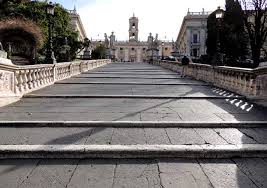
Even before those Florentine stairs are carried out, Michelangelo designs outdoor stairs in Rome (1536-46) when he creates the Piazza of the Capitoline Hill and the staircase that leads up to it:
 
 
He also makes drawings in 1557- 59 for two short staircases in a private palazzo:
 
While stairs are associated with the Madonna in theological writings from the 15th century, where she is thought of as a stairway to heaven, an intercessor for prayer to reach God, the stairs envisioned by Michelangelo in various periods in his life can be construed as his own career pathway mapped out clearly and concisely.


         For Donatello, though, the Madonna has no such clear role and his own career pathway is
haphazard and filmy. His eye on the clouds, he gives us a vision of unexpected ethereal calm.
                   
  Michelangelo may have wanted to copy Donatello's carving, but he was assuredly more of a realist.
His Madonna's feet are definitely on the ground.