Sunday, September 22, 2013

GIOTTO's SCROVEGNI CHAPEL


GIOTTO's SCROVEGNI CHAPEL

        Ambrogio di Bondone (Giotto) (1266/7-1337) paints the interior side walls, ceiling, altar arch, and apse entry wall of the private chapel of the Scrovegni family between 1303-6 in Padua. (It's possible he's the architect as well.)
For the most beautiful chapel painted before the Sistine, the artist faced numerous challenges: how to organize, design, and paint a series of stories about Christ and the Virgin Mary to give an aesthetic and clearly legible inner lining to a large sacred space? Giotto manages, in just two-three years, to present the chapel as an illuminated manuscript through which a viewer can follow easily the narrative dramas on the walls while admiring at the same time the beautiful illustrations designed by the painter. As Professor Howard Davis' lectures (at Columbia University) used to instruct, Giotto divides each wall structurally into visual components that separate the individual scenes as well as unite the chapel into one work of art. Since today's chapel is only open for 15 minutes a group, this blog will point to the crucial scenes that a new viewer should look for during a visit.
        The Chapel, sometimes known as the Arena Chapel because it was built on the site of an ancient Roman arena, was dedicated to the Virgin, Santa Maria della Carita (Saint Mary of Charity).
Left -View of Roman wall of original arena (notice the curve).
Right - Print of chapel attached to arena wall and Scrovegni palace (now destroyed).
When you arrive on the site, notice the pink and white exterior of the building from the front because when you go inside you will see a small pink and white model of it painted from the front by Giotto (play within a play) on the Last Judgment wall.
 

Giotto shows the patron here, Enrico degli Scrovegni, handing the model of the church to the Virgin as a gift.
            When you finally get into the chapel, face the Last Judgment wall and look at the wall on your left. It is divided horizontally into three tiers: The top tier begins the LIFE of the VIRGIN on the left and the stories of Mary's life continue from left to right horizontally on the top tier around onto the right wall. Mary's life is important to include because the church is dedicated to her. The stories of the LIFE Of CHRIST take up the second and third tiers beginning on the left and continuing around the building. The organization is:    LIFE OF VIRGIN (at top)
                                 EARLY LIFE OF CHRIST
                                 LAST DAYS OF CHRIST (at bottom)
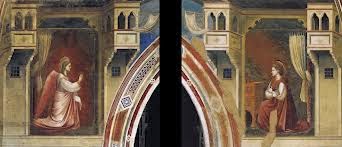
Over the altar arch you will find the Annunciation, the scene that connects Christ's life with his mother's.


 Now look up at the ceiling, the most expensive part of the fresco cycle:
The ceiling is meant to resemble a deep blue sky (made from ground lapis lazuli) studded with golden stars (gold leaf). It is the cosmos. Now for the stories taking place underneath that cosmos:
LIFE OF VIRGIN:
Most poignant scenes: 
Joachim, the Virgin's father (here in gold halo), is rejected by the rabbi at the temple because he is childless. He can't face telling his wife the news, so he goes out into the country to visit his shepherds.


The two shepherds look at each other as if to acknowledge Joachim's depression. Joachim walks towards them with his head hanging down and he doesn't even notice his little dog, who approaches him joyfully up on his hind legs. (The two shepherds are the first example of "witness figures" in Western art.)
After offering a sacrifice to God, God grants Joachim's prayers for a child, and Joachim reunites with his wife Anna at the gate of a city under a golden arch. Their faces are melted together into one face by Giotto as a symbol of the new child they will bring into the world, Mary.


EARLY LIFE OF CHRIST  and LAST DAYS OF CHRIST
The two tiers of the Life of Christ are connected both horizontally and vertically. Giotto plans the scenes from the two stages of Christ's life in duets: the Early life scene above is thematically related to the Last Days scene below and the figures in both sets are arranged in similar ways all around the chapel.
Just look at 2 EXAMPLES.

1st EXAMPLE:
ADORATION OF THE 3 MAGI from the EARLY LIFE OF CHRIST is set above the
WASHING OF THE FEET scene from the LAST DAYS OF CHRIST. Let us see how Giotto goes about uniting them. On the left wall as you face the Last Judgment

we can see in the middle tier furthest left in the photo the Magi paying homage to Mary, Joseph, the Christ Child, and 2 angels:
 

Directly below that scene the figures in the Washing of the Feet are arranged in similar fashion, with two standing apostles instead of the 2 standing kings and a kneeling Christ washing Peter's feet where the oldest king knelt.  Instead of the holy family on the right with the two angels, we find 3 apostles and a hidden apostle with halo behind the halo of the far right apostle.  The two scenes are about paying homage: in the early scene above, the 3 Magi bring gifts to the Child, in the later scene below, Christ brings his gift of love in washing the feet of the apostles. Christ has transformed from child to holy man and age has changed him from receiver to giver, from child to King. The rest of the apostles in the later scene take the places of the companions of the kings, the entourage that includes a recalcitrant camel behind the young and middle-aged kings. This bit of stage business is echoed by the apostle below who is fiddling with his recalcitrant sandal-lace.


In simple gestures and expressive dramatic layouts, Giotto conveys both stories with great effect and manages to connect what would otherwise be disparate historical events into a harmonic melody. He uses the wall as Bach might, in a later age, work his notes contrapuntally to align them for his music.
        There is an added layer of meaning in Giotto's arrangement of figures in this particular case. You might be led to ask: What is the point of the added person hidden behind the architectural element in each scene? In the Adoration it is an angel; in the Washing it is an apostle. You can argue that another apostle is needed to make 12 altogether, but there is no immediate need to place another angel behind the holy family.  If you map out the arrangement of the right side figures in the 2 stories here, you discover the angel and apostle are placed there by Giotto to complete the design of a secret cross.

Built into the images of the Adoration of the Magi and the Washing of the Feet, then, is a reminder of the ultimate end of Christ's life; for a 14th-century Christian the purpose of knowing about Christ's stories is to realize the sacrifice of his life for the sins of all people. Underlying the narrative of the chapel, literally, then, is the signal of the most intense code of sacrifice. The Kings are giving gifts, Christ is washing feet, Scrovegni gives the chapel, but the most important gift to remember is the one given on the cross by the godhead.

2nd EXAMPLE to look for, this time on the right wall as you face the Last Judgment:
RAISING OF LAZARUS
NOLI ME TANGERE
The theme of both paintings is Resurrection; in the middle tier Jesus resurrects Lazarus from the dead.
We see Jesus on the left raising his hand in blessing as Lazarus emerges from the tomb-cave swaddled in white burial cloths on the right. Giotto records the reactions of the people: some cover their noses from the stench of the newly-dead Lazarus, some bow down in front of Christ in wonder at his powers. And then Giotto paints something intangible:  the electricity that sparks between the gaze of Christ and the gaze of the reviving Lazarus, the atmosphere between the two, the air between life and death. You can almost hear the booming of Christ's voice across the space: "Lazarus, come forth!"
 
In similar fashion he paints the Resurrection of Christ after three days being dead. The two angels sit on Christ's tomb while the Roman soldiers sleep. The Resurrected is on the right; we see the holes made in his feet and hands by the nails on the cross; we see the new plants springing up beneath and around his person on the ground, signs of new life.  Mary Magdalene reaches out to touch him and the gesture of his right hand towards her is consistent with the text in John 20:17 where he says, "Do not touch me (Noli me Tangere) as I have not yet ascended to my father." He, like Lazarus, is dressed in white and Mary bows down to him as do several worshippers in the Lazarus scene. These two dramas are related thematically because they are both about someone coming back from the dead. And they are related vertically and compositionally by the placement of the resurrected person on the right and isolated in white. The gestures tell the Magdalene story here, too, and the artist leaves a space between the hand of Christ and the hands of Mary Magdalene to convey Christ's interdiction about touching and to convey the frisson of her seeing him alive again after her grief over his death. Powerful and simple, like the idea of no death for human beings.

Tuesday, August 27, 2013

RENAISSANCE INTARSIA - D - Gubbio

RENAISSANCE INTARSIA - D - Gubbio

When Duke Federico da Montefeltro had finished decorating his study in Urbino, he sent his workers over to his summer palace at Gubbio (a hill-town southwest of Urbino).
 
They (Francesco di Giorgio, Giuliano and Benedetto da Maiano, and perhaps Baccio Pontelli) in 1476 created a wood inlay studiolo for him there very like the study in Urbino.
This studiolo is no longer in Gubbio, however; the wood inlay part of it has been transported to the Metropolitan Museum of Art in New York City.  (See the museum's website and Olga Raggio's terrific pdf article posted there, or look at Luciano Cheles' Urbino studiolo book that includes Gubbio.)
          What I would like to explore here is how Gubbio fits into the chronology of one-point perspective inlay experimentation. After the Florentine sacristy intarsia is produced in 1436, the intarsia artists become more and more sophisticated in their ability to render trompe l'oeil (illusionistic) scenes on the walls so that, by the time the study in Urbino is completed, in 1476, they have a repertoire of lattice-work doors, cupboards with shelves and objects, benches, and even landscape glimpses that appear to mirror reality with one-point perspective.
 
With their increased skill comes confidence. The Gubbio studiolo is smaller, tidier, and more refined in its imagery than the Urbino study.

It includes a mazzocchio (hat-form) on a bench, musical instruments in the cupboards (cittern and drum), the garter of the Order of the Garter (a knighthood granted to Federico in 1474), scientific and writing implements, and even an attempt to render a ceramic mug in wood inlay (on left upper shelf.)


The benches are given more prominence here than in Urbino. The wall surface is entirely flat, but the illusion is that the benches project out from the wall of the picture plane. Mr. Theodore (Ted) Low, Director of the Education Department at the Walters Art Gallery in Baltimore, Maryland, used to say that, when he worked at the Met and led a tour into the Gubbio room, that inevitably someone would try to sit down on the benches in the study

and fall to the floor because there are no real benches, just the intarsia illusion of them. His story certainly speaks to the realistic quality of the wood inlay perspectives. The fictive light casting a shadow on the legs of the benches (in reality just darker wood set into the inlay) makes the bench appear to respond as a real bench would to light, even with the shadow changing direction slightly for refraction.
In this study are also sections of the benches where the sitting surface seems to be lifted up with lattice grillwork underneath.The illusion would have been even more believable when there was real light coming from the window of the palace into the room:


The benches in Gubbio are certainly good examples of FORWARD SPACE in inlay work, but, as in Florence and Urbino, the intarsia workers want new challenges, and the benches are something they already know how to do.
      The new problem the artists pose for themselves in Gubbio relates directly back to the Florentine sacristy candlestick that projected forward from the picture plane. In Gubbio the object they choose to set into FORWARD SPACE is a triangular-shaped lectern with specific printed pages of a book on it. The lectern is placed standing on one of the benches with its octagonal base forward of the cupboards.


The illusion is that the lectern rests on the bench; the shadow the lectern casts gives substance to the fictive air between the pole and the back wainscoting of the wall. When we look at the triangular top of the lectern, where the book rests and which has an open hole for reading rulers, the wood inlay illusion is not consistent, though. Instead of being placed forward of the wainscoting, the book and its support appear to slide back into the cupboard behind the lattice-work doors. What has happened to the intensely perfect one-point perspective of the rest of the study?
       The words written on the book pages of the lectern are a clue. The book is Vergil's Aeneid, 10: 635-84 and the pages displayed describe the death of Pallas, a beautiful youth who fought for Troy:
    Every man's last day is fixed.
    Lifetimes are brief and not to be regained,
    For all mankind. But by their deeds to make
    Their fame last: that is labor for the brave.
                   (Raggio, p.31, trans. R. Fitzgerald,1990, p.310)
These are words chosen deliberately to praise Federico and his deeds as well as the labor of the intarsists themselves.
The memento mori of Vergil's text reminds the viewer that everyone's life passes quickly and that great deeds (such as the creation of the studiolo) are needed to ensure that fame lives beyond death. The round mirror hanging above the lectern has an inscription, "G BALDO DX", the name of Federico's son, Duke Guidobaldo, his heir. The words set out on the fictive lectern reveal to the viewer that the end of the great era of intarsia work has come with the death of Federico, its patron. Federico dies in Ferrara in 1482 and these additions to the room were probably added after his death, not by request of his son, who was only 11 in that year, but probably by the request of Federico's closest advisor, the count Ottaviano Ubaldini della Carda. (Raggio, p.33). The lectern with Latin inscription replaces the lit candle of the Florentine sacristy with a similar object on similar stand. Instead of a positive eternal light for sacred services, though, the lectern provides an image of the inevitability of human death. The great deeds of Vergil's fame are visible in the work required to make a fictive lectern out of colored pieces of wood. The intarsists place wood words to speak of Federico's eternal fame, but as they do, they also leave a lasting impression of their own talent.
If we were unsure that the end of the wood inlay study were spelt out in this image, the exit door from the study would put the cap in place:


The book on the bench is closed rather than open, the musical instruments hung up, and the lute and collar of Ermine stick out of the cupboard door like tongues from the last gasp of an open mouth:


These afterthoughts are the end glimpses the viewer has of the study upon exiting. The art of one-point perspective for wood inlay studioli dies with Federico in 1482, even if the studiolo in Gubbio takes a few months more to be finished. The intarsia workers know they have exhausted the challenges along with the patronage. The illusions they have created for Urbino and Gubbio have reached a climactic finale that is never to be repeated. The developments begun in the Florentine sacristy are finished in Gubbio.
       After the Gubbio palace, the use of one-point perspective in wood inlay moves back into an ecclesiastical setting, into choir stalls produced in churches in the Italian peninsula, and never again do we have intarsia work on a scale or in such a creative burst as in Federico's two rooms.
       Like the musical instruments in wood inlay, an intimation of a lingering note remains. At first there seems to be a possible reference to the Christian faith in a small Tau cross hanging from one of the cupboards. Since the tau cross is associated with St. Francis and Francis is said to have tamed a wolf in Gubbio, the object may obliquely refer to that legend. But the object portrayed, after closer examination, is a tuning key for the harp, so the Christian reference is as slight as its shadow behind, and the tuning note that is meant to be literally hanging in the air is from secular music rather than church music.


The rest of the study is filled with other images of the secular life of the palace; Federico's belief in the rational life, an intellectual life constructed after reading many texts from the classical past, is apparent in both studies, but most emphasized in Gubbio. While in Urbino there were still painted portraits of popes on the wall, in Gubbio, they are eliminated. The paintings that originally hung on the walls in Gubbio are of female figures of the Liberal Arts bowed to by knights who pay them homage.  Even the Latin inscription on blue background that winds around the area above the cupboards and ties the entire study together is a humanistic or pagan caption for the images of the Liberal Arts above it; it is devoid of Christian reference:
    
 "See how the eternal students of the venerable mother, men exalted in learning and in genius, fall forward, as supplicants with bared neck and flexed knee, before the face of their parent. Their reverend piety prevails over justice and none repents for having yielded to his foster mother." (Raggio, p. 31)


The female figure in each painting here is one of the Liberal Arts: Logic, Rhetoric, and Music, respectively. They are female because the noun in Italian is feminine: la dialettica, la retorica, and la musica. The men paying homage by kneeling on steps before the women (who are seated on thrones and seem to have crowns) are courtiers from the court of Federico, including Federico himself in Dialettica.  (Three paintings are lost - grammar, geometry, and math, two (music and rhetoric) are dispersed to London (National Gallery), and two (dialectic and astronomy) were destroyed in Berlin during WWII.
        The message Federico conveys in these paintings and in the Gubbio intarsia cupboards is unusual in the period in which he lived: men should honor and treasure classical learning exclusively; enrichment and survival of the soul can be provided through the areas of knowledge passed down to us from the classics only. No reliance on Christian stories or saints here. In the privacy of his own home, he feels free to express an almost heretical view:  knowledge of secular music, grammar, mathematics, and geometrical logic are essential to the life of the mind; piety should reside in those areas of "human" specialty, the trivium and quadrivium, the liberal arts. The trivium consisted of la grammatica, la retorica, and la dialettica (grammar, rhetoric, and dialectic (logic)). The quadrivium consisted of: l'aritmetica, l'astronomia, la geometria, and la musica (math, astronomy, geometry, and music). 
        Secular thought is celebrated here in his shrine to ancient wisdom. The duke presents for his young son as well as for himself, a vision of classical education within a study that stands witness to the power of human creation. Theology has no place in the paintings or cupboards.  Federico was captivated by the rational process of one-point perspective and his one-point perspective art here includes geometry, astronomy, rhetoric, math, and music. This Renaissance duke was sure that the logic of classical learning displayed in the Gubbio intarsia was no illusion.