Showing posts with label TITIAN. Show all posts

Monday, October 22, 2018

TITIAN's FRARI ASSUMPTION

TITIAN'S FRARI ASSUMPTION 


The main altarpiece for the Franciscan Church in Venice, Santa Maria Gloriosa dei Frari, was painted by Titian between 1515 and 1518, much before the Pesaro Altarpiece painted by him for the family altar on the left side of the nave and even further before the Pieta he painted in the last year of his life, 1576, a painting intended for his tomb on the opposite side of the church from the Pesaro but within
the same nave. 
         The Assumption of the Virgin, the rising of Mary up into heaven at her death, is the largest altarpiece in the church dedicated to her.
The two other paintings by Titian in the church point towards this main altar painting with diagonal
arrangements of the figures, and both of his other paintings include Mary as part of the subject for these private altars in the nave.


The Assumption is found at Number 12 on the plan, at the end of the apse, and it becomes the viewer's focus in entering the church from the front.


The rounded triumphal arch frame in which it stands provides a suitable ending to the walk through a church meant as a celebration of Mary. Titian has painted Mary's triumph here.  
She is leaving the earthly world on a white cloud of winged putti and she raises both her hands in
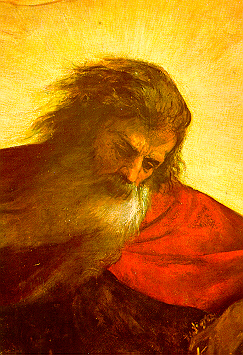
an orant gesture as she looks up to God the Father who looks down on her and welcomes her into
heaven:


She looks somewhat apprehensive about leaving what she knows for the unknown but perhaps is reassured by the opening arms of God.
 What Titian does is take the vast space of the canvas and organize it into three layers:

1) the earthly realm with blue sky and white clouds, with the apostles who witnessed Mary's death
and assumption gathered in groups standing and looking up at her figure.


2) the middle section of white cloud with winged putti rejoicing as the red-dressed figure of Mary ascends from the earth to heaven surrounded by love, literally:

3) the top section of the golden sky of heaven with God the Father accompanied by angels and seraphim:

Once the artist has set up these three zones he must find a way to connect them together and to imply the movement upward of the Virgin. He does this magnificently using the color red and arms and legs to visually elide the groups into one whole.


The apostle dressed in red at the bottom has his back to the viewer and reaches his arms up towards
the Virgin; this gesture allows the viewer to take his place as his/her own and it moves the viewer's
eye up towards the middle section, where Mary is also dressed in red; Mary's arms also repeat the
upward gesture toward God, so that the viewer follows the movement of the arms up towards God,
who also has red in his garment. Seen from afar, the red colors in each of the sections allow the eye to
to jump from lower section, closest to the viewer, on earth, to the heavenly realm, in a triangular vision of red. The artist also gives us faces to guide us from the lowest level to the highest:
The face of Thomas, the apostle who was given the Virgin's girdle (the green cloth he holds onto) at
her Assumption, looks up at the figure of Mary, which makes the viewer look upwards, too. He, too, is dressed in red.

Then, Mary looks up toward the old man face of God, so the viewer follows her turned-up face as well.


The red color at the bottom is ample and lush and gradually diminishes towards the top, where it is
swallowed up by the golden glow of heaven.

In my opinion it is likely that Raphael was influenced by Titian's arrangement of earthly and heavenly zones in his great masterpiece in the Vatican Museum, the Transfiguration. Painted between 1516 and 1520, this painting exhibits a lower earthly area where the apostles are gathered to witness the curing of a boy possessed by demons and in the heavenly realm Christ is visited by Elijah and Moses.


The middle zone in this painting is occupied by the three disciples who saw Christ in this vision:
John, James, and Peter. Raphael uses the same arm gestures as Titian to convey movement upward,
but his reds do not accelerate the movement for the viewer, as in Titian's altarpiece:


Both are paintings of visions, though. The Assumption story, meant to eliminate the possibility of death for Mary, is not recounted in the Gospels, but rather comes from the later stories about the Virgin in the legends about saints written down by Jacopo della Voragine in 1289 called The Golden Legend. There he describes the rising of Mary into heaven after she falls asleep (the Dormition of the Virgin.) "And anon the soul came again to the body of Mary, and issued gloriously out of the tomb, and thus was received in the heavenly chamber, and a great company of angels with her."(James Hall, p. 34, Dictionary of Subjects and Symbols in Art, New York, Harper and Row, 1979.)
          In Titian's version her soul issues gloriously out of the tomb, and is received in heaven with a great company of angels. The transition from earthly life to afterlife for Mary is presented as a gentle
trip on a cloud up into the sky, and the cloud is held up by angels. All of the journey is weightless as
the heaviness of the body is let go and the soul is transported to God. The use of "gloriously" in the
Voragine description reminds us that the name of the church for which this is the main altar is
Santa Maria GLORIOSA dei Frari. Her trip to glory in glory is given cinematic display by Titian,
and every visitor to the church, even now, is caught up in the drama of the event because of his
glorious rendition of it. The viewer is entranced by the color, gold leaf, and movement upward of the sacred figure. In its presence we become like the apostle in front, reaching up to touch the ideal of the sacred.


Titian understood the need for perfect saints for humans to aspire to be. That the apostle doesn't
quite touch the cloud or the heavenly figures is what Browning is suggesting when he has Andrea del Sarto say: "a man's reach should exceed his grasp or what's a heaven for?" But Browning was not thinking of a painting by Andrea del Sarto in that poem. He had surely visited the Frari and stood in front of this altarpiece in wonder.


Sunday, October 21, 2018

TITIAN'S PESARO ALTARPIECE, FRARI, VENICE


TITIAN'S CA' PESARO ALTARPIECE, FRARI, VENICE - 1519-1526


In the last blog we discussed Titian's altarpiece intended for his own tomb on the right side of the nave of the main Franciscan church in Venice, the Frari. We pointed out that nearly directly across the nave from this tomb painting in the Frari stood another altarpiece by Titian on another altar on the left side of the nave. The diagonal arrangement of the figures in both paintings complement one another and were meant to be seen as a pair by the viewer coming into the church. But while they both would have originally been set on altars meant to direct the congregant to the main altar where Titian also painted the altarpiece, (the Assumption of the Virgin, 1515-18)


 they are very different kinds of paintings, one looking out to the sky and one looking inward. The clouds and blue scene beyond the foreground figures in the Pesaro Altarpiece contrast with the enclosing architectural apse that stops the viewer from going beyond the wall behind the figures
in the Pieta. In the Pesaro altarpiece Titian is thinking about his patron, Jacopo Pesaro, and his role in the outside world, whereas the Pieta is meant to be a meditative piece about Titian's own death.


In this Italian plan for the Frari, the painting on the left was originally at number 5 on the plan and the Pieta, on the right was originally set on the right side of the nave at number 30, where Titian's body was laid in 1576. (The Pieta he made for it was transferred to the Accademia Gallery in Venice in 1814, having been taken back by Titian himself to his own studio before his death.)


Number 5 originally -                                                                               Number 30 originally:


The location of the Pesaro Altarpiece by Titian (1519-26) is reinforced in the painting itself by the artist's inclusion of two large grey columns in the background of the scene which imitate exactly the grey columns inside the nave of the Frari church itself. (See David Rosand, Painting in Cinquecento Venice, Yale, 1982, pp. 58-69.) Titian intended the Pesaro altarpiece to reflect an extension of the nave to the outside world so that the Pesaro family's accomplishments would not be limited to, but would include, the church space.


The columns extend upward beyond the picture plane so we don't see their capitals because the artist
wishes to suggest a church similar to that of the Frari but in another higher realm, in heaven. The picture plane extends to another aisle of the church, so heaven is within reach and looks very much like the church where the viewer stands. In this heavenly realm, the patron, Jacopo Pesaro, kneeling on the left, is presented to the Madonna and Child up the stairs on the right.
Jacopo Pesaro was the commander of the papal navy when it won a victory over the Turks at Santa Maura in 1502. In the altarpiece Titian paints a reminder of this victory in the portrait of Jacopo
behind whom we see a captive Turk (with white turban) and a soldier in armor looking much like a
martial Saint Mark, the patron saint of Venice (since the papal navy was made up of Venetian ships.)

The flag carried by the soldier features the coat-of-arms of Alexander VI, the Borgia Pope who
hired Jacopo Pesaro, and the coat-of-arms of the Pesaro family.

But the most prominent figure in this altarpiece sits on the stair in the middle as mediator between the donor and the Madonna, St. Peter. We know it is he because a key dangles conspicuously below his
robe on the steps:

St. Peter is not the name saint for Jacopo (James) Pesaro, so his prominent presence here is as the
first Pope, and he is here to introduce Jacopo in heaven to the Madonna and Child and to attest to
Jacopo's famous battle where he put his life on the line for Christianity and the Vatican.
           Why are the other members of Jacopo's family in this painting, then, and who are they?

The youngest, who looks out at us, is Leonardo Pesaro, the heir to the family fortunes. In front of him kneels Francesco, whose patron name saint, Francis, stands above and gestures towards him. Next to Leonardo kneel Fantino and Giovanni, and behind them all and underneath his own name saint, is Antonio. Only Francesco and Antonio are blessed by their saints, but the other members of the family are included in the group portrait.
Their presence here is to pay homage to Jacopo for his military honor as Commander of the papal navies and for his religious honor as Bishop of Paphos, Cyprus. A map showing the relation of Santa Maura to Greece and Venice as well as Cyprus is here below:

Jacopo Pesaro won the battle and, in doing so, won his family a place in heaven by fighting a crusade on behalf of all Christians against the Muslim faith. His familiarity with the Mediterranean Sea because of his position in Cyprus allowed him the confidence to take on the responsibility for the
attack on the peninsula of Santa Maura (modern-day Lefkada, Greece) halfway between Rome and
Cyprus and Venice and Cyprus.

He prays and holds in his hand a scroll that is perhaps the commission from the Pope for his undertaking. His experiences in Rome, in Paphos, on the sea in battle and as a Bishop all contribute
to the worldly portrait made of him by Titian and explain why the outside sky seen through the columns is important for the altar painting.


Everyone in the altarpiece has a serious face. Ensuring your place in heaven was a serious business of
16th-century Venice and fighting for a Pope such as Alexander VI had its own perils. As a tonsured bishop Jacopo Pesaro kneels and prays towards St. Peter, St. Francis, and the Madonna and Child. He is grateful to have survived the battle and hopes his naval victory will earn him, and his relatives, a place in the heavenly afterlife. The fact that the family members expected to be buried in the church of the Frari under this devotional altar explains why they are painted in full glory with the Madonna and Child here. The nuns who were given the job of praying daily for the family at masses said at this altar would have had Titian's image to remember the faces of the people they were to pray for. And while they were still alive, the family members would have been reassured that they might find favor in the world of the Madonna and Child.
 
 Above the heads of all the figures fly two naked angels on clouds holding a cross:

Is Titian's irreverent display of the naked bodies, one from the back, a Venetian thumbing of his nose
at the Franciscan piety he is forced to present down below? What wonders what the nuns might have thought of that? Certainly enlivened their prayers and must have amused, as would the Christ Child
sticking his foot out to touch St. Francis.
He seems to be saying, "Why all the glum faces? You will step into a new life with me."