Wednesday, October 24, 2018

BELLINI's FRARI ALTARPIECE

BELLINI'S FRARI ALTARPIECE 
The only painting Giovanni Bellini ever did for the large Franciscan church in Venice, the Frari,
was an altarpiece designed and carried out between 1485 and 1488. The artist signed and dated
the work 1488 in a faux-marble step on the Virgin's throne. 
 

                                                                 JOANNES BELLINUS
                         
                                                                                   F.   (Fecit in Latin: made this)

                                                                                1488

He made this triptych for the sacristy of the Frari, and even designed the frame which he extended into a trompe l'oeil within the painting by incorporating fictive pilasters with the same capitals as those carved on the actual frame.


The capitals of the pilasters, both painted and plastered on wood, are delicate Ionic capitals with florettes inside the horns of the Ionic order and flowers and foliate designs that resemble some
Corinthian capital acanthus plants.

By painting the faux pilasters behind the saints on both sides, the artist makes it appear as if the space of the altar is extended into rooms that house the saints. The mirroring of the actual pilasters on the frame in the painted pilasters behind makes the viewer believe the artist's pictorial measuring. He seduces the viewer into thinking an actual space exists behind the frame that encompasses the four saints.

Also between the actual frame pilasters and the painted ones, he paints slivers of outdoor scenery,


with blue sky, plants, and hills beyond, as though these fictive rooms open up to the outside world. In presenting these slivers of outdoor space he gives the viewer the sensation of a whole world beyond the world of the altarpiece. 


The four saints are closest to that real world,


 while the Madonna and Child inhabit
 a gilded world of a Byzantine apse of a Venetian church
that encloses the holy figures in the center in a gold-leaf reference to heaven above the Madonna's head. Natural light still falls on the Madonna and the child's body, as well as the legs of the angels
(see the shadow on the step to the right of the left angel.) By including natural light, too, the artist
shows us a sacred conversation where the saints share the same air and light as the Madonna.
Much about the meaning of this altarpiece was mysterious until Rona Goffen, an art historian
who taught at Rutgers University, discovered in archival work that the altarpiece stood in the sacristy over the floor tomb of Franceschina Tron, the wife of Pietro Pesaro. (Rona Goffen, Piety and Patronage in Renaissance Venice, Yale, 1986.)The personal nature of the commission from Bellini then became clear. The saints could be identified as the name saints of four members of the Pesaro family: Niccolo, Pietro, Marco, and Benedetto.
These are Franceschina's three sons and her husband presented by their substitute saints to the Madonna and Child. From the viewer's left first is Niccolo, the oldest son of Franceschina and Pietro.  He is presented as San Niccolo, the Bishop saint from Bari; he wears bishop's robes and holds a staff. Next to him and behind is St. Peter (Pietro) who has a longer beard to denote the older age of the father of the boys; he carries a book, presumably opened to the Acts, where one could read stories of St. Peter. Then on the right side of the altarpiece stand St. Mark (Marco) with dark hair and beard and Saint Benedict (Benedetto), who looks out at the viewer. Saint Benedict was not technically a bishop though here he holds the pastoral staff, but he directed a monastic order at Monte Cassino that was copied all over Europe so he is thought to be worthy of a bishopric. He carries a book which is his own personal Bible open to a page of Ecclesiasticus, Chapter 24, one of the Apochrypha. (See the next blog entry on the page of this book.)
 
Into the sacred space Bellini has painted a father, Peter, and his three sons by Franceschina: Nicholas, Mark, and Benedict. Whether the saintly figures correspond to the sons' ages and portraits is unclear because Marco looks much like Saint Mark in many Venetian altarpieces since he was the patron saint of Venice. Benedetto appears as Benedict is often portrayed, with white mustache and beard, but the fact that his book is prominently held out so the viewer can see one page of it and the fact that here the saint looks out and connects with the viewer, makes Benedict's figure more imposing and important. Niccolo looks over to his brother (not at the Madonna, as Goffen would have it) while the other two look down, so the viewer focuses most on Benedict in the group of four. And Benedetto Pesaro was the more important figure in his family, even more important than his cousin, Jacopo Pesaro, whose altarpiece Titian painted years later (See a previous blog entry.) Benedetto Pesaro was the Captain General of the entire Venetian navy, and his tomb monument frames the entry door to this sacristy in the Frari:
In his sculpted tomb monument Benedetto is presented as a Christian crusader knight between the two naked deities on pedestals, Neptune, god of the sea on the left, and Mars, god of war, on the right and Mary and child above. The two major places he captured in his sea battles, Lefkada and Cefalonia, are depicted in plaques beneath him in marble inlay.
(Tomb designed by the Bregno brothers and sculptures by Baccio di Montelupo, 1503.)

But wait, he isn't made Captain General of the navy until 1500, and the battles take place between 1499 and 1503. (As a side note, he joined with his cousin, Jacopo Pesaro, and helped him win the
Battle of Santa Maura in 1502.) So the Bellini altarpiece predates his military successes. But in 1488 he was already an imposing figure in the family and must have intended for his own tomb monument to go outside the door to the Bellini altarpiece room, so his serious face addressing the viewer in Bellini's altarpiece speaks to his ambition and force within this branch of the Pesaro family even before he was made Captain General.

His desire to protect the room housing his mother's tomb is clear in the forceful monument guarding the door.
Did he also pay for Bellini's altarpiece as a tribute to his own mother, Franceschina Tron? She dies in
1478, ten years before the altarpiece's date; her husband, Pietro, had died in 1468, ten years before Franceschina, so by 1488 Benedetto would have been 55, of the age to think about his parents' death in relation to his own. (Average life expectancy in the period is 30 years.) Bellini's altarpiece is placed directly in line with his mother's tomb, not his father's or his own. This placement would suggest that Bellini's sweet figures of the Madonna and Child at the center of this altarpiece take on the roles of Mamma and figlio for the woman buried beneath them and for the sons painted on the altar.
Then the Latin inscription written above the head of the Madonna becomes a personal homage to Benedetto's mother:
    
IANUA CERTA POLI DUC MENTEM DIRIGE VITAM: QUAE PERAGAM COMMISSA TUAE SINT OMNIA CURAE ("Certain gate of heaven, guide [my] mind, direct [my] life: may everything I do be entrusted to your care")

The Madonna is prayed to and through her, the actual mother of these boys and the wife of this father.
The musical angels playing guitar and flute point their instruments to the marble containing the
signature of the artist. Bellini is the one making the music for the family, and through his illusions of real saints standing in real air in rooms that elide with the room of the holy mother, he is the one recreating for the survivors the beauty they found in the presence of this mother. The sweet sounds of the guitar and flute fill the air around the men in the reminder of their unified life before their mother's death in 1478.


Hard to see in photographs but, also, everything about this painting glows and radiates golden light.

Bellini's light provides an aura of good will around the saints who probably knew they weren't
always saints for their good mother. And the gilded apse is a heavenly tribute to an earthly
maternity.

  And sometimes gilt speaks louder than words.


Tuesday, October 23, 2018

DONATELLO's St. JOHN in VENICE, Frari

DONATELLO's St. JOHN in Venice, Frari, 1438

While we're still in the Frari church in Venice in the mind's eye, there are two other artworks
that should be mentioned and looked at from the 15th century: Donatello's St. John the Baptist,
and Giovanni Bellini's Sacristy Altarpiece. This blog entry will focus on the first.

Donatello's St. John the Baptist seems a strange sculpture to find in Venice. But everywhere that
Florentines went, the lamb patron saint was sure to go. And in Rome and Venice in the 15th and 16th centuries Florentines paid for large chapels and even churches that made their presence known and spread the reputation of their home-grown artists. In the Franciscan church of Venice, called the Frari, the chapel immediately to the right of the main altar, was the Chapel of the Florentines and was dedicated to St. John the Baptist.


On the plan at 16, the sculpture is now part of a sculpted triptych with two other saints not by Donatello.


In 1438 Donatello was commissioned to provide the chapel with this image of the saint carved out of wood and painted in polychrome colors to make him look real.
         John retains the shape of the wood log from which he is carved, and, apart from his right arm
which is lifted up, stands in a rigid stiff way on a plinth. He holds in his left hand the scroll which
reads "Ecce agnus dei," "Behold the Lamb of God" because he is the person who baptizes Christ
and is the prophet who recognizes Christ as the Messiah. (Part of the Agnus Dei is not visible.)

Presumably in his right hand he would have originally held a wooden cross staff, one of his
attributes. He has long hair, a wild look in his eye, and is dressed in animal skins only, all signs
of his having lived in the desert as an ascetic. Donatello uses the thin tubular shape of the wood
to emphasize the thinness of John's body. The saint has fasted and prayed, eating very little in his
life in the desert. His mouth is open as if he is saying the words he points to on his scroll - His
body has eschewed the earthly life and John has concentrated on the life of the spirit, the breath of the mouth that speaks out about the Messiah. He has given his body up to worship a Christ he dies for later.
          So similar this statue is to Donatello's much later, 1453-55, Mary Magdalene (see another blog entry) that it must be seen as a preparation for that statue.
 

He is so gaunt, ragged, and has such strange eyes that he looks like many homeless people on the streets today. His skin is painted brown to tell us he has lived out under the sun for years. But, as is true for most Donatello works, his St. John looks alive; we feel a presence under the animal skins and cloak. This artist always manages to convey something of the soul inside a person when he carves and John is no exception.

His eyes, one wayward, express the shock of having seen a deity, the electric stunning of a person who has witnessed something beyond this realm. Hard to confront the directness with which Donatello conveys his living in the world of the spirit. People turn away from this statue out of respect for the power of its message.

Donatello does not give us a pretty image to absorb, but rather a person difficult to look at, as are many homeless people. He reminds the viewer that material life is not what is most important, and that the life of the spirit has unspeakable rewards.
           The date of the commission, 1438, suggests that it was ordered by Cosimo Medici in Florence after he returned in 1432 from his exile in Venice. Certainly Cosimo would have chosen John as the subject for a Florentine chapel since he is the patron saint of Florence. But choosing to portray John in his life in the desert is also probably Cosimo's choice as he would have viewed his life in Venice as a virtual exile's experience, living in a desert away from his cultural home, Florence. John's statue marks Cosimo's, a Florentine's, place in the most important Venetian Franciscan church. John's asceticism, then, becomes Cosimo's, and in showing him fasting and wasting away, the saint stands in for Cosimo's feelings about exile. At the same time John atones for Cosimo's exile sin, which, in the end, brings the reward of return to Florence. John lets every Florentine who visits the Frari see how hard it is to be away from Florence.
          Cosimo's exile was not the hardship it was made out to be. He took his private library with him and bought books to add to it. He lived in the monastery of San Giorgio Maggiore (before Palladio
had built the church) and he renovated the cloister while he was there; he had plenty of money and
was not homeless, but Venice still was not Florence, and like Dante, he longed to be back there.


He knew he owed his life to the Venetians for keeping him safe while in exile, so he sent them the statue of St. John the Baptist as a gift.  What a reminder of the sparse life of an exile! When Cosimo
returned to Florence, Brunelleschi's dome was nearly complete, 1436, and the Florentine sacred 
trust was renewed with the patron saint and the major patron reunited in a common flourishing.
Small wonder, then, that Donatello's first major commission in Florence after Cosimo returned from Venice (1433-40) was the joyful dance of putti carved in the Cantoria to be placed above one of the sacristy doors in the Duomo. 
     

Monday, October 22, 2018

TITIAN's FRARI ASSUMPTION

TITIAN'S FRARI ASSUMPTION 


The main altarpiece for the Franciscan Church in Venice, Santa Maria Gloriosa dei Frari, was painted by Titian between 1515 and 1518, much before the Pesaro Altarpiece painted by him for the family altar on the left side of the nave and even further before the Pieta he painted in the last year of his life, 1576, a painting intended for his tomb on the opposite side of the church from the Pesaro but within
the same nave. 
         The Assumption of the Virgin, the rising of Mary up into heaven at her death, is the largest altarpiece in the church dedicated to her.
The two other paintings by Titian in the church point towards this main altar painting with diagonal
arrangements of the figures, and both of his other paintings include Mary as part of the subject for these private altars in the nave.


The Assumption is found at Number 12 on the plan, at the end of the apse, and it becomes the viewer's focus in entering the church from the front.


The rounded triumphal arch frame in which it stands provides a suitable ending to the walk through a church meant as a celebration of Mary. Titian has painted Mary's triumph here.  
She is leaving the earthly world on a white cloud of winged putti and she raises both her hands in
an orant gesture as she looks up to God the Father who looks down on her and welcomes her into
heaven:


She looks somewhat apprehensive about leaving what she knows for the unknown but perhaps is reassured by the opening arms of God.
 What Titian does is take the vast space of the canvas and organize it into three layers:

1) the earthly realm with blue sky and white clouds, with the apostles who witnessed Mary's death
and assumption gathered in groups standing and looking up at her figure.


2) the middle section of white cloud with winged putti rejoicing as the red-dressed figure of Mary ascends from the earth to heaven surrounded by love, literally:

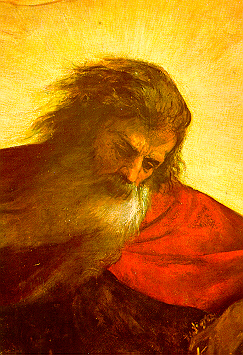
3) the top section of the golden sky of heaven with God the Father accompanied by angels and seraphim:

Once the artist has set up these three zones he must find a way to connect them together and to imply the movement upward of the Virgin. He does this magnificently using the color red and arms and legs to visually elide the groups into one whole.


The apostle dressed in red at the bottom has his back to the viewer and reaches his arms up towards
the Virgin; this gesture allows the viewer to take his place as his/her own and it moves the viewer's
eye up towards the middle section, where Mary is also dressed in red; Mary's arms also repeat the
upward gesture toward God, so that the viewer follows the movement of the arms up towards God,
who also has red in his garment. Seen from afar, the red colors in each of the sections allow the eye to
to jump from lower section, closest to the viewer, on earth, to the heavenly realm, in a triangular vision of red. The artist also gives us faces to guide us from the lowest level to the highest:
The face of Thomas, the apostle who was given the Virgin's girdle (the green cloth he holds onto) at
her Assumption, looks up at the figure of Mary, which makes the viewer look upwards, too. He, too, is dressed in red.

Then, Mary looks up toward the old man face of God, so the viewer follows her turned-up face as well.


The red color at the bottom is ample and lush and gradually diminishes towards the top, where it is
swallowed up by the golden glow of heaven.

In my opinion it is likely that Raphael was influenced by Titian's arrangement of earthly and heavenly zones in his great masterpiece in the Vatican Museum, the Transfiguration. Painted between 1516 and 1520, this painting exhibits a lower earthly area where the apostles are gathered to witness the curing of a boy possessed by demons and in the heavenly realm Christ is visited by Elijah and Moses.


The middle zone in this painting is occupied by the three disciples who saw Christ in this vision:
John, James, and Peter. Raphael uses the same arm gestures as Titian to convey movement upward,
but his reds do not accelerate the movement for the viewer, as in Titian's altarpiece:


Both are paintings of visions, though. The Assumption story, meant to eliminate the possibility of death for Mary, is not recounted in the Gospels, but rather comes from the later stories about the Virgin in the legends about saints written down by Jacopo della Voragine in 1289 called The Golden Legend. There he describes the rising of Mary into heaven after she falls asleep (the Dormition of the Virgin.) "And anon the soul came again to the body of Mary, and issued gloriously out of the tomb, and thus was received in the heavenly chamber, and a great company of angels with her."(James Hall, p. 34, Dictionary of Subjects and Symbols in Art, New York, Harper and Row, 1979.)
          In Titian's version her soul issues gloriously out of the tomb, and is received in heaven with a great company of angels. The transition from earthly life to afterlife for Mary is presented as a gentle
trip on a cloud up into the sky, and the cloud is held up by angels. All of the journey is weightless as
the heaviness of the body is let go and the soul is transported to God. The use of "gloriously" in the
Voragine description reminds us that the name of the church for which this is the main altar is
Santa Maria GLORIOSA dei Frari. Her trip to glory in glory is given cinematic display by Titian,
and every visitor to the church, even now, is caught up in the drama of the event because of his
glorious rendition of it. The viewer is entranced by the color, gold leaf, and movement upward of the sacred figure. In its presence we become like the apostle in front, reaching up to touch the ideal of the sacred.


Titian understood the need for perfect saints for humans to aspire to be. That the apostle doesn't
quite touch the cloud or the heavenly figures is what Browning is suggesting when he has Andrea del Sarto say: "a man's reach should exceed his grasp or what's a heaven for?" But Browning was not thinking of a painting by Andrea del Sarto in that poem. He had surely visited the Frari and stood in front of this altarpiece in wonder.