Monday, April 17, 2017

THE IDEAL CITY, ALMOST

THE IDEAL CITY, ALMOST


These three painted panels from the Italian Renaissance display architectural views of three different city scenes. They are approximately the same size, Height 131 cm (51.6 in). Width: 233 cm (91.7 in), and they are all three painted with oil on panel. Since the one at the bottom was originally left in the Monastery of Santa Chiara in Urbino (now in the National Gallery of the Marche in Urbino), the other two, one in the Gemaldegalerie in Berlin (middle), and one in the Walters Art Gallery in Baltimore, Maryland (top) have also been thought to have come from the city of Urbino originally.
          As with all paintings of this period, it is important to look carefully at the scenes to gather evidence before deciding on artist or date or function. All three of the scenes are constructed with the use of one-point perspective, the Renaissance discovery that if you draw all the diagonal lines in a painting to one point, you give the impression of real space. In the Baltimore panel the diagonal lines come together in the middle of the central arch opening.

 In the Berlin panel the "vanishing point" is on the water between the ships.
In the Urbino panel, the diagonal lines all meet at a point in the middle of the doorway of the central building, and the space of the piazza with the two fountains appears to be believable human space. The Baltimore panel is the only one with human figures, but those human figures may have been painted on at a later date, so they must be disregarded:  


What could be the purpose of these perspective scenes that are so perfect some have suggested they resemble stage sets? The scenes give us some clues. In the Baltimore panel, two of the buildings in the background of the piazza look like two actual buildings in Rome: a rounded-version of the elliptical Colosseum and a nearly identical version of the Arch of Constantine next to the Colosseum in Rome.
Painted version:
Actual Colosseum and Arch of Constantine:


Since the painted buildings look so much like the real ones, it is easy to imagine this panel is meant to represent Rome, with a suggestion of the walls of Rome behind the Arch of Constantine and the hills of Rome beyond that. And the four statues on the columns in the main piazza are worthy subjects for the capital city of the Papal States:  from left:
Justice with sword and scales, Temperance with wine and water measuring,
Abundance or Charity with cornucopia and child, and Fortitude with a column.
If this is meant to be Rome, though, what is the large building in the background on the right, the
octagonal structure with a cross on top?
Could this not be the largest church in Rome, an idealized St. Peter's with a centralized plan? One such plan for a new St. Peter's was envisioned later in the century by an Urbino architect, Bramante, in a drawing he made:
Since Old St. Peter's, begun in 333 A.D. by the Emperor Constantine, was, by the 15th century, dilapidated and crumbling as a complex, even as early as 1450 ideas for renovating that building were circulating among artists.  While the Constantinian basilica had been in the shape of a cross, the idea for a new St. Peter's always included turning the building into a central-cross plan church, where the arms of the transept and the body of the nave would be the same length and more perfect in form. The actual tearing down of the old structure and initial renovation began only in 1503 under Julius II. Could the painter here be imagining his own version of St. Peter's along with his version of the Colosseum and Arch of Constantine? If, as a painter, you are tasked with painting a scene of Rome, what better way to present it than with two very recognizable buildings from the ancient city and with an updated major Christian church design for the seat of the papacy? Three major sites that identify the place as Rome are the buildings in the piazza of the Baltimore panel.
           If the Baltimore panel is a scene of ROME, what cities are the other two panels meant to represent?
            VENICE and FLORENCE.
The panel in Berlin is a scene of a port city. In the distance beyond the piazza are painted several large ships on water, and the perspective lines lead directly to the water, as if the piazza were a walkway out to the sea.
VENICE in the 15th century had a such a walkway in such a piazza, as it does now, leading from the central Basilica to the Grand Canal, with the ducal palace on the left and the major library on the right. The columns of the arcade in the foreground of the Berlin view are reminiscent of the two columns which stood in Venice at the edge of the Bacino, the bay's alignment with the port water. The columns marked the site of executions in the 15th century; in the painting they have been doubled and removed from the water's edge as if to mollify their function. If you imagine standing on the far side of the piazza near the Basilica of Saint Mark, the view toward the water is still similar to that in the Berlin panel:
 

Whoever painted the Berlin panel, however, may have never seen the real Venice, and imagined Venice as a port with a fortress for a palace, like the port of Pesaro, which the artist probably had seen. But this cityscape is not Pesaro; it resembles more the piazza walkway that still exists in Venice.


 Pesaro fortress near the sea:

The URBINO panel is a simple remembering of the center of FLORENCE. The main ecclesiastical building is meant to look like the Florentine Baptistery, and the church facade behind it is a simplified version of the Cathedral in the same piazza in reality. When the perspective of the panel makes the Baptistery loom very large in relation to the Cathedral, one only has to look at the actual
Baptistery and Cathedral together from this angle, a ground view, to see that the Baptistery does look large and the Cathedral smaller in the central piazza of Florence:


The painter has made the octagonal Florentine Baptistery into a rounded building, understandable since from below it almost seems like a round building, with the rounded Romanesque arches accentuating that notion. The two-tiered elevation in the painted Baptistery is remembering the divisions in the original and the sloping roof is much the same in both. The church behind the Baptistery in the painting has just about the same area of its facade showing as it does in the real view of the Florentine Cathedral from this end of the Baptistery and the painted church is simpler than the Cathedral today because the 15th-century Florentine Cathedral facade would have been simpler as it was unfinished.
The buildings on either side of the Baptistery in the painted version lead back towards the church, as they do in reality.


            Three remembered views of the most prominent features of three major cities in 15th-century Italy. But why these three?  ROME, VENICE, FLORENCE.

             In reading a very good new biography of Battista Sforza Montefeltro by Marinella Mazzanti (2009, Urbino, Quattroventi) I came across a text from 1464 that explains it all. (The author of the biography was interested only in how the text described Battista's wedding and did not realize the connection to the panels.)   In a long poem written for Federico da Montefeltro, Duke of Urbino, by the court poet, Ser Gaugello de la Pergola, in 1464, in honor of the occasion of Federico's marriage to Battista Sforza in 1460, the poet says that wedding gifts were sent to the new couple, wedding gifts  "DA ROMA da VINEGIA (Venice) e da FIORENCA (Florence)" (from ROME, from VENICE, and from FLORENCE.)  Here is his description of the wedding celebration:
            "Non dico el peso e l'apparato grande/ De cera,de confecti et la credenca carcha d'argenti per diverse bande...da Roma da Vinegia e da Fiorenca/ Ve forno cose apresentate/ Et da signori grande eccellenca/ monete argenti con molti fiorini/ portaron tucti a donare a la sposa/ con tucti li Urbinati cittadini."
             Trans. - "I can't tell you the weight and the huge display/ of candles, almonds, and the dressers filled with silver for different groups, from Rome from Venice and from Florence there were such things represented and from excellent nobles/ silver money with many golden Fiorini (Florentine coins)/ everyone brought to give to the bride/ with all the citizens of Urbino."(p.67)
            Those same three cities! Not Naples, not Milano, which you might expect since the bride was the niece of the Duke of Milan.  The wedding presents came from Rome, from Venice, and from Florence.  And how to display the presents and acknowledge those specific city courts as having contributed these gifts?  Were these three city scene panels painted for the wedding of Battista and Federico to keep the gifts separated and not mixed up? So that gifts from Rome could be displayed under a painted view of Rome, those from Venice under the view of Venice, and those from Florence under the view of Florence? If so, it would explain why it was not important to include in the scenes more than a couple of buildings by which the city could be identified. Perhaps these panels were painted also so that the bride could remember to thank the appropriate court for the gifts sent on the occasion? With so many gifts, it would be crucial to organize them. The visual clues given in the painted panels would serve to distinguish which gifts came from which city-state when the gifts were displayed below them.
        It is also possible that these panels were actually part of a piece of furniture like a cassone, (a 15th-century wedding chest for trousseau gifts,) a decoration to denote where the pieces inside the chest came from.
Here is a cassone from the period:

If the panels were painted for this reason, it would explain why they are the same sizes, why they look so staged, and why they are simplified versions of the cities they represent.  The delineation of the location of origin of wedding gifts from three of the most important courts in Italy would explain why these panels were painted once and never again. It would explain why the bare minimum of visual specifics are given, and it would explain why the piazzas in the paintings are empty; if the panels were shoulder height and attached to spallieri (large benches with backs as here below,)

the gifts would have been displayed on the bench below them, gifts from Rome put under the image of Rome. If they were actually large cassone panels, the gifts from Rome would have been inserted into the chest space behind the painted image of Rome. You can hear the girls assisting the bride, "Oh, is that one from Venice? Here, it can be put into the Venice chest." Or, "Are those Fiorini from Florence? Put them beneath the picture of Florence there."
           Either as a way for the bride to remember where which gifts came from, which important family should be written to in thanks, so as not to mix them up with other gifts, or as a way to look over the gifts during their display for the long wedding celebrations (10 days) to see which gifts came from which relatives, the panels served a distinctive function.
Here is a Renaissance wedding scene in which the gifts are displayed on dressers on right and on the floor on the left:

The panels would have been a pretty fancy way to organize wedding gifts for display, but when wedding festivities lasted that long, and the gifts were gold and silver objects that were meant to be shown off, it is understandable that the Duke and his new bride would have asked their closest artist to produce a suitably aesthetic presentation for that display, whether outside of a chest or above it. One can imagine these panels lending a beauty to the gifts from each artistic center, whether they stood above the chest or on it:


We have established a possible date, 1460, for these panels, and a possible function. Though the function seems perhaps mundane, the panels had their own artistic merit to warrant preserving them long after the furniture was destroyed. They would be saved as wedding memories, too. What artist could have produced these in 1460 for the Duke of Urbino and his new wife?
          PIERO DELLA FRANCESCA is the only artist in the Duke's employ who combines the qualities that are necessary for the attribution of these panels:
 1) knowledge of one-point perspective. Piero wrote a treatise on perspective, De Prospectiva pingendi, explaining how to use one-point perspective in painting. His knowledge of math would have enabled him to create city scenes to small scale.

 2) ability to convey beautiful light; Piero's light is one of the captivating elements in all of his paintings.


 Annunciation, 1460                                                  Baltimore panel, 1460

 3) ability to paint statues on top of columns:  Piero shows he could do that in his painting of the
Flagellation from around the same date:
In the left scene of the Flagellation of Christ, Christ is tied to a column on which stands a statue of Apollo, the sun god; the arrangement of the column and statue is similar to that of the statues in the Baltimore panel:


4) observation of urban buildings, the shutters in windows, the prongs set outside of windows for the hanging of laundry on long rods (see the third building in from the right in the Urbino panel):


5) and Piero had been to ROME and FLORENCE but not to VENICE - perfect for the painter of these panels; his vision of Venice must have been based on what Domenico Veneziano had told him about his native city and would explain why the discrepancies with the real place are greatest in that panel.
          Three beautiful panels of ideal cities, but they are not ideal, they are meant to be real representations of real cities without people or too many specifics because they were meant to just stand for the PARTICULAR CITY - so not IDEAL, but ALMOST.
          Da ROMA, VINEGIA, e FIORENCA.
          If these wedding display panels were used perhaps for storage afterwards as well, it would explain why they are a bit like a stage set. Once the chests and gifts and guests have left, the beautiful reminders of the best parts of three cities remain. How ironic that these panels have ended up in three separate cities, and none in the cities they represent!
                                                            ROMA - is in BALTIMORE

                                                         VINEGIA is in BERLIN
                                  
                                                             FIORENCA is in URBINO

These three panels are all signs of the status of Urbino as a city center. If three of the most important city-states paid homage to the Duke of Urbino for his wedding day, how grand a place Urbino must be! At least one cityscape stayed in URBINO and gave us a hint as to the reason for the existence of all three of the panels. None of them are IDEAL CITIES, then, just enough icons to tell us which CITY they are meant to be, and just enough recognizable buildings in them to tell us who is paying tribute to the power of URBINO. Like scarves with the Eiffel Tower, we know which gifts were sent from Paris. The panels do not represent REAL cities, either, just stand-ins to identify them as that city without using words.
But the city-state that preserved these panels was aware of what these city views really said about the city-state that owned them, URBINO itself. Three cities came to the wedding of one.

Saturday, March 18, 2017

San Bernardino degli Zoccolanti

San Bernardino degli Zoccolanti

 
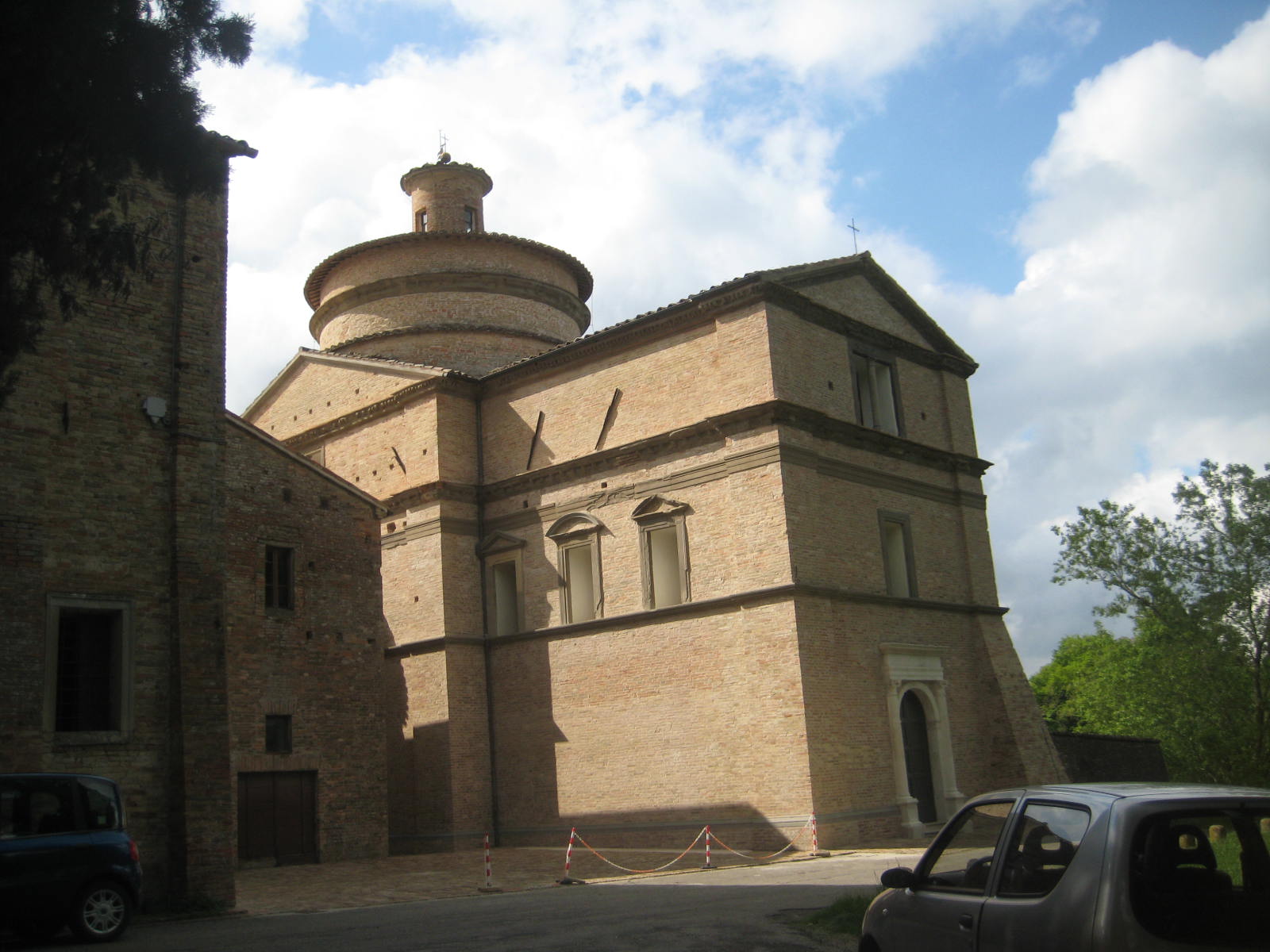
Nestled on the hill of S. Donato just outside Urbino, the church complex of San Bernardino degli Zoccolanti (Saint Bernardino of the sandal-wearers) seems to be a monastic village. As the visitor approaches, the individual church emerges on the far right as it stands out in pink brick.

From the front door of the church the town of Urbino can be seen on the neighboring hill through the trees. Not only the town is visible, but specifically the ex-convent of Santa Chiara.

We are reminded that Italian culture of the 15th century still relied upon the beliefs of the Etruscans that when people died in the city on one hill, they went to live in the city of the dead on another nearby hill. San Bernardino provides the cemetery, the city for the dead, for the town of Urbino. But
not everyone was buried outside of town. When Battista Sforza, the wife of the Duke of Urbino, dies
in 1472, her body is carried from Gubbio to Urbino, and following her wishes, is interred in the convent of Santa Chiara in Urbino.
The convent is now deconsacrated and has become an Institute for Artistic Industries, but the site still houses the tomb of Battista, and as we've said, the buildings of the ex-convent are visible from the doorway of the church of San Bernardino degli Zoccolanti.

Since the church of San Bernardino is where the Duke of Urbino, Federico is buried, and since he had the church built specifically for that purpose, the placement of the church directly across the hill from where his wife is buried is a reenactment of the couple's facing each other in Piero della Francesca's double portrait of the Duke and his wife. As this funerary chapel is begun the year that Battista dies, the location of his burial is poignantly apt. He could not be buried next to her in a convent that housed the bodies of women, but he chooses to be buried on the opposite hill as if to look at her in perpetuity as he does in the double portrait. The dome of the San Bernardino church even looks a little like the hat he wears in the portrait.


           Now let us examine the architecture of the church of San Bernardino degli Zoccolanti.
          The splaying out of the bricks to form a wider base for support of the church, as we see in the photo on the left, is similar to the same treatment of the lower sections of the Palazzo Ducale in Urbino designed by Francesco di Giorgio from 1472-80, seen on the right. The widening of the structure at the bottom provides more bricks to hold up the weight of the entire building in both cases.
 

The articulation of the balconies in the Urbino Palazzo seen on the right, in white marble arches, is carried over in the church of San Bernardino in the white marble arch of the central entrance doorway, seen here on the left:
 
The round double-ringed silos which shape the dome in the church are just like Francesco di Giorgio's double-silo corners for the fortresses built to his specifications, in this case on the right below, the Fortezza di Sassocorvaro:

Even the bell tower of the church originally had a spire that would have made it look more like the turreted towers of the Palazzo Ducale in Urbino:

No surprise, then, that the church of San Bernardino degli Zoccolanti, the main church structure in this complex, is attributed to Francesco di Giorgio Martini, the Duke of Urbino's main architect, and given the dates 1472-91. 
And no surprise either that the church itself is built as a funerary chapel for the deceased in Federico da Montefeltro's family. The mausoleum underneath the nave of the church still houses the remains of Federico and his son, Guidobaldo, as well as descendants from the family.
A marble plaque on the floor indicates the location under the floor for the body of the duke and his
son and daughter-in-law, Elizabetta Gonzaga.
Federico is considered the second Duke and Guidobaldo the third, and you can see from the
floor inscription that one child named Federico, who died infancy, is also buried here. Nowhere do you see the name MONTEFELTRO, though, and more on that later.
While the tomb monuments to Federico and Guidobaldo on the side walls in the nave of the church are much later (1620) than the construction of the church,


the interior of this Renaissance chapel is a simple, light-filled space in the shape of a Latin cross.


Curious to imagine, then, that for 138 years, from 1482 to 1620, Duke Federico's embalmed body lay in a coffin on the wall to the right of the central altar and was visible to visitors! (It was moved and interred below in 1620.) (For an account of the most recent exhumation that took place in 2000, look online for Antonio Fornaciari, in Archeologia Postmedievale 4:  211-218, 2000.)
 
How would the Duke have looked in his box on the wall? He was dressed with his characteristic red hat and robe, as in the Uffizi portrait by Piero della Francesca,

and had a sword at his side, according to a 1603 description in Italian by Bernardino Baldi. Baldi says he looked a bit wooden but otherwise lifelike, perhaps like this computer-realized image of recent years except with hat and cloak and sword; the scar from the jousting event that cost him his right eye would have been clearly visible, too, as it is here:
The church interior also originally had an altarpiece painted specifically for this location and for Duke Federico by Piero della Francesca. The altarpiece, dated 1472-74, is now called the Brera Altarpiece and can be found in the Brera Gallery in Milan.
But it was meant to stay inside this church and had a meaning connected to the place. How wonderful it would be to see it in situ, where the light painted as falling from the left and above on the figures and on the shell over the figures would correspond with the actual light of the chapel.
 
What becomes clear, as we imagine the Duke lying in state after his death in 1482 next to the Piero
altar painting in this church, is the extent of the Duke's longing for visual affirmations of his legitimacy as Duke of Urbino. 
         In the altarpiece, as we have pointed out in another blog entry, the Duke is presented as kneeling in full armor in front of the Virgin, with the red and gold cloak given to him when he became the official  Duke of Urbino in 1474:

He prays to the Virgin in this position, but he also prays to his own child, nearing age 2, who seems to be painted as a sprawled-out baby Jesus on the lap of his deceased wife, Battista, whose portrait can be seen in the Virgin's face. And much has been made of the white ostrich egg hanging above the head of the Virgin and Child in the shell-shaped painted apse in Piero's altarpiece:

We can understand the placement of this egg after having seen the two studioli constructed for Federico in Urbino and Gubbio. In the Gubbio intarsia there appears the figure of a large ostrich
eating a large nail:
with the inscription: IHC ANCOR DAIT EN GROSSO  (I can devour large metal). The ostrich is
taken as Federico's symbol because, as a mercenary soldier, he, like the bird, can devour large armies dressed in metal. If Federico is the large ostrich, then his heir, Guidobaldo, is still an ostrich egg, the next in line to become the large ostrich. The potential ostrich, heir to the dukedom, hangs with all its vulnerablity as a fragile egg above the child asleep in front of his father. The hopes of Federico for his dukedom to continue for eternity through the descendants of Guidobaldo hang in the balance over the Madonna to whom he prays. He kneels in gratitude that his wife was able to give him a male heir before she died. But he also kneels in expectation that the line of the ostrich (visualized as an actual line, string) will be protected by the saints gathered around the Virgin. And Federico had reason to worry. Guidobaldo never produced a male heir to continue Federico's ducal line.

The saints are: left to right:
John Baptist, San Bernardino, St. Jerome, 4 angels, St. Francis, St. Peter Martyr, John the Evangelist

John the Baptist is there because he is the absent wife's saint (Battista.) He points to the Christ Child
because he was Jesus' predecessor, but in this particular case, he points to the child because Battista
gave Federico the male child to carry his line. St. Francis is there because the church is Franciscan.
But what about the other saints?

One oddity in this painting only adds to the secular quality of this votive offering; the name saint of the church is shunted to the back behind John the Baptist and St. Jerome. St. Bernardino of Siena,
a preacher friar whose sainthood had only recently been approved by the church in 1450, (he had died in 1444), is given a back seat in the sacred conversation group standing around the Virgin. He was called Bernardino of the sandal-wearers (zoccolanti) because he travelled all over Italy giving sermons, so his well-worn sandals were imitated by his followers. Since the church is encircled on the interior with an inscription describing St. Bernardino, it is strange that he is relegated to this place in the altarpiece, while St. Francis and John the Baptist are given much more prominent slots. He looks down in thought and with modest piety.
         
It is as though Federico wishes to hide San Bernardino, even though the church is dedicated to him.
What is the Latin inscription about Bernardino and addressed to him that begins over the altar and continues around the crossing and into the nave of the church, encircling the whole?

O SPLENDOR PUDICITIAE ZELATOR PAUPERTATIS AMATOR INNOCENTIAE CULTOR VIRGINITATIS LUSTRATOR SAPIENTIAE PROTECTOR VERITATIS ANTE THRONUM FULGIDUM AETERNAE MAIESTATIS PARA NOBIS ADITU[m] DIVINAE PIETATIS IMPLORA NOB[is] GRA[tia]M B[eate] BER[nardine]".

ENGLISH TRANSLATION:
Oh, splendor of modesty, zealous promoter of the poor, lover of innocence, cultivator of chastity, displayer of wisdom, protector of truth, send the eternal lightning strike to us before the throne of majesty. We implore you to pray for us, send us divine piety, we pray blessed (Beato) Bernardino.

No prayer to the Virgin painted on the altar in this inscription, no prayer to God, a prayer to the divinity of the specific site, a prayer not even to a saint. The inscription is addressed to the Beato Bernardino, as though he hadn't yet been made a saint (since the title of Beato for beatification was one step before sanctification, the act that meant being given the title of Saint.) Latin inscriptions can be found in other buildings ordered by Federico, so this one seems of his own construction as well. The desire for divine piety in the inscription prayer suggests that Federico's life has been devoted to things other than piety: to the armies that brought him wealth, to the books that brought him wisdom, to the ambition to secure a legitimate place in the world. He is finally a duke in 1474, finally has a legitimate heir in 1472. He prays in Piero's painting to a Madonna who looks like his second wife, the woman who gave him the legitimate heir. By the time he dies in 1482, his heir is still alive and is ten years old; even though the painting was meant for the church, it was painted long before it was placed on the altar.
       But Federico knows he can never force the blood line of family so that he would feel that he and his descendants belong to the title of Duke of Urbino. The anxiety about illegitimacy can only be shored up so much, only assuaged, never eliminated. But what better way to expiate the sin of illegitimacy than through the building of a large funerary chapel.

He chooses to dedicate this church to a person he secretly knows, perhaps had only recently discovered, had had his best interests all along, HIS REAL FATHER, BERNARDINO della CARDA, a condottiere who made sure his first-born son had the best chance at life and career and advantage by allowing him to become adopted by Bernardino's father-in-law, the Duke Guidantonio of Urbino.
The naming of this church for Bernardino, his real father, puts to rest the notion that Federico was born in Petroia to his adopted father, Guidantonio, and a local maid, Elizabetta degli Accomandugi.
He acknowledges his real father here in constructing a large chapel for family burials and by naming
it San Bernardino. The Latin inscription is a way of paying homage to his real father, by praising all the virtues Bernardino had secretly exhibited over the course of Federico's life. He has Piero della Francesca hide the figure of St. Bernardino in the painting because if he acknowledges the truth about his origins, his title of Duke of Urbino will be called into question. The Latin inscription is also a secret way of announcing he knows who his real father is, without Federico having to renounce his Dukedom. Beato Bernardino, blessed Bernardino, is thanked in this inscription for giving up his first-born son in order to promote his well-being in his adoption by the previous Duke of Urbino. The first words of the inscription stand out over the altar in this church:
O SPLENDOR of MODESTY, but what do you notice before the O, just to the left moving around the corner towards the O, four letters, BE Re, which can be read as the beginning three letters of BER NARDINO, the name of Federico's REAL FATHER.
In this left corner of the church the end of the Latin inscription meets the beginning of it, and in so doing, connects the name of Federico's real father to the wonderful praise that follows along the altar
wall. Even here his name is hidden, in a sense, because abbreviated.
         Federico lives ten years after Battista, forty-five years after the death of Bernardino, his real
father. Yet even after thirty-five years he acknowledges his debt of gratitude to the man who gave him up so that Federico could become the Duke of Urbino. By having his own embalmed body placed directly underneath this inscription, Federico hoped to be reunited with his original father in the beautiful church he had designed by Francesco di Giorgio Martini on the hill across from his wife.       
Federico's body has been moved, the trees obscure his wife's grave now, but the Latin inscription remains as testament to his original devotion in San Bernardino degli Zoccolanti. O SPLENDOR!