ITALY for first-time visitors
ITALY IS AN AESTHETIC CULTURE, not an efficiency culture as ours is. What difference does that make, you will ask?
1) DRESS and COLOR: It means Italians are not interested in whether something works fast and well, as we are; they are interested in whether something is beautiful. The reason for living for an Italian is to make life beautiful. Consequently, Italians value the way people are dressed in public much more highly than we do; their expression “fare la bella figura” (to make the beautiful figure) is used to describe the way one presents oneself on the street, and sloppiness or casual dress is frowned upon. Americans should be aware that they can even offend Italians if they wear bright colors and tennis shoes in town or at tourist spots (darker colors are thought to be more serious, as life is, and tennis shoes are considered appropriate only on the tennis court.) Decorum is especially important in churches: you can be kept out of Italian churches if you wear sleeveless blouses or short skirts; shoulders and knees must be covered.
What seems to us a superficial concern, appearance, is how they make their living. It is also why people flock to Italy to be nourished by the beauty created there. Italian design imbues all aspects of life: the way shop windows are set up, the way meats and deli foods are displayed, the way people dress up to go out in public, the way the coffee bar man swirls the milk of the cappuccino. It can manifest itself even in the color clothing people wear: usually one color is “in” for the year and Italians usually know which it is and make sure that they conform to the wearing of that color; foreigners who are unaware of that will be easily spotted as foreigners. (*You can figure out the color by noting which color appears most often in the window displays; one year I remember it was black and every woman wore a black dress on the street; one year it was purple, another beige.)
WORKING HOURS and the– PASSEGGIATA – An aesthetic culture means that shops are not always open during the hours posted; it’s more important for the shop owner to be out making the “bella figura” than to honor the hours on the sign. It also means that if you expect to look quickly through a shop for ten minutes, the shop owner will want to show you the best wares and those should be appreciated for their aesthetic value, which takes time, not possible in an efficiency browse.
You should expect that if you ask for a gift to be wrapped in a shop, even just to take out into the street, that time and attention will be required to admire the aesthetic way in which the gift is tidily packaged by the salesperson. Even if you buy wrapping paper, it will be wrapped for carrying in public! The shop owner will not understand if you are anxious to get away; s/he is not concerned with efficiency but with whether his/her or your own sense of the aesthetic life has been satisfied; that’s why Italians are always late to appointments; it’s more important to be seen in full dress for as long as it takes to be appreciated than it is to be on time somewhere. If you want to see Italians displaying their aesthetics, take a walk around 4 in the afternoon when they are out for their “passeggiata.” (the family stroll through town.) You will see people dressed up, laughing and talking as they walk slowly just enjoying the relaxing time between the siesta(2-3) and when they go back to work (4-7), (Italian time 5-8) . So the period 4-6 each day regarded as wasted in American Puritanical eyes is essential for the beauty of life for an Italian.
Even going to the post office or the bank can take hours because the point is not to get through quickly with stamps and packages mailed; the point is to watch the aesthetic way in which the teller counts out the money or the pleasing way in which the post office man pounds his dating stamp or lays out the beautiful stamps on the counter. If you go in expecting efficiency, you will only be frustrated. (Hours of operation are usually 8-12 and 4-7, but some museums and offices are only open 8-12.)
2) PUBLIC vs. PRIVATE LIFE - You should never carry anything, groceries, shoes for repair, cleaning, anything, in the street without putting it/them into a bag. Things need covering in public because an Italian never wants to offend the eyes of the other people in the street, or to be offended himself. So you will rarely see an Italian eating as they are walking out in public; even gelato usually gets eaten indoors. The chance that someone might be publicly offended by unwrapped shoes, unwrapped food, or even unwrapped gift-wrap is a sensitivity developed over many years in their aesthetic culture. They regard life as an aesthetic endeavor and if they err in the carrying out of that premise, they think it almost as immoral as we might a social crime. Many of our students used to get vicious looks for eating hamburgers on the run, an act of betrayal.
Consequently, the experience of Italy can be enhanced if you go into the society without American expectations and just enjoy the aesthetic experiences as they roll by you: the shoes and belts of the passersby, the display windows of shops (especially in Florence), the proper way a waiter serves the “fish soup”, “zuppa di pesce” or pasta, the way people have planted window boxes whose flowers cascade down the walls, the various greens in the scenery: silver-green of olive tree leaves, the dark green of the cypresses, the yellow-green of the vineyard leaves, the beautifully made leather and silver and mosaic inlays, not to mention all the artwork in the shops and museums and the food presented at table.
In Rome have a granita di caffe near the Pantheon at the Tazza d’Oro; in Florence have a pastry and caffe macchiato at the bar Gilli in piazza della Repubblica, a hot chocolate at Rivoire’s in Piazza Signoria, in Venice have a “zuppa di pesce” at the Taverna di San Trovaso near the Accademia Museum; have a Bellini drink at the Caffe Florian in Piazza San Marco. Take in the art of beauty that Italians know how to create. “Beauty is nourishment,” I always told my students. No better place to get nourished than Italy.
3 CITIES:
ROME: Walking in Rome, except around the Pantheon, is like trying to walk in L.A.-excruciating because the place is huge; take an American Express tour bus ride for major sights; otherwise take a cab. Public buses and the metro are rife with gypsies and pickpockets.
ART: Must-sees: – SISTINE CEILING and St. Peter’s
FORUM and COLOSSEUM
PANTHEON
From Pantheon walk to the nearby church of San Luigi dei Francesi (for Caravaggio’s paintings of the life of St. Matthew) and then on to Piazza Navona; or at night, walk from the Pantheon to the Trevi Fountain or Spanish Steps. If you want ancient art, walk from Pantheon to Capitoline museums housing bronze equestrian statue of Marcus Aurelius and Boy Pulling Thorn out of his foot (Spinario). Otherwise take a bus tour.
If you have time: Galleria Borghese(tickets ahead) for Bernini’s statues of 1)David and 2) Apollo and Daphne (check out Daphne’s feet turning into tree roots).
For Baroque architecture a must-see is San Carlo alle Quattro Fontane by Borromini. Take a cab- Borghese and San Carlo both too far to walk. Or see Bernini’s Ecstasy of Saint Theresa in Santa Maria della Vittoria, also by cab.
FOOD:
Good pizza on Via Arenula (no sign, two blocks or so from river on left)
Good restaurants in the Campo dei Fiori
Good restaurant for the Roman specialty of Carciofi alla Giudea (Judean artichokes) – OTTAVIA
Good restaurant in the Trastevere area: DA MEO PATACCA (singing waiters and shows and outdoor tables)
Good outdoor restaurant called VECCHIA ROMA in Piazza Campitelli (between the Capitoline Hill and the river)
Good restaurant near Piazza Navona: DA EUSTACHIO
3 Scalini in Piazza Navona has great chocolate truffle ice cream
Tazza d’oro near Pantheon for granita di caffe
FLORENCE:
ART: 4 must-sees: MICHELANGELO’S REAL DAVID in the Accademia Museum
(book tickets online ahead of time)
BOTTICELLI’S PRIMAVERA and BIRTH OF VENUS (both in the same room in the Uffizi Galleria (Uffizi museum), also best visited with tickets ordered ahead)
View from PIAZZALE MICHELANGELO-10-minute cab-best view of city and river.
If you have time: Baptistery interior, Duomo (interior – see the wood inlay sacristy behind altar on left or climb to top of dome for the view – c.463 steps)
Opera del Duomo (museum behind Duomo that holds one of Michelangelo’s Pietas (he did 4) and the bronze doors of the Baptistery by Ghiberti)
Medici Chapel (behind San Lorenzo) for Michelangelo’s statues of Night and Day
Medici Palace Chapel for Gozzoli’s fresco of the Procession of the Magi
Museum of San Marco for Fra Angelico’s cell paintings
Museum of Chiesa del Carmine for Masaccio's frescoes
FOOD: Breakfast – Caffe Patrizio Cosi, Borgo degli Albizi– 7 a.m. onward
Lunch – 1:00 – (more like a dinner – can be 3 courses) – BORDINO’s over the river and up the hill left one block beyond Ponte Vecchio
Dinner – 7 or 8 – AQUA AL DUE – Tastes of 5 different pastas for first course – you might not want a second course; Il LATINI, Via dei Palchetti, 6r(red)-Tuscan food and lots of it.
FANCY RESTAURANTS in FLORENCE: ENOTECA PINCHIORRI, Via Ghibellina, 87
or OTTORINO, Via della Oche, 12
VENICE:
ART: 2 must-sees – EXTERIOR AND INTERIOR OF SAN MARCO exterior and interior of San Marco church – Mosaics line façade and interior walls. Visit the Pala d’Oro (10th century to 1342) behind the main altar – extra payment but worth it –thousands of jewels. Climb stairs in narthex to see the Hellenistic gilded bronze HORSES that originally stood where the copies stand now on the façade; façade walk there has good views.
If there’s time: Church of San Zaccaria – way behind San Marco – second altarpiece on left of nave – by Giovanni Bellini (1505) – a contemplative masterpiece with St. Peter,with keys, St. Catherine with her wheel, the Madonna and Child with lute player, St. Lucy with a palm frond, symbol of martyrdom, and San Zaccaria (the father of John the Baptist, Saint Zaccharias, who is buried across from the painting.)
Palazzo Ducale with the Bridge of Sighs and prisons from which Casanova escaped
Accademia Galleria – paintings by Titian, Tintoretto, Veronese, Carpaccio (15 minute walk from San Marco-follow signs)
Church of the Frari masterpieces by Donatello, Bellini, and Titian.
Palladio's church of San Giorgio Maggiore (visible from Palazzo Ducale, must take boat ride across canal).
FOOD: DA RAFFAELE - on canal – take a gondola ride afterwards and pay for an accordion player and singer to accompany) La Madonna (for seafood risotto) Fenice (elegant -near the famous theater) And, of course, Taverna di San Trovaso, near Accademia Gallery, for the fish soup “zuppa di pesci”(might not be served in summer)
ISLAND: Murano to see glass-blowing factory; good outdoor restaurant in main piazza;
fabulous Giovanni Bellini painting in the church of San Pietro Martire there, but church rarely open
Be careful not to get Stendahl’s disease - presents as dizziness from seeing too much art – hospital cases reported every year in Italy, seriously!
QUICK ITALIAN PRONUNCIATION COURSE:
No word “to spell” in Italian because once you know the rules you can pronounce any Italian word :
All VOWELS are PRONOUNCED (no silent vowels as in English and French)
USUALLY the ACCENT is on the PENULTIMATE SYLLABLE
C or G followed by I or E is soft –
C or G followed by A,O, or U is hard –
Carciofi (artichokes) has first hard C hard as in CAR then a soft C as in CHOKE so “artichokes” is pronounced in Italian: Carciofi=CAR-CHO-FEE (Accent on the cho)
Godi (you enjoy) – Go-DEE, Giotto (Joh-toh)
CENTO DOLLARI (one hundred dollars) = CHAYNTO DOLL-AR-EE (accents on CHAYN and DOLL)
I is always pronounced EE
E is always pronounced long A as in the first letter of the alphabet, AY
A is always pronounced short A as in AH
Double consonants are always given emphasis – PIZZA - Peezzah
CHI or CHE is always a hard “K” sound,
Key or Kay respectively for these two words that mean “Who” or “What” in English., so the word for church, CHIESA, is pronounced “Key-AY-ZAH” with accent on the AY, but cathedral, CATTEDRALE, is pronounced CAH-TAY-DRAH-LAY (accent on the drah).
Phrases you will use most:
PER FAVORE (Please) ; PEAR– FA-VOR-AY (Accent on vor)
GRAZIE (Thank you): GRAH/ZEE-AY accent irregular- on GRAH
PREGO (You’re Welcome or to urge someone to go ahead of you in line)PRAY-GO (accent on PRAY)
SCUSI – (Excuse me) : Scoozee (accent on scoo)
QUANTO COSTA(how much does it cost?) – Quahnto – costah?
Every region in Italy has a different dialect; in Florence, for instance, they
aspirate every C to an H sound, so Coca Cola becomes “Hoha hola”, but leave regionalisms for your next trip. Italians are always happy if you try to say anything in their language.
Tuesday, July 2, 2013

Sunday, February 10, 2013
BELLINI's SAN ZACCARIA - is it JEROME or ZACHARIAS?
BELLINI'S SAN ZACCARIA - Jerome or Zacharias?
Up to now most scholars have described the altarpiece which Giovanni Bellini painted in 1505 for the convent church of San Zaccaria in Venice as an image of the Madonna and Child with saints Peter, Catherine, Lucy, and Jerome.
 St. Peter is easy to identify on the far left because he carries keys as well as a book. Catherine, too, holds the palm of martyrdom in her right hand and touches the wheel of her martyrdom with her left.
.jpg)
That leaves the far right male figure clad in a red mantle with white underlining, who looks down at an open book he is holding with both hands; the hands seem to have gloves on them and the undergarment sleeves are embroidered. The only identification for this figure that I have seen in print is Saint Jerome, but I don't believe it is Jerome.
It is understandable why St. Jerome first comes to mind when looking at this male saint. Jerome is depicted usually in three different ways in Renaissance images.
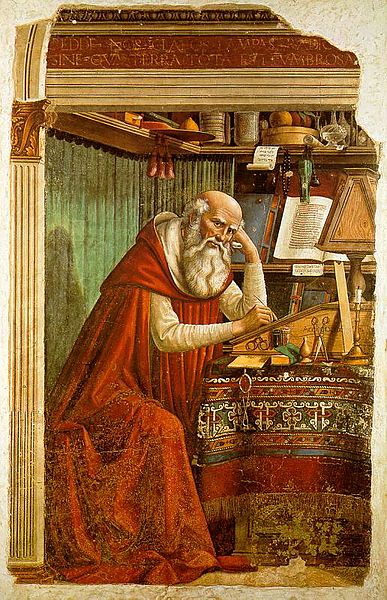
1. Jerome as Cardinal: Often he is dressed in a red cardinal's cape and his red cardinal hat is prominently displayed somewhere near him, as in this Ognissanti fresco in Florence of St. Jerome in his Study by Ghirlandaio of 1480, where the tassels of the hat dangle from the shelf above him:


Uffizi
S. Crisostomo, 1513 Ashmolean
But the red-clad saint in Bellini's San Zaccaria altarpiece has no red cardinal hat, no church model, is not dressed as an ascetic monk, and certainly has no lion. He is none of the usual types associated with Jerome. So is this Saint Jerome at all? And if not, then, who is he?

 The top of the facade of the church has a statue of John the Baptist, but the statue over the central doorway is a replica of a statue by Alessandro Vittoria of John's father, Saint Zacharias. (The original statue was damaged from being outside and is now being restored):
 So the church is dedicated to Zacharias on the outside; and inside, the decoration also pays attention to him. The first thing one encounters when entering the church is the baptismal font. The statue in the middle of that fountain is another statue of Zacharias of 1543 by Alessandro Vittoria (photo by Giovanni dall'Orto):


The Vittoria statues inside and out are later than Bellini's altarpiece, but they give us some idea of how Zacharias was conceived by Renaissance artists: here he is a New Testament prophet, priest of the temple, dressed in long flowing robes which are draped over his head, and in his left hand he holds a book, presumably anachronistically, the Bible, or perhaps, as we shall see later, the book in which he writes his son's name.
The next thing one notices in the nave of the church is the wall decoration on either side of the nave.The mural decoration for the nave was divided between the Virgin, whose stories are told on the left nave walls and Saint Zacharias and his son, John the Baptist, both of whose stories are told on the right walls of the nave.


In order to confirm that Bellini's red-clad saint is Zacharias, we need to look at colored images of Zacharias before Bellini's. Between 1485-90 Ghirlandaio paints the story of Zacharias in his fresco cycle about the life of John the Baptist for Giovanni Tornabuoni in Santa Maria Novella in Florence. The first image of the cycle is of Zacharias, in red robe with white underlining, being visited by the angel Gabriel at the temple altar:


Castagno's image has been forgotten over the centuries, but Bellini's still brings in the noisy crowds, and suddenly, before the beauty of Bellini's art, they are struck mute.

Up to now most scholars have described the altarpiece which Giovanni Bellini painted in 1505 for the convent church of San Zaccaria in Venice as an image of the Madonna and Child with saints Peter, Catherine, Lucy, and Jerome.


Lucy is occasionally mistaken in the descriptions for Mary Magdalene,
but the martyr's palm in her left hand rules out Mary Magdalene. And
although both Lucy and Magdalene often hold oil lamps, the oil in this
lamp has traces of the eyes which, according to legend, Lucy had gouged
out to demonstrate her devotion to virginity and the Virgin and to
dissuade her boyfriend who admired them. The Virgin later restored her
eyesight, so the nearly blond girl with eyes looking down at her
previous eyes, is Lucia, (light), St. Lucy.

.jpg)
That leaves the far right male figure clad in a red mantle with white underlining, who looks down at an open book he is holding with both hands; the hands seem to have gloves on them and the undergarment sleeves are embroidered. The only identification for this figure that I have seen in print is Saint Jerome, but I don't believe it is Jerome.
It is understandable why St. Jerome first comes to mind when looking at this male saint. Jerome is depicted usually in three different ways in Renaissance images.
1. Jerome as Cardinal: Often he is dressed in a red cardinal's cape and his red cardinal hat is prominently displayed somewhere near him, as in this Ognissanti fresco in Florence of St. Jerome in his Study by Ghirlandaio of 1480, where the tassels of the hat dangle from the shelf above him:

or this Antonello da Messina example in the London National Gallery (1460) where the cardinal hat lies on the bench behind him:


2. Jerome as Church Father: Sometimes Jerome is painted with cardinal hat on and holding a church model. He is a model for the church as he is considered a church father. Two examples of this type of Jerome in Venice are:
Vivarini's altarpiece of the 1440's for the Santa Sabina chapel in the same church where Bellini painted, San Zaccaria:


or Bellini's father, Iacopo Bellini's altarpiece of 1460-64 for the Carita in Venice where Jerome stands on left holding church.
3. Jerome as ascetic monk:The third type of Jerome is that of the ascetic monk living in the desert, sometimes with his lion:
Three examples of this type by Bellini himself, from the Uffizi, S. Crisostomo, Venice, and Ashmolean respectively: 


Uffizi
S. Crisostomo, 1513 Ashmolean
But the red-clad saint in Bellini's San Zaccaria altarpiece has no red cardinal hat, no church model, is not dressed as an ascetic monk, and certainly has no lion. He is none of the usual types associated with Jerome. So is this Saint Jerome at all? And if not, then, who is he?
To answer that question we must look at the setting for Bellini's 1505 altarpiece, the church of San Zaccaria. The name of the church is derived from the major relic contained within it, the
body of Zacharias, the father of John the Baptist.
Because of the holy relation of John and Jesus, Zacharias is made a saint in Venice, San Zaccaria in Italian. The nuns of the
convent received the body of St. Zacharias from the Byzantine Emperor
Leo V in the 9th century and the new Renaissance church (1490-1504) designed by Gambello and then
Mauro Codussi was built to house the relic.
The Vittoria statues inside and out are later than Bellini's altarpiece, but they give us some idea of how Zacharias was conceived by Renaissance artists: here he is a New Testament prophet, priest of the temple, dressed in long flowing robes which are draped over his head, and in his left hand he holds a book, presumably anachronistically, the Bible, or perhaps, as we shall see later, the book in which he writes his son's name.
The next thing one notices in the nave of the church is the wall decoration on either side of the nave.The mural decoration for the nave was divided between the Virgin, whose stories are told on the left nave walls and Saint Zacharias and his son, John the Baptist, both of whose stories are told on the right walls of the nave.
Then one becomes aware of two protrusions from the side walls of the nave, both in the second chapel; on the right, the tomb of Zacharias:

And just opposite it, Bellini's altarpiece, in the second chapel on the left:

Bellini would have known that his wall painting was meant to fit into the stories of the Virgin, hence his altarpiece was a sacra conversazione, a sacred conversation of the Virgin and Child with saints in the same space. But he must have also been conscious of the position of his altar with respect to the tomb of Zacharias, the name saint of the church itself. Since he includes Peter in deference to the patron, whose name was Peter (Pietro Cappello), why should he not place the name saint of the church in the place of honor closest to the main altar, the saint whose relic was housed just opposite, namely Saint Zacharias? And what better way to honor the name saint of the church buried just opposite than with a painted image of him facing his tomb?
What about Zacharias makes him appropriate to be placed within the sacred space of the Madonna and Child Enthroned? Zacharias' story is told in Luke 1, 5-25 and then gets expanded in the life of the Virgin in the Golden Legend. Zacharias is the father of John the Baptist and was himself assistant
priest in the temple. He is married to Elizabeth, Mary's cousin, and he
helps to officiate at the Presentation of the Virgin at the Temple.(See David Rosand on Titian's Presentation in the Temple of 1534.) He
also figures in the fresco cycles about his son's life because his son's
birth was considered a miracle. Zacharias and Elizabeth were both old
people and had wanted to have children but were barren. He offers incense in
the temple one day, whereupon an angel appears and tells him he
will have a child. As a sign of God's power in the birth, the angel says Zacharias will be struck mute for some time so that everyone will
understand that he has been visited by God and that the birth is miraculous. John is born and people
assume the baby will be called Zacharias after his father. Elizabeth says
that he will be called John and people question her decision and go to
ask Zacharias, who still can't talk. The moment he writes down his son's
name, John, he regains speech. God's intervention in his life is marked by his being struck mute.
And just opposite it, Bellini's altarpiece, in the second chapel on the left:

Bellini would have known that his wall painting was meant to fit into the stories of the Virgin, hence his altarpiece was a sacra conversazione, a sacred conversation of the Virgin and Child with saints in the same space. But he must have also been conscious of the position of his altar with respect to the tomb of Zacharias, the name saint of the church itself. Since he includes Peter in deference to the patron, whose name was Peter (Pietro Cappello), why should he not place the name saint of the church in the place of honor closest to the main altar, the saint whose relic was housed just opposite, namely Saint Zacharias? And what better way to honor the name saint of the church buried just opposite than with a painted image of him facing his tomb?
In order to confirm that Bellini's red-clad saint is Zacharias, we need to look at colored images of Zacharias before Bellini's. Between 1485-90 Ghirlandaio paints the story of Zacharias in his fresco cycle about the life of John the Baptist for Giovanni Tornabuoni in Santa Maria Novella in Florence. The first image of the cycle is of Zacharias, in red robe with white underlining, being visited by the angel Gabriel at the temple altar:

Ghirlandaio's
idea of Zacharias as priest includes an undergarment that is
embroidered and his mantle has a hood. Zacharias is a white-haired,
white-bearded man with white mustache. Zacharias is painted again in the same cycle when he decides to write down his son's name:
 Again he is a white-bearded old man with red cloak seated in the center of the group (his undergarment is green, the only difference from the image in Bellini):


In the Zaccaria altarpiece, the
male figure in red on the right faces frontally, has a long white beard
and wears a red cloak in much the same way he does in the earlier
Florentine fresco. Bellini has made nearly all of the figures in this
altarpiece look


down, not at each other, not at the Madonna and not at the viewer. The Madonna and Child look down as well.
Even the bas-relief of God the father over the throne does not look out, is silent as stone.

The only person who could be thought to be looking out is the musician who glances toward the entrance to the church. But the musician perhaps has stopped playing, is listening,
so the effect is an atmosphere of silence and contemplation. It is the silence that Bellini wishes to infuse in his painting to remind the viewer of God's stopping the voice of Zacharias, God's turning Zacharias mute. Zacharias looks down with mouth closed. He holds his book without speaking; he is mute. He contemplates the word of God in the book that is so precious he wears gloves so as not to defile it. The gloves muffle the sound of the hands on the book. God's will silenced Zacharias' life and the power of that silence is present in the world of this altarpiece. The sacred conversation here is a sacred place of no conversation. No sound and no movement. The four saints are caught in the silent power of God's plan in their lives. The figures force the viewer to stillness, too, in front of the altarpiece; they force the viewers to think silently about the mystery of God in their own lives. Behind Zacharias to the right are two trees, one barren and one in leaf, that echo in visual clues the change in Zacharias' body from one that was barren to one that conceived life.
The red-cloaked priest of the temple here is Zacharias, in the temple of San Zaccaria, where his body lies directly across from his painted image. Bellini understood that Zacharias was a relative of Mary; his wife was Mary's cousin, and both his wife and Mary conceived children miraculously. Zacharias' own belief in the power of God in his own life is conveyed through his still contemplation of the word of God in the book he is holding. He has known Mary as a small child and now he stands with her in a space where she holds her own small child on her lap. He knows his own child, John the Baptist, is the prophet who will tell the world of Christ before Christ is revealed. As a priest of the temple, his job is to interpret the word of God, and in this image, he is deeply engrossed in the book of that word. The same angel who visits Mary, Gabriel, visits Zacharias, to tell him of God's power. Gabriel says to Zacharias,"And behold, thou shalt be dumb, and not able to speak, until the day that these things shall be performed, because thou believed not my words, which shall be fulfilled in their season." Zacharias in Bellini's work believes the words now because he has already had a son five months before Mary's in the altarpiece. He contemplates the space and time of his own life laid out between Bellini's painting and the tomb across from it, a lifetime in which the power of silence and prayer has given him hope, and the wisdom to remain quiet in the face of miracles.
Should we need further confirmation that this man is Zacharias, we need only look at an earlier painted image of Zacharias in the same church. In 1442 Andrea del Castagno paints the ceiling of the nun's Chapel of San Tarasio, further along and to the right of the nave in the church of San Zaccaria: the very far right figure in his ceiling fresco appears opposite St. John the Baptist who is on the far left; the furthest right saint there is a figure clad in red robe with white underlining who stands on the ceiling along with God the father and the four Evangelists.The red hood wraps over the top of his head. He is the name saint of the church, John's father, Zacharias:


If Bellini had any doubts about how to depict Zacharias in his altarpiece, he had only to walk down the church hall.
But wait, what is that hovering over Bellini's altar? Is it an incense burner?


(For more on the church see Gary M. Radke's illuminating article “Nuns and Their Art: The Case of San Zaccaria in Renaissance Venice.” Renaissance Quarterly 54 (2001 ): 430-59.)
Monday, January 28, 2013
BERNINI'S APOLLO and DAPHNE
BERNINI’S APOLLO
and DAPHNE
Gian Lorenzo Bernini is in his twenties
when he is commissioned to do four different statue groups for Cardinal
Scipione Borghese in Rome. The last of these, begun in 1622 when Bernini is 24
and completed in 1627 when Bernini is 29, is a marble carving of two people out
of one block, the god Apollo and a nymph named Daphne.


Bernini, Apollo and Daphne, 1622-27, Galleria Borghese, Rome
The story is told in Ovid’s Metamorphoses
(1st cent. A.D.), Book 1, and concerns a certain revenge which
is exacted upon Apollo by the god of Love, Cupid. Cupid is mad that Apollo has said that
Cupid’s arrows are not manly and Cupid is thus determined
to show Apollo the full force of his power. He shoots Apollo with a golden arrow
designed to enflame love in him; he then shoots Daphne with a lead-tipped arrow
that causes her to be repulsed by love. What follows is the ultimate story of
unrequited love. Apollo falls enamoured of Daphne, then chases her. Daphne runs, horrified by his pursuit; as he
is about to reach her, she calls out to her father, the river-god Peneus, and
asks him to save her from her pursuer; her father turns her into a laurel tree
just as Apollo is about to touch her. Ovid records this story because he was interested
in transformations, hence his book’s title. Apollo, in Ovid’s version, reacts
to his love’s change into a tree by proclaiming the tree sacred to him and the
laurel leaves the perfect flora for victory wreaths. “Since you can never be my
bride,” he says, which seems an acknowledgement of Cupid’s victory, even though
he never formally tells Cupid himself.
When Bernini decides to sculpt the
statue group of Apollo and Daphne in 1622, he does not include Cupid at all,
but many of Ovid’s lines are realized in the sculptor’s figures. Here are some of the passages of Ovid’s tale
that may influence Bernini’s choices (light blue for Daphne, purple for Apollo):
Ovid on Apollo and Daphne (from
his Metamorphoses, trans. Rolfe Humphries, (Bloomington, Indiana:
Indiana Univ. Press, 1955, 1983), Book I, pp.16-21:
“He would
have said
Much more
than this, but Daphne, frightened, left him
with many words unsaid, and she was
lovely
Even in flight, her limbs bare in the wind,
Her garments fluttering, and her soft hair
streaming,
More beautiful than ever.


But Apollo,
Too young a
god to waste his time in coaxing,
Came following fast. When a
hound starts a rabbit
In an open
field, one runs for game, one safety,
He has her,
or thinks he has, and she is doubtful
Whether she’s
caught or not, so close the margin,
So ran the god and girl, one swift in hope,
The other in terror, but he ran more swiftly,
Borne on the wings of love, gave her no rest,
Shadowed her shoulder, breathed on her streaming
hair.


Her strength was gone, worn out by the long effort
Of the long
flight; she was deathly pale, and seeing
The river of
her father, cried “O help me,
If there is
any power in the rivers,
Change and
destroy the body which has given
Too much
delight!” And hardly had she finished,
When her limbs grew numb and heavy, her
soft breasts
Were closed with delicate bark, her hair was leaves,
Her arms were branches, and her speedy feet
Rooted and held
and her head
became a tree top,
Everything
gone except her grace, her shining.
Apollo loved
her still. He placed his hand
Where he had hoped and felt the heart still beating
Under the bark

and he
embraced the branches
As if they
were still limbs, and kissed the wood,
And the wood
shrank from his kisses, and the god
Exclaimed: “Since you can never be my bride,
My tree at
least you shall be! Let the laurel
Adorn,
henceforth, my hair, my lyre, my quiver:
Let Roman
victors, in the long procession,
Wear laurel
wreaths for triumph and ovation.
Beside
Augustus’ portals let the laurel
Guard and
watch over the oak, and as my head
Is always
youthful, let the laurel always
Be green and
shining!” He said no more. The laurel,
Stirring,
seemed to consent, to be saying Yes.”
It is clear when the text is compared to
the statue group, that Bernini must have read some of the lines in Ovid’s
telling. He carves the bare limbs, the soft hair, the god breathing on her
shoulder. Her hair is sculpted as though turning into leaves, her “speedy feet”
are shaped into marble roots emerging from her toes. (The marble of the roots
is carved to such a thin width in parts, the marble broke and had to be
restored later.)
But the passage of both text and
sculpture that is the most moving because of what is implied is the hand of
Apollo on the bark/skin described by Ovid and carved by Bernini on the abdomen
of Daphne.
He placed his hand
He placed his hand
Where he had hoped and felt the heart still beating
Under the bark


The
sculpted passage of the hand on the bark that is fast covering up the skin
reveals Bernini’s ability to show the woman still alive, with heart beating,
beneath the bark, beneath the marble. It is the beating of the heart described
in the text that Bernini wants to present to the viewer in the touch of
Apollo’s hand on the body of the girl/tree. The viewer is meant to imagine the
pulse.
We see
three layers of marble in this passage:
the naked skin of Daphne, the bark of the laurel that is forming around
her body, and the spread fingers of Apollo carved above the level of the bark. The
beating heart in Ovid means the girl is still alive inside the tree; the
beating heart is what Apollo had hoped to appeal to, the emotional side of her
nature. The beating heart in Bernini is implied by the hand feeling her body
under the bark, a visceral response to touch. For the viewer, the beating heart
implied there also means the marble lives as well as the girl. For a story
about Cupid’s control of love in everyone’s lives, the beating of the heart is
the theme pressed (literally) home by the sculptor. He wants his white block to
live.
When that passage is added to the
other images carved where Bernini manages to transform marble into toes into roots,

marble
into hands into leaves,

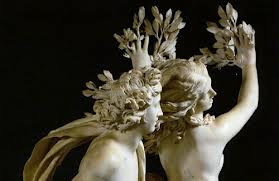

marble into
skin into face, marble into curls into hair, the effect is to change not only
Daphne into a tree but the marble itself into figures that are alive in a
landscape. They move through space in rapid flight, one possessed by the desire
for the other, one straining to avoid contact with the other. The tension
between the two and yet their inevitable linking holds the viewer’s attention.
Even Daphne’s beautiful head, which looks back as her mouth opens to call for
help from her father, seems, from certain angles, to move toward Apollo, rather
than away from him, so that the viewer coming upon them in the villa’s room
might have thought them lovers with a different ending.

When placed side by side the Apollo Belvedere looks positively staid
in comparison with Bernini’s Apollo, whose weight is entirely on the right leg
and whose left leg is lifted up into the air in full sprint. But they are both
nude statues of the hunter god with drapery and outstretched arms. While the
drapery of Apollo Belvedere is slung over his left arm as it gestures out to
hold what would have been originally a bow,

Bernini’s Apollo has drapery that sways
back behind him at the waist from the wind as he moves through the air. The drapery
over the shoulder of Bernini’s Apollo pushes out into an arc that compliments
the forward curve of Daphne’s body (another way in which they are joined as a
couple).
The head of Bernini’s Apollo is a close
twin of the Apollo Belvedere’s head
as well:


From certain angles the laurel leaves of
the tree Apollo makes sacred sprout, in Bernini’s version, out of his head (2nd
view) as well as Daphne’s; those leaves make Bernini’s Apollo different from
the ancient statue where the feathers from the arrows stand out of the quiver
behind him (1st view) but there is no reference to the laurel. The
same gathering of the sun’s rays on the top of his hair, since he is the sun
god, is nearly identical (4th and 5th views). The same
contrast in texture between skin and deep-cut hair curls is present in both,
the angle of head-turn to torso the same, and the delicate limbs and youthful
body of an excellent athlete are portrayed in both.

But the running of Bernini’s god is what
implies desire; the passion which “moves” him to reach for the maiden in his
hunt. Bernini’s action and passion are the same here and are what differentiate his statue group from that of Leochares.
It is possible that Bernini was influenced by another written source: a
1620 poem by Giambattista Marino entitled “Apollo e Dafne”. Here is the text
and my translation (with thanks to Professors Victor and Ann Marie Carrabino
for their help with it):
Stanca, anelante a la paterna riva, Tired,
longing for her father’s riverbank,
qual suol cervetta affaticata in caccia, Like that sweet doe fatigued from the hunt,
correa piangendo e con smarrita faccia The virgin was running, crying, and with confused face,
la vergine ritrosa e fuggitiva. Bashful and fleeing.
E già l’acceso Dio che la seguiva, And already the inflamed the god who was following her,
giunta ormai del suo corso avea la traccia, By this time having found the track of her run,
quando fermar le piante, alzar le braccia Saw her immediately in the act of escape
ratto la vide, in quel ch’ella fuggiva. Put down roots and raise up her arm branches.
Vede il bel piè radice, e vede (ahi fato!) He sees the beautiful foot root, and sees (oh, destiny!)
che rozza scorza i vaghi membri asconde, What a rough covering the beautiful limbs hide
e l’ombra verdeggiar del crine aurato. And the shadow greening of the golden brow.
Allor l’abbraccia e bacia, e, de le bionde So he hugs and kisses her, and, of the blond
chiome fregio novel, dal tronco amato Tresses a new frieze forms from the beloved trunk.
almen, se’l frutto no, coglie le fronde. At least, if not the fruit, he’ll collect the leaves.
(Italian text taken from terzotriennio.blogspot.com/)
qual suol cervetta affaticata in caccia, Like that sweet doe fatigued from the hunt,
correa piangendo e con smarrita faccia The virgin was running, crying, and with confused face,
la vergine ritrosa e fuggitiva. Bashful and fleeing.
E già l’acceso Dio che la seguiva, And already the inflamed the god who was following her,
giunta ormai del suo corso avea la traccia, By this time having found the track of her run,
quando fermar le piante, alzar le braccia Saw her immediately in the act of escape
ratto la vide, in quel ch’ella fuggiva. Put down roots and raise up her arm branches.
Vede il bel piè radice, e vede (ahi fato!) He sees the beautiful foot root, and sees (oh, destiny!)
che rozza scorza i vaghi membri asconde, What a rough covering the beautiful limbs hide
e l’ombra verdeggiar del crine aurato. And the shadow greening of the golden brow.
Allor l’abbraccia e bacia, e, de le bionde So he hugs and kisses her, and, of the blond
chiome fregio novel, dal tronco amato Tresses a new frieze forms from the beloved trunk.
almen, se’l frutto no, coglie le fronde. At least, if not the fruit, he’ll collect the leaves.
(Italian text taken from terzotriennio.blogspot.com/)
In this version of the story there is no
Cupid mentioned and the description of the scene is much as Bernini chooses to
carve it, making the viewer wonder which came first, the poem or the sculpture.(The fact that Marino repeats the verb
“vede” (he sees) in the third stanza seems a Freudian slip that gives away his
having “seen” the sculpture or a bozzetto of it before writing the poem, in my
opinion.)
The most pertinent passages in the poem that connect to the sculpture
are highlighted in purple:
correa piangendo e con smarrita
faccia (in the marble she
is running as she cries and has a confused face)and the description of the foot
turning into root and the rough bark on the skin:
il bel piè radice, e vede (ahi fato!)
che rozza scorza i vaghi membri
asconde. The foot turning
into a root is the section of the sculpture closest to the viewer when the viewer is
standing below it.
The emphasis in the Marino poem, however, is on the feelings of both
figures and on the futile nature of the hunt; the hunter ends up with leaves
instead of fruit, inedible love-making. The emptiness and waste of the man’s
hunt is what the poet sees as the moral since the poet imagines the definitive
end of the chase.
Bernini, on the other hand, chooses the moment before the end, the
moment of greatest tension and greatest movement, the apex of the hunt, before
it closes down. That way the viewer still sees the human beauty that envelopes
both the protagonists. The lifelike quality of both Apollo and Daphne, the
youthfulness of their heads, and the loveliness of their figures in motion all
contribute to Bernini’s riveting scene, the moment when she is about to turn
into a tree, the moment when Apollo is about to reach her, the moment when the
chase is about to be over. Bernini chooses that moment, not the moment when her
change into tree is completed, not the moment when Apollo spies her, not the
moment when she is alone in the forest, before she runs from the god.
The apex of the action is what is appealing to him because it is before
the action stops. In this way his art can continue to live. She will never
fully be a laurel tree; he will never fully grasp her as a tree. Apollo is most
alive in his pursuit; Daphne is most alive in her flight before the roots take
hold and she is immobilized by ground and bark.
She will never lose her youthful beauty that made him love her in the
first place; he will never lose his youthful power that made her fear him. The
energy conveyed by Bernini in the movement of the drapery and hair and limbs of
the figures will continue to surge even after this century is gone; he has
understood that the electricity between the figures will be eternal, he has
understood that his art will continue to represent the fleeting moment in time
eternally. The capturing of the maiden
is not the art; the almost capturing of her is.
She can never die in this sculpture; she and Apollo are in marble the
essence of what they are in the myth, nymph (daughter of a god), and god. They
are caught in youthful beauty in the timelessness of all the gods and Apollo
also in a human timeless longing not only for love but for youth itself.
The viewer is caught, too, in the beauty that Bernini creates that nourishes
no matter how many times a person revisits. In that way the metamorphosis that is
taking place in the sculpture is mirrored in the viewer. We are transformed by
the vision that he presents of what sculpture can achieve, the vision of beauty
caught in a story where the beautiful nymph is not caught, a vision of the
capture of movement in a material that seems unwieldy and unmoving, the capture
of realistic materials in a material that appears unbendable. The unrequited
love then is also the wish of the viewer to be those figures, be that beauty,
be young again forever.
For Bernini art is metamorphosis, the transformation of marble into
human beings, into hands, toes, fingers, hair, eyes, legs, then transformation
into nature: tree trunk, tree bark, tree leaves, branches, and roots, and
finally drama. But Bernini’s transformation always includes beauty of form. If
you compare his work with painted images of the same story in early periods:
i.e.,
Pollaiuolo’s Apollo
and Daphne of 1470-80 in the National Gallery, London:


or Domenichino’s Apollo and Daphne painted for the Aldobrandini villa in Frascati
from 1616-1618, now in the National Gallery in London, too, the distance
between the figures is, in the first example, too close and, in the second, too
far away. Like the bed finally decided upon by Goldilocks, Bernini’s is just
right. In Pollaiuolo’s the branches of the laurel tree that emerge from
Daphne’s arms look like two pompoms on a cheerleader being lifted at a football
game. In the Domenichino example, she almost looks back at him as if to say,
“What’s taking you so long?” because the space between them is too great. Only
Bernini understood the importance of proportion in the bodies of the figures
and in the space between them. These two painted images seem laughable when set
next to Bernini’s sculpting.(Domenichino's fresco is noted by Bruce Boucher, Italian Baroque Sculpture, (London: Penguin, 1998).
But what Bernini also understood that these two painters did not is that
if you are making a work of art about desire and love, you must carve physical
beauty into the figures so that the viewer will understand why the person
desired, why the person was loved in the first place. Both Apollo and Daphne in
his version are peerless young people and the viewer’s desire to be nourished
by looking at them is evident when groups of people who stop in front of them
cannot leave; they are transfixed as though they are the ones turned into trees. Beauty is nourishment, and Bernini nourishes with his whole heart
and soul in this statue group, mesmerizing the public. In his skillful hands
the dramatic moment comes alive and the metamorphosis continually recurs. What doesn’t change is the nature of
desire, and our desire to view beauty is, in Bernini’s sculpture, a love
requited.
Subscribe to:
Posts (Atom)