Thursday, January 17, 2013

January 16, 2013 - ITALIAN SEXUAL GRAMMAR- THE TOWER AND THE DOME

     Today, no matter from which direction you approach Florence, Italy, the two tallest building in the city are the ones that stand out in the skyline: Palazzo Vecchio and Santa Maria del Fiore. The first is the town hall and the second the cathedral of the city. One is an isolated tower, the other a dome surrounded by other church buildings.

The Palazzo Vecchio, begun by Arnolfo di Cambio in 1299, was the first to reach its height of 94 meters or 308 feet by 1314. The Cathedral took longer, from 1296 to 1436; begun also by Arnolfo di Cambio, the apse chapels and cupola were completed by  Brunelleschi and its lantern by Michelozzo on designs of Brunelleschi in 1446. By then the height was 114.5 meters or 375 feet. The tower and the dome seem almost equally high, though, even when photographed in a closer view.

A bird's-eye view of Florence painted in 1475, once in the Museo Firenze Com'era
(closed for renovation) shows these two buildings at the center of the walled city, still
the two tallest among other towers and structures present at the end of the 15th-century
metropolis. Even the defensive towers at the city wall gates do not compete with the central buildings. The Campanile of the Cathedral, of about 1334, in this view looks close to the Cathedral's height, but the angle from which it's seen, southwest of the city, would naturally have blocked a portion of the dome in the cityscape. The Cathedral and Town Hall are the two tallest, despite the odd elongation of the Campanile.
      
              That the two most striking buildings of the center city have not changed since 1475 speaks of the concerted effort of the citizens of Florence over the years to maintain these two structures as the face of Florence. In the fifteenth century, city councilmen wrote statutes to ensure that no building would supersede the height of the dome of the Cathedral. And, even today, the city councillors have pushed any new architectural construction to locations outside the central zone of tourism and toward the Autostrada's encircling belt towards Prato. As a consequence, the skyline of Florence for the modern tourist is similar in principal structures to that of Botticelli's day. And noone viewing it would mistake it for another city. The tower and the dome make Florence the sight that people all over the world continue to return to see.


The magic of those two figures in the landscapes is still maintained by the body politic. Palazzo Vecchio is still the center of civic government and Santa Maria del Fiore the center of ecclesiastical power and they balance each other in function and shape.
             
         What is the magic produced by these two structures and why are they still the tallest? Why, too, are they preserved in their original forms?
          In order to understand the power of the "palagio dei priori" (as Palazzo Vecchio was known in the 14th and 15th centuries) and that of the "cattedrale" or "Santa Reparata" (as the cathedral was known before its new dedication as Santa Maria del Fiore), one must return to the language used to name them.         
         It is my contention that the most prominent shapes visible in the cityscape of Renaissance Florence are directly related to the language used by the builders of those shapes. There is a direct correlation between the emergence of Italian as the dominant language during the Trecento and Quattrocento and the emergence of architectural forms imitating the sexualized nouns in the oral language of the time. As Latin fades into the background as the dominant language (its vestiges still preserved in Florentine contracts, formal documents, and in erudite poetry of the period), Italian pushes forward as the language used orally, in written documents, in letters, in poetry, in inventories, in prose and theater productions, in diaries, in zibaldoni (instructions for heirs). Italian’s dropping of the neuter nouns of Latin in favor of the masculine and feminine forms of nouns encourages an emphasis, in every aspect of Italian life, on the polarity of the sexes and the tension and balance achieved between them. This emphasis can be found in every art form produced in the Quattrocento, including architecture.
          The masculine title for the Palazzo Vecchio is Palagio dei Priori (Palace of the Priors); the o's at the end of most Italian nouns indicate that the noun is masculine; the masculine article "il" is used for the palace in this case, too:  "il palagio" and "il palazzo" are both names given to the town hall tower and they are masculine names and articles.
        A's at the end of most Italian nouns indicate that the noun is feminine. Santa Reparata or Santa Maria del Fiore are both feminine names for a female saint, and the name for the cathedral is, thus, also feminine. Another name for the central church is "la cattedrale" or the cathedral (except in English the neuter is used for almost every noun, so the feminine gets lost in translation) and in Italian "la Cattedrale" is feminine, too. "La chiesa", the Italian word for "church", is also feminine. (For those who know the cathedral is often called "Duomo", the origin of that name for the major church in any Italian city is the Latin word "Domus", "House", which is feminine.)
          It is not a coincidence that these two central buildings' prominence is protected just at the same period that the language of the people who create them is being promoted by writers and humanists. The language and the architecture are indelibly linked in the history of the city, perhaps in the history of all the cities where that language is spoken. The two buildings, the Palazzo Vecchio, or the Palagio dei Priori, and the Cathedral of Santa Maria del Fiore, are the architectural equivalents, writ in large form literally, of the masculine and feminine nouns in the Italian language itself.  The emergence of Italian as a strong oral and written language and the letting go of Latin as the official language of documents occurs just in the same period that these buildings are built in Florence.
          In the Italian language every part of the grammar is affected by the use of masculine and feminine nouns. For an English speaker it is hard to fathom the importance of the gender of nouns unless they try speaking a foreign language where those are crucial.  An English speaker has to remember whether a noun is masculine or feminine and adjust the adjectives, verb variants, and pronomial direct and indirect objects, in effect adjust a whole sentence or way of thinking, whereas an Italian speaker grows up knowing them and instinctively adjusting for the gender differences. In Latin the neuter is still present in the language, but Italian oral and written language of the 14th and 15th centuries has no neuter. In fact, the first poem written down in Italian, in the volgare, is by Francis of Assisi, and is a poem about Brother Sun and Sister Moon, Frate Sole e Suora Luna, a division of masculine and feminine for objects in nature but also in the new language.
         What happens in Italian beyond the masculine and feminine nouns is that adjectives, articles, and possessives used to describe those nouns are also masculine and feminine, depending on the noun. Verb forms, like the past participle, take either masculine or feminine, depending on the subject or object. This principle then applies to pronouns and articles used for direct and indirect objects. Everything in Italian is sexualized in a grammatical sense because of the sexual division of its nouns. But is it only in a grammatical sense? Don't the architects of the culture respond also to the sexual grammar in the shaping of their buildings?
          The Palazzo Vecchio or Palagio dei Priori is a masculine building. 

It is strong, defensive, protective and powerful. It is designed to protect the entire population of the city within its walls when it is built. The projection of the tower is sexually suggestive in its thrust upwards from the base


    and the rough-hewn walls are designed to evoke power and strength.
              The tower was set within a piazza where artists kept adding sculpted male heroes (David, Hercules, Perseus later), reinforcing the original function of the building. Two sculpted lions guard the entrance and actual lions were kept in a cage behind the structure in the 15th-century (the street there is even today named Via dei Leoni, the lions also masculine plural). The bell in the bell tower was used to warn citizens in case of enemy approach. The rustication of the exterior stone as well as its brown and beige colors are designed to promote a sense that it is a large military impenetrable shield, and the height of the tower was designed to instill fear in the viewer. The holes under the top moldings were for pouring out hot oil on enemy trying to scale the walls. The crenellations at the top emphasize the fortress-like quality of the edifice and the whole is a phallic shape, meant to remind viewers of masculine power at its height, literally. Even now its aggressive nature commands respect and awe, and holds the viewer's gaze from below looking up. It has sharp edges at the corners and in the crenellations.
               Once installed in the landscape, the tower might have been left by itself to represent Florence, the city-state. But in my interpretation of the constructions of the Early Renaissance in Florence, this building is the MALE NOUN.  It, then, needed a FEMALE NOUN, to balance and counter it within the Comune as the female nouns balanced the male nouns in the language of the Florentines.  And, sure enough, begun before, but not finished until much afterward, there is a competing structure in the city that represents all the feminine, as the palazzo stands for the masculine.  And that building is the Florentine church of Santa Maria del Fiore.
      The Cathedral of Florence is begun in 1296 by Arnolfo di Cambio, and he completes much of the nave and transept.  It is a building that is sheathed in the most precious and colorful marble, pink from the Maremma, green from Prato (next door), and white from Carrara, a building for a woman, dressed in a beautiful gown of multi-colored marble.  Even within the marble panels are inlay colored marble sections that resemble flowers.

 The 1296 building was intended to replace a smaller building that had also been dedicated to a woman, Santa Reparata, a local saint.
         The new dedicatee was St. Mary of the Flower and she is appropriately dressed. This cathedral also has a feminine shape. When Brunelleschi begins building his sections of the church between 1420 and 1436, he adds on apsidal chapels that are round, choosing to make the church look like a flower, with the nave as the stem and the apsidal chapels as the petals at the top or end of the stem.

 Then he designs and builds the dome, the breast shape, the Cupola, that completes the structure.
         

The rounded ends of the building on the street below

accompanied by the rounded form of the CUPOLA, not to mention the 8 oculi (circle windows) in the drum and the concave shell niches added to the apsidal outer walls, embody the curving female forms. Sharp edges are muted, the curves accentuated by the white marble ribs.
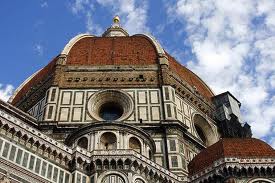

The FEMALE NOUN, CHIESA to complement the MALE NOUN, PALAZZO, in a city where the local language already divides every noun into female or male. 
      Just as the Palazzo Vecchio is strong and imposing and phallic and protective, the church of Santa Maria del Fiore is full of soft colors, soft curves, concavities and convexities, and is the home of a female saint. The church represents the receptive side of life as opposed to the defensive and protective side, the all-accepting love of the mother as opposed to the fierce fortress security of the father.  Weapons were not allowed in church in the 15th-century (the Pazzi Conspiracy is an anomaly because of that), so it was meant to be a place where violence could be put aside.  It was a place associated with charity, as the church as an institution gave to the poor and encouraged generosity and kindness.  The emphasis on the Virgin Mary and her role as mother means that the church is the ecclesiastical center and the nurturing, mothering center, a place well suited to a building with a breast shape.

And although there was no separation of church and state in Italy even in the Renaissance (some civic functions were held in church and some church functions held in the Town Hall), and certainly the church was run by men, women were at least in the congregation in the "chiesa", while in the Palazzo della Signoria or Priori, no women participated in the government in the same period. Women were allowed inside the "chiesa" and the original statue of Arnolfo of the Madonna and Child welcomed women from the facade in the 15th century. 
  
    When a visitor saw the city from a distance, he would be aware of both buildings above the others, female and male, and feel at home with the language mirroring.

 When Florentine citizens walked up the hill to view the city from the church of San Miniato (already there in 1063), by 1436 they would have realized that the two structures, the palazzo and the chiesa, were the manifestations of the two sexes, the two genders. They would have observed them as natural architectural emanations from their own language choice to separate and categorize nouns as either female or male.
Each kind of noun from the language had its own representative in the largest buildings in the city, and, in that way, the citizens felt most at home with that division, so much at home that, for every year up to and including the years of the 21st century, the buildings stand out and stand for the two poles (one is literally a “pole”).  The silhouette of the city outline, then, is fixed with the two noun genders of the city's major language.
      There is a reason why the two tallest and most impressive buildings in Florence in the 15th century were masculine and feminine shapes and names.  These structures emerge from the ground, as it were, to present the reality of the language to the very people who speak the language; is it a conscious choice to design the buildings this way?  Yes, insofar as the Florentines wish to convey the very differences between men and women in the society, and insofar as they wish to convey the very differences that are articulated by each citizen from birth to death in their own language.  And the very different functions of the buildings are designed to polarize the two different approaches to life:  the masculine and the feminine. If visitors to the city today are attracted to the skyline projections, it is because the buildings resonate with the feminine and masculine sides in all of us. The magic lies in the tension and attraction between the genders, the magnetic resonance and electricity between the cathode and anode. Let us hope the preservation of the "lingual view" will continue long past the usurpation of the Italian language by the global one threatening to take over in a new linguistic development, inglese.
               

Sunday, January 13, 2013

MASACCIO and SELF-PORTRAITURE in PAINTING

January 10, 2013 - MASACCIO and the 
TRADITION of SELF-PORTRAITURE in PAINTING

As we have explored in an earlier blog on the Louvre panel of 5 men, Masaccio is an artist who is extremely aware of his place in art history.  He is not the first painter to record his own features, however; some scholars feel that even in the 14th century in Italy artists were beginning to allow their own features to be presented in their art works. Giotto, for example, in the Arena Chapel in Padova (1305-6), may be the fellow painted in yellow cap and gown in the realm of the blessed in the Last Judgment.

Giotto's presumed self-portrait does not show the artist facing his audience, and his profile aims his entire figure towards the image of God in heaven, a sign that Giotto's own endeavor is pious work, even if he wants to include himself, a layman, in it. His figure gives permission to artists who follow him to create works in which self-portraiture has a place.
           One of Giotto's pupils, Taddeo Gaddi, paints a secular panel of three men, with labels identifying them as himself, his father, and his son, three generations of artists:
While the labels here may be suspect, the ages of the men portrayed are not. The oldest member of the group is the furthest to the left, and should be labelled Gaddus Zenobi, or Gaddo Gaddi, the father of Taddeo and grandfather of Agnolo. This man has the whitest hair, the most wrinkles on his face and neck, and his placement to the left ensures that we "read" him as the first in the narrative of the family left to right.  That would then mean that the central figure who looks out at us is the artist himself, Taddeo Gaddi, the middle-aged man, who has put himself between his mentor father and his student son, Agnolo, who appears on the far right.  Agnolo has no wrinkles, has a youthful goatee and mustache neither of which have any white or grey hairs in them. He then is the youngest member of the family, the grandson of Gaddo and the son of Taddeo. 
           If Taddeo is the central character in this documentation, he is probably the first artist to show himself looking out at the viewer. Because his eyes seem slightly cross-eyed, and because the artist has little interest in anatomy, the picture we look at seems less realistic and more one-dimensional than 15th-century portraits of artists.  However, as a model for the Louvre panel by Masaccio of the 5 men, 4 of whom are artists, it is an important record of self-portraiture and of artistic liaisons before Masaccio. This 14th-century panel is Taddeo's marking down his place in the generations of artists in his family. His father looks to him from the left and is his source of interest in art; his son looks in to him from the right and sees his father as mentor. Taddeo, like many middle-aged people, sees himself between the two generations, that of the past and that of the future. He positions himself between the two to say he is not alone in his endeavor, that artistry is an industry passed from father to son, from father to son, down the long line of generations.
           The faces all seem at first to be on the same plane, but if you look closely at how the borders of their clothing are connected, the grandfather is furthest back in the pictorial space because oldest in time (his drapery is covered by the drapery of the central figure at the edges) and the grandson is furthest forward in the pictorial space (his drapery covers the drapery of the central figure); the line of past to future runs through the figures themselves by placing them spatially back to front, left to right; that means the identifying labels on the panel are wrong except for the grandson; the labels for his father and grandfather should be switched. The past is placed further back in space, the future, furthest forward. Taddeo is conscious of his place in his immediate family, but he is also conscious of his place in the line of artists stretching back into the past and forward into the future. His self-consciousness and willingness to look out at the viewer are both new, but artists after him develop those two qualities even more.
           At the beginning of the 15th century another artist, this time outside of Florence, in Montepulciano, paints a self-portrait that faces the viewer for the first time in an altarpiece. Taddeo di Bartolo presents himself as his name saint, Thaddeus, in the scene of the Dormition of the Virgin at the bottom of the Assumption of the Virgin executed for the Cathedral of Montepulciano in 1401:
      His raised halo says, "Santo Thadeus", Saint Thaddeus, and he holds his left ring finger with his righthand. He certainly tries to convey his five-o'clock shadow, scruffy mustache, and gives a local language code in his finger gestures (perhaps indicating he's a devout Christian); but within the code the three fingers pointing upwards toward his face make us look at him and recognize him as the artist of the triptych in the cathedral. He looks directly out at the viewer, and tries to make a connection with the audience, unlike Giotto. But because his face is so small in comparison with the saints in the wings of the altarpiece, the effect, though electrifying in miniature, allows his identity to get lost in the swirl of the greater vision of the Madonna being assumed into heaven:

Could Masaccio have seen this altarpiece before beginning work in Florence in 1424? Hard to know. Montepulciano is further south on the way to Rome from Masaccio's hometown of San Giovanni Valdarno, not on the route to Florence or Pisa where Masaccio ended up working. On the other hand, his own self-portrait in the Brancacci Chapel is also 3/4 view and he looks out seriously in much the same manner as Taddeo: 
Whatever the connection might be between these two, it is slight when considering the weight of influence that Masaccio's self-portrait had on generations of artists after him.  Vasari says of him,e 
"E quanto a la maniera buona delle pitture, a Masaccio massimamente, per aver egli prima di ogni altro fatto scortare i piedi nel piano, e cosí levato quella goffezza del fare le figure in punta di piedi, usata universalmente da tutti i pittori insino a quel tempo; et inoltre, per aver dato tanta vivezza e tanto rilievo alle sue pitture, che e' merita certamente non esserne manco riconosciuto che se e' fusse stato inventore della arte. Con ciò sia che le cose fatte innanzi a lui erano veramente dipinte e dipinture, ove le sue, a comparazione de' suoi concorrenti e di chi lo ha voluto imitare, molto piú si dimostrano vive e vere che contraffatte." (online Vasari, Le Vite)
His admiration of Masaccio stems from Masaccio's having invented foreshortening (scortare i piedi nel piano) (literally foreshorten feet in the plane)and for his ability to give "vivezza e tanto rilievo" (lifelike quality and sculptural relief quality) to his pictures. He recognizes that Masaccio differs from the painters before him because his paintings seem "vive e vere" (alive and real) and not artificially constructed (contraffatte). 
        Masaccio draws a mark in the sand (so to speak) in his paintings about St. Peter in the Brancacci Chapel 1424-27 in the Chiesa del Carmine in Florence for the reasons that Vasari enumerates, but he also makes an artistic statement on behalf of all artists in general by painting his own self-portrait into the Enthronement of Peter scene in the lower right register of the left wall of that chapel.  Masaccio paints himself anachronistically as a witness to the Enthronement of Peter story, but he puts himself into a group of contemporary witnesses, some of whom include his friends, other artists:  from left to right: Masolino, Masaccio, Alberti, and Brunelleschi.
Masaccio's face is the only one in the group that looks out at the viewer and directly engages the audience. As the painter of the scene and himself in it, he recognizes that he can document not just the scene but his own production of it by painting himself looking out of it. He places his self-portrait like a signature on a document, at the lower right of the painted wall, so that he can be a testamentary with his friends for the cycle as a whole.  His decision to show himself looking out is partly influenced by his friend Alberti painted next to him since Alberti says in his Della Pittura that the painter should include a person who looks out at the spectator and draws him/her into the scene. For Masaccio that person is himself. 
           Masaccio is such a self-conscious artist here, he may have had an idea that he was producing an image that would have an influence on other artists, but he has an influence because he places himself on the wall in three historical moments:  1) the moment from ancient biblical history when Peter is adored by the King of Antioch for having raised his son from the dead, 2) the moment in which Masaccio has painted himself with his friends into the old story with contemporary 15th-century dress, as though they were standing around watching a play unfold next to them, and 3) the moment in which Masaccio looks out to any viewer in the future who comes to see his own creation and admire him for raising himself and his fellow artists from the dead.  In fact, Alberti, whom he paints next to him, says in his book On Painting, "Painting contains a divine force which not only makes absent men present, as friendship is said to do, but moreover makes the dead seem almost alive." (Spencer transl.) Masaccio has resurrected himself and his friends from the dead in his image that lives even today.
          Now it might be that if Masaccio had painted in Montepulciano or San Giovanni Valdarno that his artistic choice to paint a self-portrait that looks out from the wall would have had little or no effect on other artists. But he is painting in Florence, and the chapel he paints quickly becomes the place for artists to come for lessons in how to shape reality, how to copy nature. Vasari says of the chapel that "da infiniti disegnatori e maestri continuamente fino a 'l dí d'oggi è stata frequentata questa cappella." ("This chapel was continuously visited by infinite numbers of draughtsmen and masters of art even up until today." - my translation) Vasari also tells of Michelangelo drawing with fellow artists in the chapel when Michelangelo boasts of his own drawing to the other youths; one of them, Pietro Torrigiani, is so incensed by Michelangelo's boasting that he punches him in the nose, disfiguring him for life. While the documentation of Michelangelo's sparring is visible in later portraits of him, especially the bronze by Danielle da Volterra, the story of that sparring tells us that the chapel was a gathering place for artists and a classroom for painters learning how to draw.  It was the locus for artistic influence. (Vasari even lists all the artists who learned from Masaccio.)
          And Masaccio's influence on self-portraiture carried out by other artists was great indeed.
A short survey of 15th- and 16th- century painters who paint self-portraits into murals that postdate the Brancacci self-portrait:
Uccello's Presentation of the Virgin in the Temple, 1435-40, Prato Cathedral (near Florence)
Here the artist faces us but does not look out to the viewer, but he is placed on the lowest right on the wall.
Fra Filippo Lippi, Barbadori Altarpiece, 1437:
The artist looks out at left; he is a Carmelite monk who was a pupil of Masaccio in the Carmine; his placement at left sets his signature in contrast to his teacher's, but he still presents himself looking out at the viewer.

 Fra Filippo Lippi, Coronation of the Virgin, Uffizi, 1441 
In the Coronation he is also on the left kneeling, second in from front, looking impish:

Benozzo Gozzoli, Procession of the Magi, 1459, Medici Chapel, Palazzo Medici, Florence
In this case Gozzoli is not able to put his features at the far right of the painting because the painting winds itself around the room on several walls, so he puts his self-portrait in the middle of the crowd of followers of the Medici family, whose portraits he has painted into other figures, and then he realizes that no one will know him in the crowd, so he paints his name on his hat (OPUS BENOTII - the work of Benozzo) so that his authorship is clear. He does look out at the viewer but not happily, perhaps because he knows Masaccio had not had to write his own name above his head to be recognized.
    Botticelli's Adoration of the Magi, 1475, Santa Maria Novella (Florence - now in Uffizi)


Botticelli depicts himself on the right side of the panel, looks out at the viewer, and crooks his left arm under his cape. He understands the statement made by Masaccio and continues the tradition of "signature" on right.
Ghirlandaio, Resurrection of the Child, Sassetti Chapel, Santa Trinita (Florence),1483-85

Ghirlandaio paints his "signature" to the right of the resurrection of the boy scene and he looks directly out at the viewer with left hand on hip, arm akimbo.
Ghirlandaio, Joachim's Expulsion from the Temple, 1485-90, Santa Maria Novella, Florence:

Ghirlandaio stands 2nd in from right at right side of scene, looks out at the viewer, points to himself with his right index finger and places left arm akimbo. The painting to the right of this in the cycle is the Birth of the Virgin and he cannot include himself in the far right scene there because it depicts the birthing chamber where men were excluded. Within the context of the Expulsion of Joachim scene, however, he stands to the far right.
        Both Botticelli and Ghirlandaio are far enough removed from Masaccio's time to continue his message without feeling the need to rebel against him, as Fra Filippo Lippi does. They know that if they put themselves on the far right and paint themselves looking out, they will be recognized as the artist of the work.
Raphael's School of Athens, 1508-12, Vatican, Rome:


Raphael places himself looking out 2nd in from right in lower right corner of the wall.
By this point the tradition has been established for over eighty years and Raphael contributes his own features as signature in 1508-12 in line with Masaccio's choices in 1424-27. I will stop with Raphael, but the incomplete list gives the reader a sense of the importance of Masaccio's self-portrait in setting out the model to be followed by artists after him.
           While the self-consciousness of artists certainly continues today, the need for them to paint their self-portraits at the edges of their painted scenes becomes less crucial than it seemed to be in the 15th and early 16th century. Many artists in the centuries after the 1400's, even artists in our time, paint themselves looking out at the viewer. Masaccio begins the interest in performing on the wall and establishes the place he thinks artists should record their features for posterity, at the right looking out. He makes such a strong statement, the artists in the century following him usually "sign on" to his choice in order to align themselves with artists or painters in particular as a group. By repeating the insignia in individual form, they link themselves to all painters. This in-group knows that their mentor has shown them a way of entering their own creations and recording their own features as a sign of pride in the work and as a sign that they are "signing" the work as a contract documentation of their own labor. In this regard they are often part of a group of men; since two witnesses were required to make a document legal, the artists include at least 2 witness figures next to their signature. They no longer paint themselves in a group facing the godhead, as in Giotto's day. By painting themselves looking out, they connect themselves eternally with the ever-changing audience for their works. They paint themselves into their creations in an attempt to thwart death and the passage of time. They live still on the walls or in the altarpieces, saving their artistry and faces for eternity.       


Thursday, January 10, 2013

January 6, 2013 -
The LOUVRE PANEL of FIVE MEN and UCCELLO'S SELF-PORTRAIT

Written on a cassone panel in the Louvre from the early 15th century are the names of five Italian artists:
              Giotto    Paolo Uccello               Donatello       Antonio Manetti         Filippo Brunelleschi

Since the names are presumed to have been written on the panel in a later period, they carry less value in the identification of the figures. Whoever wrote the names was considering a gathering of portraits of artists in the Italian Renaissance who were interested in the art of perspective. Giotto plays with space in all his paintings, Uccello did perspective drawings of mazzocchi and used one-point perspective in his paintings. Donatello was introduced to the idea of one-point perspective by Brunelleschi, and his bas-reliefs then reflect his own interpretation of natural space, using one-point perspective in the panel under St. George on Orsanmichele or two-point perspective in his Sant'Antonio panels in Padua.  If the Antonio Manetti here is Antonio Manetti di Chiaccheri, he is the same man responsible for the intarsia panels executed around 1436 for the North sacristy in the Florentine Duomo, where the use of one-point perpective is particularly clear and skillful. That leaves Brunelleschi, the inventor of one-point perspective in his painted panels of the Baptistery and the Palazzo Vecchio (now lost), probably created around 1409, the same time period as the story of the Grasso Legnauiolo.
         But wait. The identifications, like news reports in the modern day, need to have confirmation from other sources before we can be sure these portraits are of these names. The only identification that seems certain without a doubt below these faces is the one for Filippo Brunelleschi. His profile portrait is nearly identical to a death-mask plaster taken of him (now in the Museo dell'Opera del Duomo) and to the profile portrait of him painted by Masaccio on the lower left wall of the Brancacci Chapel in the scene of the Raising of Peter (the one furthest to the right.)


In fact, the style of the painted figures in the Louvre panel is so similar to the style of the portraits of the four men in Masaccio's scene: Masolino, Masaccio, Alberti, and Brunelleschi, in that order left to right, that several scholars have decided this Quattrocento panel in the Louvre is painted by Masaccio.  A date is not on the panel itself, but from the way light is treated on the faces and the sculptural quality of the drapery, the panel would easily fall into the 1420-30 period in Tuscany, precisely the period in which Masaccio is painting the Brancacci Chapel figures (1424-27).
          It is worth noting at this point that Vasari actually mentions this panel specifically as by Masaccio in his Life of Masaccio in Le Vite. Here is what he says in Italian:         
"E gli artefici piú eccellenti, conoscendo benissimo la sua virtú gli hanno dato vanto di avere aggiunto nella pittura vivacità ne' colori, terribilità nel disegno, rilievo grandissimo nelle figure et ordine nelle vedute de gli scorti, affermando universalmente che da Giotto in qua di tutti i vecchi maestri Masaccio è il piú moderno che si sia visto; e che e' mostrò co 'l giudizio suo, quasi che per un testamento, in cinque teste fatte da lui, a chi per lo augumento fatto nelle arti si avesse ad avere il grado di quelle: lasciandocene in una tavola di sua mano, oggi in casa Giuliano da San | Gallo in Fiorenza, i ritratti quasi vivissimi, che sono questi: Giotto per il principio della pittura; Donato per la scultura; Filippo Brunellesco per la architettura; e Paulo Uccello per gli animali e per la prospettiva; e tra questi Antonio Manetti per eccellentissimo matematico de' tempi suoi." (online Vasari, Le Vite, 1551)
        Vasari himself here attributes a panel with five heads to Masaccio and says it is in Giuliano da Sangallo's house in Florence. He identifies the portraits as Giotto, Donatello, Brunelleschi, Paulo Uccello, and Antonio Manetti, the same names written on the Louvre panel; we cannot be sure if the labels below the heads were added after Vasari's identifications or not, but even though the order is not the same, the labels seem influenced by Vasari's list. Vasari's vast undertaking in writing The Lives ensures that he is not always right about things, especially when more than a hundred years has passed from the panel's creation to the author's writing about it. But he is right about the panel being by Masaccio, even though in his 1568 edition of the Lives he changes his mind and attributes it to Uccello.
          In fact, the best article I've read on this panel so far is the one by Jeno Lanyi (published after his death in the April, 1944 issue of the Burlington Magazine), where he thinks the panel is a copy from Masaccio's Sagra del Carmine (c. 1422). Masaccio is said by Vasari to have painted the procession (Sagra) in the church of the Carmine in which he included portraits of Brunelleschi, Donatello, and other of their friends in the procession to the Chiesa del Carmine. Lanyi sees the individual portraits with light coming from the right as a record of a fresco lit from the right where the apparent differences of position and distance of the heads can be explained by their having been copied from Masaccio's fresco on a wall. (The Sagra del Carmine was destroyed in the 17th century and we only know it through drawing fragments.) Lanyi's identifications then are:
MASACCIO     UNKNOWN       DONATELLO      MANETTI(di Chiaccheri)   BRUNELLESCHI
         His argument that the "Giotto" figure at the far left is Masaccio dressed up in his Sunday best is very persuasive, especially when you reverse the self-portrait of Masaccio in the Enthronement of Peter in the Brancacci Chapel.  It shows the same self-aware person looking out at the viewer with pride in his work. The angle of the head to torso is the same and the serious self-awareness and intention to connect with the viewer is the same. The same long nose and small mouth are present in both. The painting on the panel of the 5 artists is of such high quality that I believe it is by the hand of Masaccio himself and not a copy made by another artist of Masaccio's work (as Lanyi surmises). If Masaccio had used a pricked drawing for the fresco, the use of the same drawing twice, reversed for the panel, would make economic sense, too.

If you reverse his face, the features line up nicely with those on the Louvre panel:

The fact that he is looking out at the viewer confirms it as a self-portrait. Masaccio is the first painter in the history of art to make a realistic self-portrait looking out at us in the lower right section of a mural. It is as if he wanted to sign his work in the usual place for signatures in documents of the period, but paints his own face instead looking out as a 3-dimensional signature, a document of his having been responsible for the painting. (Taddeo di Bartolo does a self-portrait in the center of the Assunta triptych in Montepulciano slightly earlier, 1401. He puts his saint's name above in the halo so we will be sure to know it is he),


but Masaccio's mural had much more influence on later artists (subject of another blog entry) and the way they present self-portraits precisely because Masaccio painted in Florence and Bartolo in Montepulciano. It goes without saying that Masaccio also paints in a new Renaissance style that acknowledges flesh and light, while the Montepulciano painter still relies on Medieval formulas for waves of hair and finger-lengths, with no care for light source.
           If this Louvre panel figure dressed in red gown and cap is Masaccio, it makes sense that Brunelleschi and Donatello would be properly identified on the panel along with him, since they were both friends with him and both had contributed to the Brancacci Chapel project (Brunelleschi was responsible for teaching Masaccio the one-point perspective used for the first time in wall painting in that chapel and Donatello may have carried out the central bas-relief panel in marble for the chapel  - the Ascension of Christ giving the keys to Peter, a relief of 1428-30 now in the Victoria and Albert Museum).
       But then what of Masolino, Masaccio's partner in the chapel, whose portrait is probably next to Masaccio's in the Enthronement scene?  Masaccio means "Big Ugly Tom" and Masolino means "Little tiny Tom" so in the portrait of him on the left wall of that chapel, Masolino is small in height and head next to the portrait of the artist who paints the scene:
Is that fellow not the same as the man next to Brunelleschi on the Louvre panel? Just spruced up with hat and lace shirt and red over-tunic as if on parade? Just shown in 3/4 view instead of profile?
If Masaccio were making a panel to record people who were involved in the Brancacci
project, Masolino would be the logical artist to include since he painted the rest of the chapel (except for the sections finished later in the 1480s by Filippino Lippi.)  Masolino's height is not important in a panel recording faces, so his height seems the same as Brunelleschi's and even taller than Donatello's in the Louvre portrait, but that is just because the five faces have no spatial relation to one another in the Louvre panel. Since Antonio di Chiaccheri is not involved in the Brancacci Chapel project, he would not be appropriate to include here. Antonio di Chiacchieri and Masaccio never worked on a project together and therefore, if the far left figure is Masaccio, the identification of this second right figure cannot be Antonio.

             Which leaves the portrait second from left labelled "Paolo Uccello" on the Louvre panel.
             In order to dispute the identification as Paolo Uccello, we should find out what Paolo Uccello actually looked like. How to figure that out? Since he is painting around the same time as Masaccio and is born in 1397, he cannot be the old man with the forked-beard in the Louvre panel (as Lanyi had realized.) At the time of the Brancacci murals, he would have been 27-30 years old and the man in the Louvre panel is certainly much older than 30. Uccello knew about one-point perspective and was a friend of Donatello's, but he had been trained by Ghiberti and was at work on his frescoes in the Green Cloisters of Santa Maria Novella in Florence around 1432-36, just after those years 1424-27 in which the Brancacci was being painted. When Masaccio leaves Florence in 1428, it is presumed he would return to finish the chapel, so it is possible that Uccello would not have seen the chapel in the 1430's but only later.
              Masaccio begins the tradition of artists' "signing" their works in the lower right corners by painting in self-portraits. Wouldn't Uccello have been aware, through Donatello, that Masaccio had made this "new" artistic statement?  All artists want to know what the latest trends are in artistic rebellion, how tradition is being changed and molded by the artists around them. Uccello's early paintings (1432-36) of Creation and Expulsion in the Green Cloisters of Santa Maria Novella do not show any use of 1-point perspective, nor do they show any reflection of awareness of Masaccio's new move on the Brancacci left wall. But what of his works after the Brancacci revolution? His later Green Cloister narratives (1447-48) display extraordinary 1-point perspective, as though he were trying to outdo Masaccio.
          And doesn't Uccello put his own features on the face of Noah's son in the Drunkenness of Noah there? The head wraps over the mazzocchio so that we don't see that he's bald, but the raised eyebrows, prominent eyes, long nose and short-width mouth are the same as in the other examples we shall see in a minute; he's just more idealized here:
 
Since that mural is late in the cycle, we should explore earlier paintings of Uccello's to see if he decides to paint a self-portrait in them in rivalry with and in homage to Masaccio.
             Where would we look in Uccello's works to find Masaccio's signature interest? What are the projects that Uccello works on after 1427? In between the two Green Cloister projects Uccello takes on the painting of the Chapel of the Assunta in the Prato Cathedral between 1435 and 1436. Can we find a self-portrait of the artist there that conforms to the "new" Masaccian model?
             Sure enough, if we look closely at the frescoes in Prato, Uccello uses several opportunities to record his own features in scenes, even once at the right as his "signature". Uccello is asked to paint the Life of St. Stephen, the first martyr, and the Life of the Virgin, both in the first chapel to the right of the main altar chapel in the Cathedral at Prato. Since the Cathedral is dedicated to St. Stephen, it made sense to include his story both on the main altar walls and in the next chapel over. While the story of Stephen's Stoning on the left wall is probably painted by Andrea di Giusto, the rest of the chapel stories are Uccello's. In the Disputation of Stephen are two very specific characters to the left of the saint:  a man's whose eyebrows are raised in disbelief and a man whose cheeks are blown up as if he's spewing hot air on the saints' ideas or as if he's whistling disbelief at them:
The younger man with the purple turban has such a distinct face with pointed ears. We are struck by the specificity of his eyebrows painted in like Gothic arches, his long nose, his short mountain-range mouth.While he doesn't look directly out at the viewer, he faces forward as if conveying his reaction to the saint to an audience. He is unlike any of the other participants in the event.  He would be just an individual face in the crowd, though, if he didn't appear again in the cycle on the wall.
          For the Prato Cathedral's Presentation of the Virgin, the lowest scene in the Virgin's Life on the opposite wall to the St. Stephen story, also by Uccello, the turbaned man with no hair sticking out appears again, and this time, guess where? The far right side of the Presentation:
As if to make fun of the tradition started by Masaccio, Uccello places himself as a signature on the far right side of the scene but instead of looking out at the viewer, he is looking at the face of the woman in the roundel of the scene's border decoration:


And once you see the face of the artist, he appears other places as well, the clock in the Florence Duomo that is encircled by 4 prophets or Evangelists, one of whom might be a self-portrait:

and in another roundel outside the main scene, in the left decorative frame near the Birth of the Virgin where
he doesn't look directly at the scene since he is a man and the birthing room is off-limits to males.
In all of these depictions he is bare-headed, nearly bald, and has eyes in peculiar positions and raised eyebrows, pointy ears. Even with head covered again as one of the shepherds in the stained-glass Nativity done for the Duomo c.1434-44, where his eyes stand out though hard to see in this reproduction; it makes sense that he would want his own image kneeling toward the Holy Family in a work in the sacred center of Florence.


None of these images look at all like the old man in the Louvre panel labelled Paolo Uccello. He has no pointy ears, no turban, and he has long-white forked beard. And noone looking like the Louvre panel man shows up in the paintings of Uccello.
            So who is this man with the forked beard and fur hat second from left in the Louvre panel?  What connection might he have to the other figures that would make him appropriate for this panel?
           If you think about the panel as a mapping of the work done on the Brancacci Chapel, then all of the other four men fit:
Masaccio worked on                    Donatello did the          Masolino worked on  Brun. oversaw
Left wall                                      central altar sculpture          Right wall                   Perspective


The aged white bearded figure, then, should somehow fit into the overall project on the left.
To the left of the central altar in the Brancacci Chapel are two scenes of Peter, one preaching and one healing with his shadow.
If we look at both of those scenes, we find a man with a bi-forked beard just like the one in the panel:
In the preaching scene he is dressed in burgundy robe, kneeling without head covering before Peter; in the shadow scene he is trailing in the far back behind Peter and wears a blue cap.  Is he the original patron of the chapel, the Piero di Piuvichese for whom Felice Brancacci had the walls painted?  His great age would be a way of showing a person from the past, an old relative, the ancestor buried in the chapel walls, honored by his descendent by being included in the fabric of the chapel he had had constructed.
           Piero di Piuvichese is one of the reasons the life cycle of Pietro (Saint Peter) is chosen as the subject of the chapel walls; St. Peter is his name saint. It would make sense that he would be among the bystanders in the saint's pictorial life in the chapel itself as well as in the document made by Masaccio of the contributors to the project. So, in my opinion, the identity of the five figures in the Louvre panel should read as follows:


                MASACCIO       PIERO di PIUVICHESE            DONATELLO                 MASOLINO          BRUNELLESCHI 
                Painter-Left wall   BRANCACCI Original Patron     Sculptor-Center              Painter-Rt.wall                  Draughtsman

Even if Lanyi was right, that these figures were taken from another work where some of these men processed in the Sagra del Carmine, they all are vital to the creation of this holy chapel, and Masaccio would have selected these out of the whole procession as men who were connected by the chapel's work.  Masaccio's modern self-awareness is presented twice here, once in his own self-portrait, and once in the notion displayed on the panel that the "workers" should be documented for their adornment of the sacred space. That the workers share the space on the panel with the original patron (who would not have appeared in the procession but funded the original chapel project) is just another sign of Masaccio's artistic prescience.