

One of the things we haven't discussed with regard to the Presentation in the Temple paintings by Andrea Mantegna and Giovanni Bellini is that they represent a competition between the two artists. Since Giovanni Bellini grows up in the household of Jacopo Bellini, even though he is not his son but his half-brother, (see other blog entries and Maze's article) he has had a painting teacher from the age of three. Jacopo Bellini was trained in Florence and elsewhere by
Gentile da Fabriano, (after whom he names his real son) and he is in Florence when artists like Masaccio and Donatello are beginning their careers. As we have said, Jacopo keeps a notebook of drawings that include his own ideas about compositions for various Biblical subjects, particularly from the Life of Christ, and one of them is the Presentation in the Temple.
Jacopo Bellini's version of the Presentation in the Temple does not look like the half-figural representations of Mantegna and Giovanni. It looks like many of the other drawings in Jacopo's notebook, architectural stage sets on which small, full-length figures are placed in large open spaces to represent the Biblical stories.

Often the protagonists in the drama are in the background, as they are here,
and are hardly visible. But Jacopo in his notebook has worked up a repertoire of possible subjects for paintings in order to teach pupils about the Christian subjects they will be required perhaps to paint in the course of their careers.
Though his Presentation scene doesn't look anything like the panels painted by Mantegna and Bellini, the idea for the Presentation in the Temple as a subject still might have come from the master in the "school," Jacopo himself, the half-brother of Giovanni Bellini and the father-in-law of Mantegna. Jacopo had been part of Gentile da Fabriano's workshop in Florence, and when he returns to Venice in 1424, he sets up his own workshop. Since by 1429 he is in charge of two young boys, his own son, Gentile, and his father's son, Giovanni, he intends for them to eventually work for him and probably takes on the role of art teacher for them. When Mantegna joins the family in 1453 by marrying Jacopo's daughter, he, too, at age 22, is probably regarded by Jacopo as another artist to nurture and teach.
Jacopo keeps all his life the notebooks we have referred to in other blog entries (now in the Louvre and British Library) where he makes drawings of the subjects he thinks an artist might be called upon to paint; he sketches outlines of scenes and dramas of stories from the Bible, and it is not hard to imagine that his notebooks are used in his workshop as teaching tools for younger artists, namely for his half-brother, his son, and his son-in-law. His sketchbooks were considered so valuable to the family that he passes them down to his son, and when Gentile writes his will in 1507, he wills them to Giovanni.
When Jacopo was in Florence, the Baptistery competition where Ghiberti and Brunelleschi produced these trial bas-reliefs had already taken place,

and Jacopo would have seen Della Robbia and Donatello competing in the Cantoria commission, Ghiberti and Brunelleschi competing for the Cupola, and Gentile da Fabriano, his mentor, competing with Lorenzo di Monaco in painting The Adoration of the Magi into altarpieces, Monaco for the church of Sant'Egidio in 1422, Fabriano for the Strozzi chapel in Santa Trinita, in 1423.


These altarpieces, both in the Uffizi now, are similar sizes, with three rounded arches in the frame and the procession of the kings moving toward the left-hand figures of Mary, Joseph, and the baby.
Gentile da Fabriano, 1423, Magi Lorenzo Monaco, 1422, Magi
Not surprising, then, that Jacopo's most talented students often paint similar subjects, sometimes at similar times. I will make a partial list of subjects painted by both Mantegna and Giovanni Bellini in another blog to show the rivalry that existed between the two artists; even some subjects tackled by one early in his career will be attempted later in the other's. And Gentile Bellini should not be considered outside this realm of competition. Now that scholars understand that Gentile was younger than Giovanni and older than Mantegna, his body of work will have to be reevaluated as well.
Let us examine several of the possible competition paintings between Mantegna and Giovanni. Certainly one of the earliest would have to be the
Presentation panels we have discussed at length, carried out in 1454. Isn't it possible that these are suggested by Jacopo as a possible competition subject for these two men when Jacopo's first grandchild is born in 1454?
Since drawings were copied from Mantegna to Bellini for the figures of the Madonna and Child, Joseph, and high priest in these panels, as well as parts of the figure of Nicolosia, (see the catalogue for the London show, 2018) it is clear that drawings are important for the underpinnings of the works. Jacopo's training in Florence would have emphasized the need for drawings in preparation for painting, and the contours of the figures in both Mantegna and Bellini's paintings respect the notion of "disegno" that was characteristic of Florence of the 1400's, when and where Jacopo was taught.
In 1453 when Mantegna joins the Bellini family in 1453 by marrying the
niece of Giovanni Bellini, Jacopo's daughter, Nicolosia, Mantegna is entering a family where the teaching of painting has been the primary concern of the elder Bellini for the care of his half-brother, Giovanni, and for the care of his own son, three years younger than Giovanni, Gentile. And while Mantegna does not follow all of Jacopo's precepts for his painting, Mantegna's use of tempera paint rather than oil and his emphasis on "disegno" in all of his works are things for which Jacopo must have respected him. Giovanni Bellini, on the other hand, does not typically do preparatory drawings as Jacopo had but rather usually draws or paints directly onto the surface of the panel before painting in oil, not tempera. In some ways, then, Mantegna is more conservative and closer to Jacopo's tradition than Giovanni, but they both are stimulated by the proposals and experiences of father-in-law and half-brother, Jacopo.
Predictably we find an Adoration of the Magi in Jacopo's notebook sketches, in fact, two:


An Adoration of the Magi that repeats the formula shown in Jacopo's notebooks
is now in Ferrara's Pinacoteca:
 Is this painting by the teacher or one of his pupils?
We know that Mantegna paints the Adoration of the Magi later, in a triptych in the Uffizi. 

The composition is not exactly like Jacopo's, but he prefers to give a landscape setting, as he usually does, for the Magi and their entourage curving down a path toward the child.

And a smaller panel exists with larger figures (half-length, like the Presentation panel) now held by the Getty, in which we find the Three Magi and Mary, Joseph and the baby. 
This panel has been attributed to Mantegna, but Mantegna, like Jacopo, liked to conceive of his paintings with a stage set, and these are more like the portraits painted by Giovanni Bellini, which would tempt us to think Giovanni is trying a subject suggested by Jacopo again in rivalry with Mantegna. But the emphasis on feelings usually seen in Giovanni's work seems absent in this panel, and it raises the question about whether this version of the Adoration of the Magi might not be by Gentile, with some help from Giovanni in the painting of the vase holding the gold coins.
The Getty's attribution of this panel to Mantegna, at any rate, needs to be reexamined.
Many years before Mantegna paints his Adoration of the Magi triptych, he is competing with Giovanni Bellini in another subject, as you might now guess, also found in the notebooks of Jacopo: the Agony in the Garden or the Garden at Gethsemane.


In Jacopo's Agony Christ kneels on the left in a striated landscape and in the distance we see a city. The three disciples occupy the foreground and middle ground, stretched out, asleep. The luck that Jacopo's composition is extant in his notebooks allows viewers to see how much indebted both Mantegna and Giovanni Bellini are to Jacopo's idea for this subject.
And both Mantegna and Giovanni Bellini paint panels of the Agony in the Garden that have also survived and hang near one another normally in the National Gallery in London now so that viewers can compare them.

Competition between Mantegna and Giovanni Bellini produces beautiful works, in the Presentation in the Temple paintings, which we have seen, and in these two panels with the Agony in the Garden.


The dates usually given these Agony paintings is c.1455, which seems plausible since it would be one year after the competition panels of the Presentation, (see our blog entry on those and their date of 1454), a time before Mantegna was working on the San Zeno altarpiece 1457-60 in Verona and before he had to go back to Padua to finish the Ovetari chapel in 1457, and a time before Giovanni has taken up residence in 1459 in the zone of San Lio in Venice away from Jacopo's workshop. (see Maze)
The Agony in the Garden paintings have similarities to each other and also to Jacopo's composition of the subject, but they also showcase the differences between Mantegna and his wife's uncle.
Unlike in these photo images, they are roughly the same size and shape. They are also both painted in tempera on panel, unusual for Giovanni. We do not know of a commission for these works, so could they be teaching moments for Jacopo
and his students?
Mantegna's Agony in the Garden on the left, shows Christ kneeling in prayer towards naked child angels who carry the symbols of his later torture, while in the foreground sleep the three disciples who accompanied him to the Garden, Peter, John, and James. 
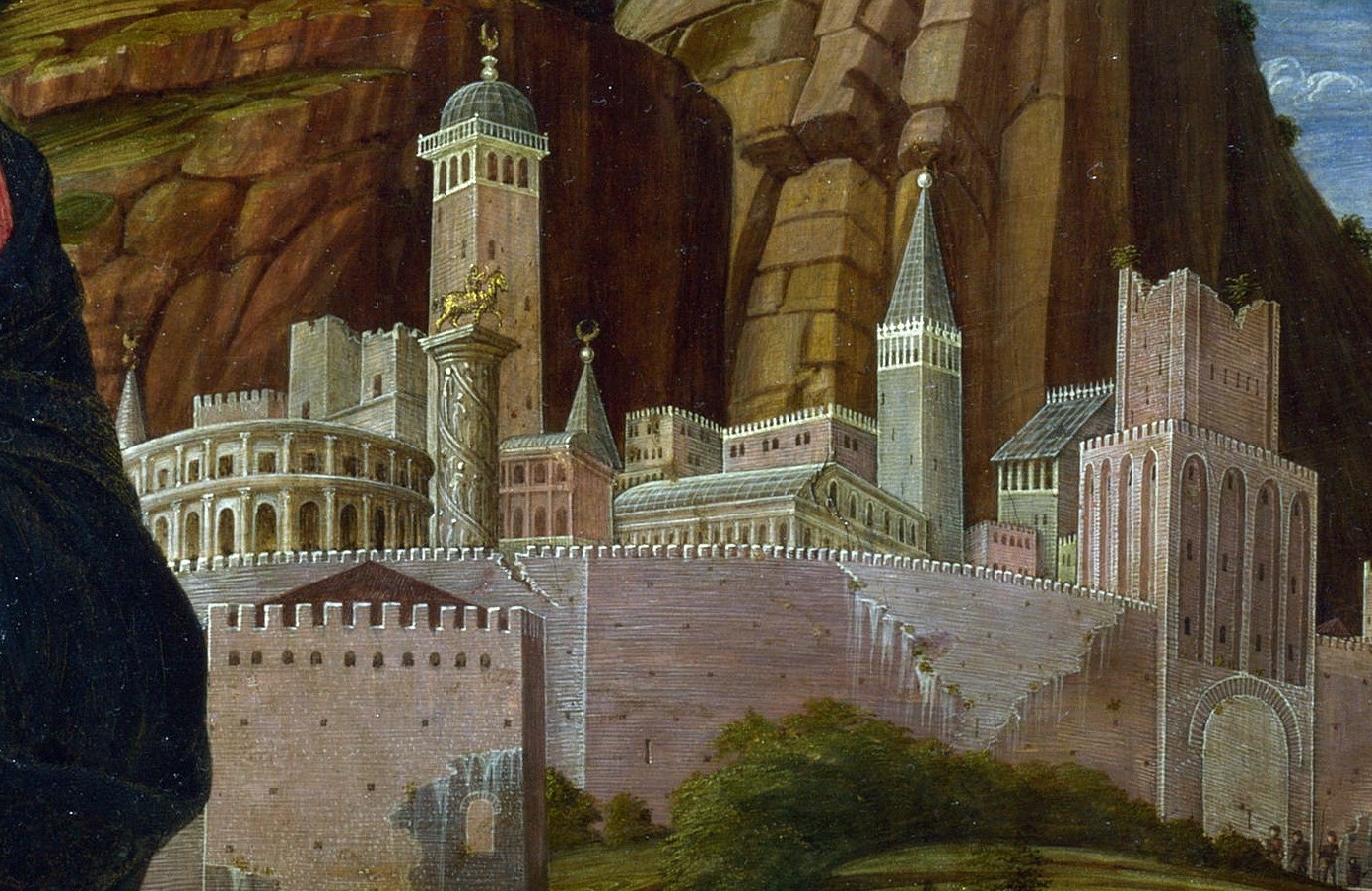
Over on the right in the background we see the walls and towers of
Jerusalem and the Roman soldiers coming to arrest Christ with Judas, his
betrayer, leading the way under the dark bird of bad omens.


OPUS ANDREAE MANTEGNA


He is also proud of how he paints architecture so the city of Jerusalem with edifices resembling the Colosseum and Trajan's Column is enlarged to three-quarters of the picture plane. The buildings that make the viewer think of Rome reveal Mantegna's close study of ancient buildings and ruins in Rome and Northern Italy (he even paints the equestrian statue of Marcus Aurelius on top of the column.) Since Jerusalem was under Roman rule when Christ was arrested, it made historical sense to Mantegna to paint his Jerusalem like a miniature Rome.



In Giovanni Bellini's Agony in the Garden Christ faces in the opposite way and kneels towards a single angel in the sky holding a chalice, the bitter "cup" Jesus asks God to take away from him as he is praying. The disciples are asleep in the foreground, as in Mantegna's, Jerusalem appears in the distance on the hill, and the Roman soldiers with Judas are depicted in the middle ground, as in Mantegna's.
While a sense of urgency appears in both, Bellini's pink dawn in the sky of his vast landscape makes us feel the end of Jesus' difficult night and gives a reason
for the disciples to have fallen asleep, but the rose dawn suggests a new hope as well.

The Agony in the Garden as an event takes place in the Bible right after the Last Supper. Jesus has known at that supper that Judas will betray him; he announces it at the table.
Judas leaves and accepts 30 shekels of silver from the Roman soldiers for the information as to Christ's whereabouts. The "good" disciples accompany Christ after the meal to a garden where Christ sets himself apart from them to pray.
The disciples are human and fall asleep while Christ wrestles with the knowledge that he will be arrested, tortured, crucified, and buried. The scene shows the viewer Christ's understanding of his own death and his own asking God to be allowed to forego the horror.
In Mantegna's scene we are made aware that soon he will be found and captured.

The anxiety of his arrest is compounded by the artist in his tracing out for the viewer the path the soldiers will follow around the hill to the sleeping men and up the stone stairs to the praying Christ.

The soldiers appear close and on the move. Even the rabbits on the path will be scattered in the coming tumultuous encounter. All the obstacles that Mantegna puts in the soldiers' way, the rabbits, wooden bridge, disciples legs, will soon be pushed past in the next moment of the onrush.

The sky reflects the ominous nature of the next moment, as does the black bird.
In Bellini's scene we know he will be captured, but the soldiers seem further away

and the brilliant light in the sky appeases the anxiety of the viewer with its beauty. God's plan for Christ seems less imminent and less hazardous in Bellini.
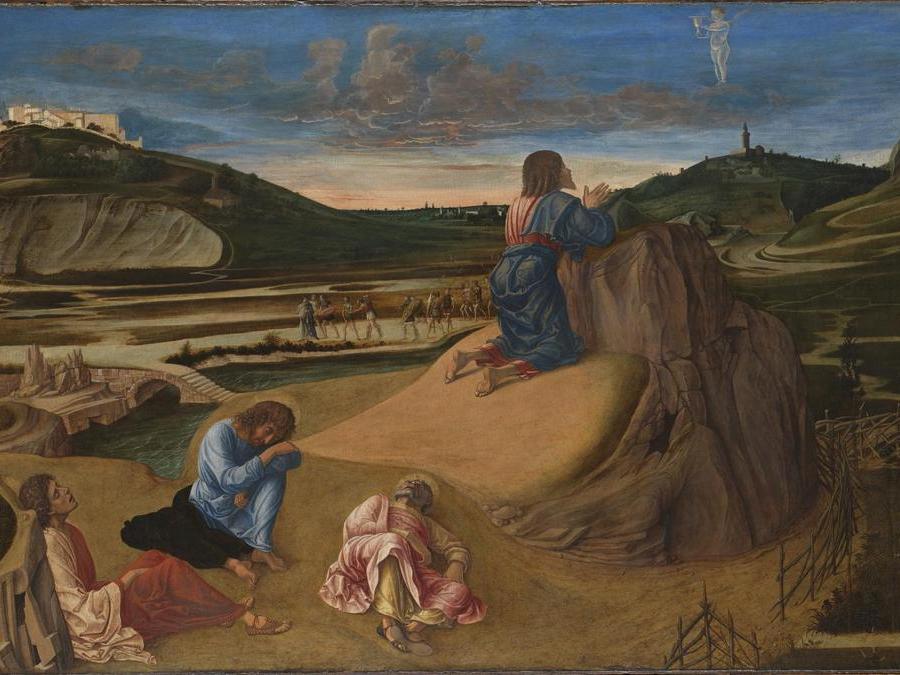
Bellini places steps in his painting, too, but they follow the curve of the beautiful Venetian bridge over the canal waterway and are so small they seem much further away.

Even the city appears high on a hill in the distance.

The viewer is allowed to imagine that Christ and his disciples might have time to gather their belongings and get away from the Romans.


Bellini's landscape is all inclusive to suggest that Christ's story is part of a larger history, not the individual story of a specific city as it is in Mantegna. The bigger ideas of fate and the range of human frailty come across the path over the bridge in Bellini. We are swept away as viewers in his scene by the height and loveliness of his dawn light beyond Christ's kneeling figure.

Mantegna's gang of putti wielding instruments of torture offer no redemption.
Bellini's God offers the cup of hardship from a sweet-faced baby boy.

Mantegna wants us to feel the agony in the scene.


