Friday, May 5, 2017

DONATELLO's DAVID

DONATELLO'S DAVID  - LAURO as DAVID

Donatello's bronze sculpture of David is a remarkable work. Leaving aside its importance as the FIRST BRONZE MALE NUDE STATUE in the ROUND SINCE ANTIQUITY, (although how can you leave that aside for long?) it has features that make it one of the most intriguing versions of David ever made. Here is a view of it in its present location, the Bargello Museum in Florence:
Left arm akimbo, left leg bent, left foot standing on the head of Goliath, it is a good example of contrapposto, the ancient way of showing motion on one side of the body while the other side is at rest. While the vertical split of movement/stasis was meant to give balance to statues, it also gave
the viewer a visual contrast that made the figure seem alive as David does here. The arm and leg gestures present a young shepherd who is cocky, sure of his triumph over the larger, older foe. He almost seems to smile remembering his confidence against all odds.

The statue, however, was not created for a museum originally; according to Vasari, it was made for a home, for the Medici family's open courtyard in Via Larga (Via Cavour now) in Florence. In Vasari's account Donatello made it for Cosimo de' Medici before Cosimo was sent into exile in Venice in 1433, and he says that it was placed in Palazzo Vecchio during Cosimo's time away. Vasari's account seems unlikely if the palace courtyard in which it stood was not begun being built until 1444. Since there is no documentation, the most recent scholarly consensus chooses a date for it that is later than what Vasari said, and definitely places it after the building of the courtyard and palace by Michelozzo from 1444 until 1457, when the family settled into their home. Since Donatello and Michelozzo were often partners in joint projects (Prato outdoor pulpit, for example), it would make sense that the sculptor would wait until his architect friend had finished the space before installing his statue in the middle of it.
As is visible in this plan of the Medici house (courtyard arcade outlined in yellow, pedestal for Donatello's statue in purple circle,) any visitor to the Medici Palace could have seen Donatello's David from the street and certainly as soon as they entered the first open air courtyard of the palace.
                       Exterior of the palace and interior of the first courtyard:


Imagine the impression the statue would have made upon family and non-family members! A free-standing bronze sculpture of a young man standing over the decapitated head of an older man.
  But Goliath's head is not apparent when viewing the statue from afar.

The Latin inscription that originally stood on the pedestal would have mitigated the horror of that death and turned the statue into a symbol of the freedom of a small city-state like Florence. "The victor is whoever defends the fatherland.  God crushes the wrath of an enormous foe.  Behold! A boy overcame a great tyrant.  Conquer, o citizens!” (Victor est quisquis patriam tuetur/Frangit immanis Deus hostis iras/En puer grandem domuit tiramnum. Vincite, cives!")
           Donatello chooses the narrative moment in the story of David after David's triumph over the giant Goliath. In the Bible verses describing this event in the Old Testament, 1 SAMUEL 17 - verses 1-58, many of the verses are spent on the threat Goliath represented to the Israelites because of his size and weighty armor:

4 And there went out a champion out of the camp of the Philistines, named Goliath, of Gath, whose height was six cubits and a span.
5 And he had an helmet of brass upon his head, and he was armed with a coat of mail; and the weight of the coat was five thousand shekels of brass.
6 And he had greaves of brass upon his legs, and a target of brass between his shoulders.
7 And the staff of his spear was like a weaver's beam; and his spear's head weighed six hundred shekels of iron: and one bearing a shield went before him.
8 And he stood and cried unto the armies of Israel, and said unto them, Why are ye come out to set your battle in array? am not I a Philistine, and ye servants to Saul? choose you a man for you, and let him come down to me.
9 If he be able to fight with me, and to kill me, then will we be your servants: but if I prevail against him, and kill him, then shall ye be our servants, and serve us.

Much is made in the Biblical text of Goliath's height and weight in order to make David's conquering of him even more heroic. David is a slight figure in Donatello's version to compare with the huge


size of Goliath's head at his feet:
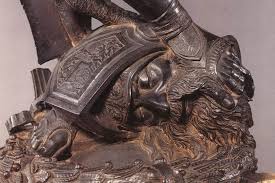
Goliath wears the helmet of the armor mentioned in the text, he has a large mustache and beard, and in Donatello's hands, his head is twice the size of David's in the statue though it seems buried under the victor's feet:
David is also 2/3 lifesize to emphasize his youth; he is an adolescent shepherd, too young to join his three brothers in the battle against the Phillistines. He is asked to take food to the troops and once there, can't believe anyone would be afraid of Goliath's threat. He is so confident about his ability to slay the giant that he is brought before the King, Saul.

34 And David said unto Saul, Thy servant kept his father's sheep, and there came a lion, and a bear, and took a lamb out of the flock:

35 And I went out after him, and smote him, and delivered it out of his mouth: and when he arose against me, I caught him by his beard, and smote him, and slew him.

36 Thy servant slew both the lion and the bear: and this uncircumcised Philistine shall be as one of them, seeing he hath defied the armies of the living God.

Saul then provides him with armor for the fight, but David takes it off, saying he had not yet "proved" it. He either felt it was too large for his size or he felt that he should only receive armor if he had been valorous in battle. 

In Donatello's bronze, David is naked, without armor. He wears a hat that looks much like a shepherd's hat, now encircled with laurel wreath in honor of his victory:

The ribbons of the hat remind us of his life before the battle:


From the back view we can see the stone still in his left hand, and on the ground at the back, if you look carefully you can find the slingshot that he has dropped near his feet after using it to knock out the giant (marked out in yellow in the second photo - the slingshot disappears behind the other feather from Goliath's helmet.) 


The sword in David's right hand is too large for his body; Donatello knew David used Goliath's own sword to cut off his head after he had knocked him out, so the sword is meant to be Goliath's size.
The feathers that run up the inside of David's leg are part of the decoration on Goliath's helmet but are splayed out in celebration of the smaller warrior's achievement:
At the base of the statue is a laurel wreath of victory, larger even than Goliath's head and interspersed in the laurel leaves are small balls, symbols of the Medici family.


The bronze bas-relief on the giant's helmet is a scene of putti, small children, on a triumphal cart, an evocative premonition of the death of the giant.
              The laurel leaves in the wreath on the base as well as those on David's hat are a code for the nickname of Cosimo de' Medici's grandson, Lorenzo the Magnificent. He was always known as "Lauro" by the family and "Lauro" means Bayleaf or Laurel in Italian. The encasing of the figure of David in the symbols of the Medici and specifically in the visual codes for "Lauro" is Donatello's way of saying that we are looking at an idealized portrait of Lauro as the ancient hero David.
At what age is Lorenzo given pride of place in the family home, an image of Cosimo's grandchild as great warrior for Florence? Lorenzo is born in 1449. By 1459 he would have been ten, the age at which his portrait is painted by Benozzo Gozzoli as the youngest Magi in the private family chapel in the Medici Palace, one story up from the courtyard of the David statue:


By that time the family home is finished and the family is living there. The celebration of the new residence is completed with portraits of the young Lorenzo, age 10-14, in painting and sculpture, one dressed and one undressed. Lorenzo, Lauro, appears almost an adolescent in the Procession of the Magi, but in the David statue, he may be slightly older, 14 or 15. If so, the statue could certainly be dated later than 1459 and before Donatello died in 1466. 
        For the modern viewer a portrait of a favorite oldest grandson on view in the family home is easy to understand. Since photography is not an option for the Medici family (photography not being invented until the 19th century), the media at hand are painting and sculpture. For a modern viewer perhaps the grandson painted as the youngest of the three kings might seem a bit odd, and
a sculpted version of the same grandson as the Biblical hero, David, also strange, but for a Renaissance visitor to the Medici Palace, portraits of living beings dressed up as figures from ancient stories is only reinforcing what they might have seen on the street in religious pageant parades. We know the Medici participated in the Feast of the Magi processions where family members took the roles of the three kings, (see Rab Hatfield's marvelous book on Botticelli's
Uffizi Adoration (Princeton, 1976) so the presentation of Lorenzo as the youngest king or Magus is understandable in the family chapel:


The laurel bush behind the head of the painted Lorenzo reminds us again of his nickname, LAURO:
And lest we wonder what his last name is, there are balls everywhere, balls being the symbols of the Medici for their coat-of-arms.
The original motif may have come from "pills" since the family name means "doctors," but the balls took on the additional meaning of "courage," as is its usage in the modern phrase "to have balls or have courage."  In the painted Gozzoli version of Lorenzo there are balls on the tips of his crown points, balls in the decoration on the crown, balls on his tunic, belt, and
balls on the trappings of the horse and on the halter:
           

They are not really needed in a chapel where everyone would know who was dressed up as the youngest king, but they are the kind of thing that would have identified Lorenzo in a parade out in the city of Florence as a member of the entourage of the Medici. Balls fill the chapel on floor and ceiling as well,

 but they connect the family space here with the family space of the courtyard where Donatello created ball bas-reliefs in the architrave of the courtyard arches.

Balls, then, will not surprise us showing up in the wreath of Donatello's statue of David, and he adds one to the hilt of David's sword (making it look very phallic) and David's rock can be read as a ball as well.

The symbols surrounding David in Donatello's bronze turn his David into a young Lauro with his courage "screwed to the sticking place." The emphasis on the family emblems become an emphasis on David's and young Lauro's courage in the face of great odds and compliment the grandson as well as the grandfather who probably ordered the statue.
        
(The marble pedestal was added later but also has balls, this time in the form of the egg-and-dart motif of ancient architecture.)
          Skip forward to 1469, the year in which Lorenzo the Magnificent gets married at age 20 to Clarice Orsini from Rome. A description of the family feast in the courtyard can be found in a manuscript in the Biblioteca Nazionale (MS II, iv, 324, fol. 108v - my thanks to Cristelle Baskins for this reference in her terrific article in Studies in Iconography, vol. 15,1993.) The 1469 description is the first time Donatello's David is mentioned in a document. I'm sorry I don't have the original Italian, but the translation from Janson's book on The Sculpture of Donatello, p. 77, is as follows: "There were no pantry tables for the silverware, only tall counters covered by tablecloths in the middle of the courtyard around the beautiful column on which stands the bronze David..."
           
The same embarassment that modern grooms may have when their brides-to-be are shown the early naked photographs of them as children must have been present for Lorenzo when leading his new bride into the courtyard where his early portrait as a naked David was set up prominently in the center. But not embarassment for long because the balls, the hat with laurel, the cocky stance akimbo display the new groom in the best light, that of a young hero. And the bride would have recognized that the hero stands on a bridal wreath, as Baskins has pointed out. In the Renaissance brides are painted into cassoni scenes wearing wreaths to help the wedding party identify the bride, white dresses not being yet the tradition:     Adimari cassone, Accademia, Florence, c.1450

In this case the bride wears peacock rather than laurel with balls, but the conquering of the bride seems to be suggested in the David of Donatello:
And since this is the ONLY statue of David from the Renaissance that has a wreath on its base, it seems more than coincidence that the first mention of the statue is in a wedding party specifically to celebrate LAURO and his bride. Before we make too much of the conquering of the woman in
marriage theme, though that is certainly present, we must recall that in the original Biblical story, one of the prizes that Saul offers to the man who can defeat Goliath is the hand of his daughter in marriage:
22 And David left his carriage in the hand of the keeper of the carriage, and ran into the army, and came and saluted his brethren......

25 And the men of Israel said, Have ye seen this man that is come up? surely to defy Israel is he come up: and it shall be, that the man who killeth him, the king will enrich him with great riches, and will give him his daughter, and make his father's house free in Israel.


Donatello's statue, then is a celebration of the triumph of young LAURO as DAVID, not just as the killer of Goliath, but as the winner of Saul's daughter in marriage. Since Clarice Orsini came from a Roman family with connections to the papacy, the Medici courage to take on a larger ambition, ally themselves with Rome, is given visual splendour in Donatello's dark bronze statue in the court. The result of the union with the Orsini made by the Lauro David on his wedding day ensured that one of his sons would become Pope Leo X and one of his nephews would become Pope Clement VII. No small feat for the grandson of Cosimo de' Medici, whose friendship with Donatello was so close they
are buried next to each other in the crypt of San Lorenzo in Florence. Neither Cosimo nor Donatello lived to see the wedding (Cosimo dies in 1464, Donatello in 1466,) but Cosimo's political ambitions may be on display in his wishes for his grandson.The statue was probably conceived before 1466 and put in place before 1469. (John Paoletti thinks the statue might be posthumous and carried out from Donatello's mold, not outside the realm of possibility for this art historian.)
Although we might misread the artist's intentions in other contexts, Donatello made sure we understood the personal relationship of this David to Donatello's greatest patron.
If the statue is created by Donatello in 1463, a year before his patron died, his grandson, LAURO, would have been 14, just right for the model young man seen here on his way to a bright future. The smile on David's face, then, can be read not just as the sign of triumph and courage, but the happy look of a young man on the way to claim his prize.

Monday, April 17, 2017

THE IDEAL CITY, ALMOST

THE IDEAL CITY, ALMOST


These three painted panels from the Italian Renaissance display architectural views of three different city scenes. They are approximately the same size, Height 131 cm (51.6 in). Width: 233 cm (91.7 in), and they are all three painted with oil on panel. Since the one at the bottom was originally left in the Monastery of Santa Chiara in Urbino (now in the National Gallery of the Marche in Urbino), the other two, one in the Gemaldegalerie in Berlin (middle), and one in the Walters Art Gallery in Baltimore, Maryland (top) have also been thought to have come from the city of Urbino originally.
          As with all paintings of this period, it is important to look carefully at the scenes to gather evidence before deciding on artist or date or function. All three of the scenes are constructed with the use of one-point perspective, the Renaissance discovery that if you draw all the diagonal lines in a painting to one point, you give the impression of real space. In the Baltimore panel the diagonal lines come together in the middle of the central arch opening.

 In the Berlin panel the "vanishing point" is on the water between the ships.
In the Urbino panel, the diagonal lines all meet at a point in the middle of the doorway of the central building, and the space of the piazza with the two fountains appears to be believable human space. The Baltimore panel is the only one with human figures, but those human figures may have been painted on at a later date, so they must be disregarded:  


What could be the purpose of these perspective scenes that are so perfect some have suggested they resemble stage sets? The scenes give us some clues. In the Baltimore panel, two of the buildings in the background of the piazza look like two actual buildings in Rome: a rounded-version of the elliptical Colosseum and a nearly identical version of the Arch of Constantine next to the Colosseum in Rome.
Painted version:
Actual Colosseum and Arch of Constantine:


Since the painted buildings look so much like the real ones, it is easy to imagine this panel is meant to represent Rome, with a suggestion of the walls of Rome behind the Arch of Constantine and the hills of Rome beyond that. And the four statues on the columns in the main piazza are worthy subjects for the capital city of the Papal States:  from left:
Justice with sword and scales, Temperance with wine and water measuring,
Abundance or Charity with cornucopia and child, and Fortitude with a column.
If this is meant to be Rome, though, what is the large building in the background on the right, the
octagonal structure with a cross on top?
Could this not be the largest church in Rome, an idealized St. Peter's with a centralized plan? One such plan for a new St. Peter's was envisioned later in the century by an Urbino architect, Bramante, in a drawing he made:
Since Old St. Peter's, begun in 333 A.D. by the Emperor Constantine, was, by the 15th century, dilapidated and crumbling as a complex, even as early as 1450 ideas for renovating that building were circulating among artists.  While the Constantinian basilica had been in the shape of a cross, the idea for a new St. Peter's always included turning the building into a central-cross plan church, where the arms of the transept and the body of the nave would be the same length and more perfect in form. The actual tearing down of the old structure and initial renovation began only in 1503 under Julius II. Could the painter here be imagining his own version of St. Peter's along with his version of the Colosseum and Arch of Constantine? If, as a painter, you are tasked with painting a scene of Rome, what better way to present it than with two very recognizable buildings from the ancient city and with an updated major Christian church design for the seat of the papacy? Three major sites that identify the place as Rome are the buildings in the piazza of the Baltimore panel.
           If the Baltimore panel is a scene of ROME, what cities are the other two panels meant to represent?
            VENICE and FLORENCE.
The panel in Berlin is a scene of a port city. In the distance beyond the piazza are painted several large ships on water, and the perspective lines lead directly to the water, as if the piazza were a walkway out to the sea.
VENICE in the 15th century had a such a walkway in such a piazza, as it does now, leading from the central Basilica to the Grand Canal, with the ducal palace on the left and the major library on the right. The columns of the arcade in the foreground of the Berlin view are reminiscent of the two columns which stood in Venice at the edge of the Bacino, the bay's alignment with the port water. The columns marked the site of executions in the 15th century; in the painting they have been doubled and removed from the water's edge as if to mollify their function. If you imagine standing on the far side of the piazza near the Basilica of Saint Mark, the view toward the water is still similar to that in the Berlin panel:
 

Whoever painted the Berlin panel, however, may have never seen the real Venice, and imagined Venice as a port with a fortress for a palace, like the port of Pesaro, which the artist probably had seen. But this cityscape is not Pesaro; it resembles more the piazza walkway that still exists in Venice.


 Pesaro fortress near the sea:

The URBINO panel is a simple remembering of the center of FLORENCE. The main ecclesiastical building is meant to look like the Florentine Baptistery, and the church facade behind it is a simplified version of the Cathedral in the same piazza in reality. When the perspective of the panel makes the Baptistery loom very large in relation to the Cathedral, one only has to look at the actual
Baptistery and Cathedral together from this angle, a ground view, to see that the Baptistery does look large and the Cathedral smaller in the central piazza of Florence:


The painter has made the octagonal Florentine Baptistery into a rounded building, understandable since from below it almost seems like a round building, with the rounded Romanesque arches accentuating that notion. The two-tiered elevation in the painted Baptistery is remembering the divisions in the original and the sloping roof is much the same in both. The church behind the Baptistery in the painting has just about the same area of its facade showing as it does in the real view of the Florentine Cathedral from this end of the Baptistery and the painted church is simpler than the Cathedral today because the 15th-century Florentine Cathedral facade would have been simpler as it was unfinished.
The buildings on either side of the Baptistery in the painted version lead back towards the church, as they do in reality.


            Three remembered views of the most prominent features of three major cities in 15th-century Italy. But why these three?  ROME, VENICE, FLORENCE.

             In reading a very good new biography of Battista Sforza Montefeltro by Marinella Mazzanti (2009, Urbino, Quattroventi) I came across a text from 1464 that explains it all. (The author of the biography was interested only in how the text described Battista's wedding and did not realize the connection to the panels.)   In a long poem written for Federico da Montefeltro, Duke of Urbino, by the court poet, Ser Gaugello de la Pergola, in 1464, in honor of the occasion of Federico's marriage to Battista Sforza in 1460, the poet says that wedding gifts were sent to the new couple, wedding gifts  "DA ROMA da VINEGIA (Venice) e da FIORENCA (Florence)" (from ROME, from VENICE, and from FLORENCE.)  Here is his description of the wedding celebration:
            "Non dico el peso e l'apparato grande/ De cera,de confecti et la credenca carcha d'argenti per diverse bande...da Roma da Vinegia e da Fiorenca/ Ve forno cose apresentate/ Et da signori grande eccellenca/ monete argenti con molti fiorini/ portaron tucti a donare a la sposa/ con tucti li Urbinati cittadini."
             Trans. - "I can't tell you the weight and the huge display/ of candles, almonds, and the dressers filled with silver for different groups, from Rome from Venice and from Florence there were such things represented and from excellent nobles/ silver money with many golden Fiorini (Florentine coins)/ everyone brought to give to the bride/ with all the citizens of Urbino."(p.67)
            Those same three cities! Not Naples, not Milano, which you might expect since the bride was the niece of the Duke of Milan.  The wedding presents came from Rome, from Venice, and from Florence.  And how to display the presents and acknowledge those specific city courts as having contributed these gifts?  Were these three city scene panels painted for the wedding of Battista and Federico to keep the gifts separated and not mixed up? So that gifts from Rome could be displayed under a painted view of Rome, those from Venice under the view of Venice, and those from Florence under the view of Florence? If so, it would explain why it was not important to include in the scenes more than a couple of buildings by which the city could be identified. Perhaps these panels were painted also so that the bride could remember to thank the appropriate court for the gifts sent on the occasion? With so many gifts, it would be crucial to organize them. The visual clues given in the painted panels would serve to distinguish which gifts came from which city-state when the gifts were displayed below them.
        It is also possible that these panels were actually part of a piece of furniture like a cassone, (a 15th-century wedding chest for trousseau gifts,) a decoration to denote where the pieces inside the chest came from.
Here is a cassone from the period:

If the panels were painted for this reason, it would explain why they are the same sizes, why they look so staged, and why they are simplified versions of the cities they represent.  The delineation of the location of origin of wedding gifts from three of the most important courts in Italy would explain why these panels were painted once and never again. It would explain why the bare minimum of visual specifics are given, and it would explain why the piazzas in the paintings are empty; if the panels were shoulder height and attached to spallieri (large benches with backs as here below,)

the gifts would have been displayed on the bench below them, gifts from Rome put under the image of Rome. If they were actually large cassone panels, the gifts from Rome would have been inserted into the chest space behind the painted image of Rome. You can hear the girls assisting the bride, "Oh, is that one from Venice? Here, it can be put into the Venice chest." Or, "Are those Fiorini from Florence? Put them beneath the picture of Florence there."
           Either as a way for the bride to remember where which gifts came from, which important family should be written to in thanks, so as not to mix them up with other gifts, or as a way to look over the gifts during their display for the long wedding celebrations (10 days) to see which gifts came from which relatives, the panels served a distinctive function.
Here is a Renaissance wedding scene in which the gifts are displayed on dressers on right and on the floor on the left:

The panels would have been a pretty fancy way to organize wedding gifts for display, but when wedding festivities lasted that long, and the gifts were gold and silver objects that were meant to be shown off, it is understandable that the Duke and his new bride would have asked their closest artist to produce a suitably aesthetic presentation for that display, whether outside of a chest or above it. One can imagine these panels lending a beauty to the gifts from each artistic center, whether they stood above the chest or on it:


We have established a possible date, 1460, for these panels, and a possible function. Though the function seems perhaps mundane, the panels had their own artistic merit to warrant preserving them long after the furniture was destroyed. They would be saved as wedding memories, too. What artist could have produced these in 1460 for the Duke of Urbino and his new wife?
          PIERO DELLA FRANCESCA is the only artist in the Duke's employ who combines the qualities that are necessary for the attribution of these panels:
 1) knowledge of one-point perspective. Piero wrote a treatise on perspective, De Prospectiva pingendi, explaining how to use one-point perspective in painting. His knowledge of math would have enabled him to create city scenes to small scale.

 2) ability to convey beautiful light; Piero's light is one of the captivating elements in all of his paintings.


 Annunciation, 1460                                                  Baltimore panel, 1460

 3) ability to paint statues on top of columns:  Piero shows he could do that in his painting of the
Flagellation from around the same date:
In the left scene of the Flagellation of Christ, Christ is tied to a column on which stands a statue of Apollo, the sun god; the arrangement of the column and statue is similar to that of the statues in the Baltimore panel:


4) observation of urban buildings, the shutters in windows, the prongs set outside of windows for the hanging of laundry on long rods (see the third building in from the right in the Urbino panel):


5) and Piero had been to ROME and FLORENCE but not to VENICE - perfect for the painter of these panels; his vision of Venice must have been based on what Domenico Veneziano had told him about his native city and would explain why the discrepancies with the real place are greatest in that panel.
          Three beautiful panels of ideal cities, but they are not ideal, they are meant to be real representations of real cities without people or too many specifics because they were meant to just stand for the PARTICULAR CITY - so not IDEAL, but ALMOST.
          Da ROMA, VINEGIA, e FIORENCA.
          If these wedding display panels were used perhaps for storage afterwards as well, it would explain why they are a bit like a stage set. Once the chests and gifts and guests have left, the beautiful reminders of the best parts of three cities remain. How ironic that these panels have ended up in three separate cities, and none in the cities they represent!
                                                            ROMA - is in BALTIMORE

                                                         VINEGIA is in BERLIN
                                  
                                                             FIORENCA is in URBINO

These three panels are all signs of the status of Urbino as a city center. If three of the most important city-states paid homage to the Duke of Urbino for his wedding day, how grand a place Urbino must be! At least one cityscape stayed in URBINO and gave us a hint as to the reason for the existence of all three of the panels. None of them are IDEAL CITIES, then, just enough icons to tell us which CITY they are meant to be, and just enough recognizable buildings in them to tell us who is paying tribute to the power of URBINO. Like scarves with the Eiffel Tower, we know which gifts were sent from Paris. The panels do not represent REAL cities, either, just stand-ins to identify them as that city without using words.
But the city-state that preserved these panels was aware of what these city views really said about the city-state that owned them, URBINO itself. Three cities came to the wedding of one.