Friday, September 23, 2016

The Try-Out audition for Raphael's Disputa


The Try-Out Audition for Raphael's Disputa
 

In 1505 Raphael (Raffaello Sanzio) (1483-1520) was still only 22 years old and working as an apprentice for his teacher in Perugia, Perugino.  By 1509, four years later, he is a major player in the most important decorative program in Italy after the Sistine Ceiling, the frescoes of the Stanza della Segnatura in the Vatican apartments in Rome.  How does he appear as if from nowhere to become one of the three greatest artists of the Late Renaissance?  Up to now, scholars have speculated that he joined Pinturicchio in his decoration of the Chapel of the Piccolomini in Siena, and learned a great deal from helping to paint the cycle of the Life of Aeneas Sylvias Piccolomini (1502-3) there. But the
Pope for whom that was painted, Pope Pius III, died in 1503 after one of the shortest papacies in history, 26 days, so the work begun there is terminated with Pius' death and Raphael has to find other
employment. It is certainly true that the Sienese program prepared him for wall frescoes and he is
depicted in those frescoes himself, arm akimbo, as though Pinturicchio were aware of Raphael's incipient talent.


Scholars have talked about Raphael's going to Florence in the year 1504-5 and being influenced by Leonardo and the Mona Lisa. How does he jump from being just a helper, albeit such a crucial one that Pinturicchio paints him twice, to becoming a full-fledged painter in the Vatican?  
            If you look at two of his works in 1504-05, they still seem to be painted in the mode of Perugino, his teacher: the Mond Crucifixion and the Marriage of the Virgin


In these panels, the faces are sweet and pink-cheeked like Perugino's faces, the figures are slender
and seem to bear very little weight, the hair, banners, and staffs are ribbon-like. The figures stand in a landscape that appears infinite and all action is concentrated in the foreground.

But by 1505 he is back in Perugia and the painting we see there in the Cappella di San Severo
shows an artist who has broken from the style of his teachers, Perugino and Pinturicchio, and
is emerging as his own man.
The fresco that he paints in the chapter room of that Chapel is, in retrospect, a TRY-OUT fresco for the pictorial arrangement of figures in space that he produces in the fresco of the DISPUTA in the Vatican Stanza della Segnatura. Just as you can see the old man in photos of the child, and the child in the photos of the old man, we can see in looking at a comparison of the two works, the development of ideas that are child-like in Perugia, and grow and mature in the Stanza.
          What is this work in Perugia that is relatively unknown?

It is in the chapter house of the Chapel of San Severo, Cappella di San Severo, a room used for prayer by the monks of the establishment. The fresco takes up one wall of the room and a bench on the wall opposite allows the contemplation of the work or the reading of Scriptures.
Raphael signs and dates the work 1505 in the lower left section of the painting:
RAPHAEL DE VRBINO D. OCTAVI/ANO STEPHANI VOLTERRANO PRIO/RE SANCTAM TRINITATEM ANGE/LOS ASTANTES SANCTOSQVE / PINXIT / A.D. MDV. But the lower right inscription suggests that the work is finished by another artist by 1521. Since fresco painters begin work at the top of the wall and work down, we would assume the upper half of the fresco to be by Raphael, even if the style evidence didn't already indicate that. The subject is the Trinity up in heaven with angels and saints, and other saints appear in an enclosure down on earth that includes a niche containing a terracotta Madonna and Child.
Here is the painting with all the identifications:
While some of the figures may remind us of Perugino, particularly the two flying angels with
hands in prayer next to Christ, the saints seated on the clouds in a half-circle who converse with
one another are most definitely painted by the new-style Raphael. These saints, Maurus, Placidus, Benedict on the left and Romuald, Benedict Martyr, and John(damaged) on the right all seem to bear weight and have volume and body under their drapery. They turn in natural 3/4 views to converse with one another and seem to be actual live figures with foreshortened limbs, as opposed to the stiff scarecrow saints down below them. While those stiff standing saints and the Christ figure may be by another artist, the small angel above the head of St. Benedict on the left has musculature that reminds us of later Raphael children, such as the two boys (Christ and John the Baptist) in the Uffizi Madonna of the Goldfinch (1505-06.)
 
How is the whole Perugia fresco a try-out for the Disputa then? In the San Severo fresco Raphael is playing with two different levels, two tiers, to represent the heavenly realm and the earthly realm. His saints above sit on benches similar to the bench in the room itself; they contemplate the Trinity, Father, Son, and Holy Ghost in much the same way that the monks in the room would. The saints hold objects that identify them, but since some of them are less well-known, Raphael also writes their names below their bodies to identify them. The spatial arrangement of the figures in a semi-circle around the Godhead in the heavenly realm is almost identical to the compositional arrangement of the saints set up in the Disputa in the Vatican.


In both works instead of the action being placed entirely in the foreground, the space of the upper tier gradually recedes in the cloud formation and the figures take up natural positions in that gradual recession so that the action is not crowded in the front of the picture plane. The main figures in both are in the center and represent the Trinity in both cases. The saints turn in toward the Trinity in both
paintings and they hold attributes in both that identify them. The two-tier system for heaven and earth
is repeated in the Disputa in roughly the same manner as it is composed in the San Severo scene a semi-circle of seated sacred figures who converse.
       Raphael begins work in Rome at the Vatican Stanza della Segnatura (the Official Signing Room) for Pope Julius II in 1509 and works on it until 1511. On the ceiling of that room were painted four women who represented four IDEAS -THEOLOGY, PHILOSOPHY, POETRY, and LAW. The four wall frescoes in that room are displays of people from history and myth concerned with each of those areas of human knowledge.
 Thus, the DISPUTA is meant to be a documentation of famous thinkers about THEOLOGY. Disputa refers to a discussion about TWO important religious tenets of Christians: the WAFER on the altar as a symbol of the body of Christ in Christian belief and the TRINITY, the idea that God is tripartite (FATHER, SON, and HOLY SPIRIT.) All of the men painted on the wall have some interest in the discussion and they come from many time periods in theological history. The artist included portraits of contemporaries and maybe even himself. Here is an enlarged LABELLED DISPUTA
Scroll to the right to see the whole.
The heavenly arrangements of saints begun in San Severo is carried out with supreme confidence in
the Disputa. Instead of just Christian saints, Raphael includes figures from the Old Testament
in the upper realms:
On the left Adam and David converse with St. Peter and St. John the Evangelist:
On the right Abraham and Moses are engaged with St. Paul and St. James Minor and St. Lawrence:
The seated figures gather on a bench that can't be seen in this representation, but the arrangement of
heavenly figures in a semi-circle holding their attributes is very much like the setup in the San Severo
fresco, Christ and the Holy Spirit in the center. 
Even Christ raises his arms in exactly the same gesture in San Severo and the Disputa.
 
In the lower half of the Vatican fresco, Raphael has expanded the world of his saints out to an infinite
landscape. He has extended it to men who have thought about theological questions or who have been involved in religious constructions. Thus he places on the right in the earthly realm Dante who died in 1321, Savonarola (d. 1498), very near Sixtus IV, who died in 1484, along with St. Thomas Aquinas(labelled by Raphael,d.1274) and Bonaventure(labelled by Raphael, d.1274), as well as two FATHERS OF THE CHURCH, Augustine (d.430A.D.)and Ambrose (labelled by Raphael, d. 397). 
 
On the left he includes himself, his friend Bramante who was the first architect of the new
St. Peter's, St. Francis (who died in 1226), and the two other FATHERS OF THE CHURCH, 
GREGORY the GREAT (labelled by Raphael, d.604) perhaps a portrait of Julius II, and JEROME, translator of the Bible (labelled by Raphael, died 420.)
The men look as though they are seeking out answers in books, answers to the question about how
the bread on the altar can become the body of Christ in Heaven, answers to the question of how God can manifest in three forms. Their gestures suggest they are all involved in a conversation about these important Catholic beliefs. Some of them look at or gesture towards the altar and the wafer held in the monstrance on the altar and some point to or look up at the vision of the Trinity:
For Raphael and Julius the conversations about the meaning of Christ's words at the Last Supper or  those about God, his Son, and the Holy Spirit are discussions which continue over the centuries and engage many of the most interesting religious minds. The inclusion of figures such as Adam and Moses does not mean these Old Testament icons actually had considered the issue of transubstantiation or that they were Christian believers, but they are included in order to convey the idea that from the beginning of time (Adam) God has intended to give his only Son in sacrifice for people's sins. The continuum of discussions about religion extends to all of Judeo-Christian history.
            The contemplation of the images of the Trinity and the saints who believed
in the Trinity are represented in both San Severo and the Disputa. In the Disputa Raphael has enlarged the scene from a gathering of local saints to a gathering of writers and thinkers from theological history up to his lifetime, a display of men concerned about FAITH. The San Severo image is meant to be used as a stimulus for Perugian monks whose faith is chosen. This is the only image they would have confronted in the room. The Disputa, on the other hand, is placed in a room
opposite the SCHOOL OF ATHENS, a painting where the great minds of PHILOSOPHY are displayed in an architectural setting.


Raphael's San Severo piece is his preparatory fresco for the arrangement in the Disputa, but the artist
who painted the SCHOOL of ATHENS was prepared for more than religious conversation.


Gone are the pink-cheeked Perugino faces, gone the ribbon-like bands of scrolls, all replaced with serious, weighty figures whose life-like stances and gestures set in realistic landscape and light
provide a full picture of Western thought in ideal human forms.

Sunday, September 11, 2016

GHIRLANDAIO'S GIOVANNA DEGLI ALBIZZI


GHIRLANDAIO'S GIOVANNA DEGLI ALBIZZI

Alberti says in part in his treatise on painting, Della Pittura (1436) that "painting has a divine force that not only makes absent men present but makes dead people almost alive after many centuries."

(Tiene in sé la pittura forza divina non solo quanto si dice dell'amicizia, quale fa gli uomini assenti essere presenti, ma più i morti dopo molti secoli essere quasi vivi, tale che con molta ammirazione dell'artefice e con molta voluttà si riconoscono.)Book 2

Fifteenth-century painters worked before the invention of photography in the 19th century.
Their insistence on mirroring nature, however, is a way of answering the human need for recording people's features, especially to remember them after they are dead, a need which is answered in the modern era through photography. In 1489-90 Domenico Ghirlandaio (1449-1494) paints a panel portrait of Giovanna degli Albizzi (now in Madrid in the Thyssen-Bournemisza Museum). The portrait displays Ghirlandaio's mirroring of nature and his desire to adhere to Alberti's call for keeping the dead alive through art.
          Giovanna degli Albizzi was a young Florentine woman of a prominent patrician
family in Florence who was married in 1486 to a young man of another prominent Florentine
family, Lorenzo Tornabuoni.  Lorenzo was the son of Giovanni Tornabuoni,
who was the head of the Medici Bank in Rome and the brother of Lucrezia Tornabuoni,
the mother of Lorenzo the Magnificent of the Medici family. Through the Medici bank connections, Lorenzo, shown here in portrait medal and in Ghirlandaio's fresco in Santa Maria Novella,
 
is heir to a fortune and wants to provide for his new wife. But two years after their marriage, Giovanna degli Albizzi dies in childbirth. While death in childbirth is a common occurrence for women in 15th-century Italy, Giovanna's death at age 20 is a great blow to the family in 1488.
           Ghirlandaio is then commissioned to paint her portrait, probably by the family. Presumably it would have hung in the family home (Palazzo Tornabuoni - here a photo of one of the rooms in that palace today)
as a reminder of her beauty and youth, and as a reminder of what she looked like before she died.
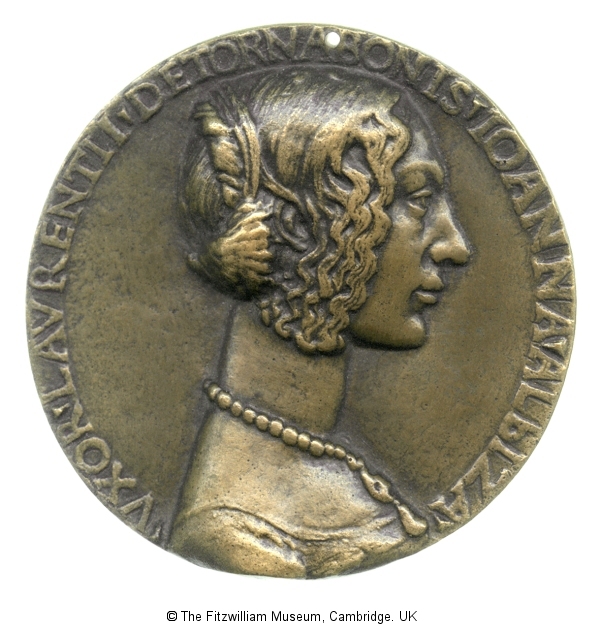
Ghirlandaio's portrait, however, is not the only memorial made of her features. The family
commissions a medallion of her face with three naked Graces on the back (now in the Fitzwilliam
Museum in Cambridge, England):
 

On the obverse of the coin is her profile image with the Latin inscription bearing her name beginning at middle right:  Ioanna Albiza Uxor Lavrentii de Tornabonis (Giovanna degli Albizzi, Wife of Lorenzo Tornabuoni.) Her hairdo is similar to the painted portrait with short curls falling over the ears and the long straight hairs at the back of her head wound up in a tight bun. Her nose appears larger in the medal than in the painting and the bulging around the eyes is eliminated in the painting. The reverse of the coin has the qualities that she was associated with written around the edges:  Castitas (Chastity), Pulchritudo (Beauty), and Amor (Love,) as well as an image of the three Graces of ancient myth who embody those virtues. (Chastity after marriage in 15th-century terms meant fidelity to the husband.)
       Ghirlandaio's reliance on the coin image in fashioning his portrait of Giovanna is limited to the profile outline. He does not include the three Graces or their words and he idealizes the face of the young woman. But he does include other objects in his painting that are clues to the personality of the sitter. And he does make reference to the immortality he expects Giovanna to enjoy from his own art. Let us examine closely the photograph-like image he produces for his viewers.       
       As in many of his larger paintings, the viewer sees a symmetry to the arrangement of objects in the pictorial space. He imagines Giovanna as an extension of her coin image, her profile in silhouette against a dark background of a plain grey wall with inset shelves.

          On one side, the left, are objects of material value, jewels, pearls, gold brooch and pendant, and on that side she wears two rings, one on her pinkie finger of the left hand and one on the ring finger of the right hand. Since rings are given as gifts in the 15th-century male exchange of contracts which was the 15th-century marriage, it is appropriate for her to be wearing two here, and since the rings are often passed down from other family members, the fact that one is too small for her is appropriate, too. (They didn't always fit.)
           On the right side are objects of spiritual value, the rosary beads for prayer, coral to protect her in the afterlife (coral in the 15th-century was thought to ward off the devil),


the opened Book of Hours to sustain her in more prayer, and the CARTELLINO, with the words from Martial's epigram 32 in Book 10, words about her spiritual character and soul and the date 1488, of her death:
LATIN:  ARS UTINAM MORES                    ENGLISH:  Art, if you could only
              ANIMUMQUE EFFINGERE                                Portray the manners and soul,     
              POSSES PULCHRIOR IN TER                            There would be no more
              RIS NULLA TABELLA FORET                           Beautiful panel on earth.
              MCCCCLXXXIII                                                   1488


The inscription is taken from the ancient Roman writer Martial, but one letter has been
altered from the original on purpose. The Latin Posses in Ghirlandaio's 'cartellino' was
originally Posset in Martial's poem. That one letter change from t to s changes the Latin from a musing about art to a direct address to Art. Martial writes: "If only art could portray the manners and soul, No more beautiful panel on earth would exist." The artist in the 15th-century includes the
cartellino with the Latin words in order to talk to Art directly. "Art, if you could only portray
the interior life, this painting would be even more beautiful." The inscription is turned into a
compliment for the spiritual life of this young woman.
          The Latin words Pulchrior, effingere, bella in tabella appearing to the right side of the
profile of the girl, all contribute to the viewer's impression of this portrait as a beautiful representation of the sitter. Of course the artist knows that his contemporary viewers will
connect this painting with the life-size portrait of Giovanna inserted into the Visitation scene
in the fresco cycle he painted for the Tornabuoni family in Santa Maria Novella, where she appears
next to her husband's aunt:
 
But Ghirlandaio is aiming at an audience for his painting that goes well beyond the immediate family,
well beyond his contemporaries. His Latin inscription reminds us of other centuries, both past and future, when art has competed and will compete with reality to make beauty. 
         It has already been pointed out by scholars that Giovanna wears the insignia of the Tornabuoni,
the figure of a diamond, seen sideways in the cloth embroidery of her outer gamurra garment, as well as an L embroidered on her shoulder in a loop to remind us of her loyalty to her husband Lorenzo:
 
           In the panel painting she is contained as if in a coffin with the objects that the family wants to 
accompany her in death. Thus, her precious jewels are set on the shelf and she wears one; her
beautiful yellow brocaded camurra is given pierced windows in her left sleeve (much like the pierced window through which we see her) for her muslin undergarment peeking through. All is restrained
and hushed, her lips parted slightly where we imagine no sound because of the stillness of her gaze. She looks out towards another window, from which light is coming; the light casts a shadow on the jewellery and on her gown, as well as on the book on the shelf. The shadows fall to the right since the light comes from the left. She holds onto a white handkerchief as a reminder of the way that she died; the white cloths used in the preparation of childbirth are alluded to in it. 
She faces the light, which in the 15th-century is always symbolic of Christ; she is facing her maker with her material and spiritual objects of value to be placed with her profile figure in the weighing of her soul in the afterlife.  Her body stands in a grey pietra serena cupboard, presumably in the Tornabuoni palace, but she is being painted as though dead, stiff and unyielding, with her youthful beauty and belongings set before the light of the afterlife.
          The artist in this case is so aware of the fragility of life and of its temporality, that he dares
to include himself in the work, something noone has pointed out before:

Worked into the intricacy of the pendant Giovanna is wearing we can make out two letters: O and B.
The O is formed in the ring of slate blue stone at the top of the pendant, the B is formed in the gold
decoration holding the ruby in the middle above the pearl balls that are Medici symbols:
O B - Secretly he has inserted  OPUS BIGHORDI (the work of Bigordi - Bigordi was Domenico's
family name) into this work as he had done in the fresco in the church of Santa Maria Novella:
 And just as he had inserted his own self-portrait into two scenes of the frescoes in the same cycle:
He knows how tenuous is his own part in the documenting of history. In the self-portrait
image he points to himself as author of the work. In the Giovanna portrait he draws a
line, the beautiful thin line of the pendant on her neck from his own initial to the inscription bearing
as its first word:  ARS
He has tried to follow Alberti's prescription for the painting of people to keep them alive even 
after death. In the beautiful conception of his Giovanna degli Albizzi, he has resurrected and reminded us also of the artistic skill of Ghirlandaio himself.