Wednesday, November 25, 2015

DELLA ROBBIA's ANNUNCIATION in FLORENCE

DELLA ROBBIA and BOTTICELLI -
the two most exquisite ANNUNCIATIONS 

So many Annunciation scenes were painted in the 15th century in Italy it might be difficult to single out any one as the most beautiful. But of all the Annunciations carried out by Italian Renaissance artists, two are conceived and produced in such a way that they could be chosen as the most exquisite renderings of that subject. This blog will be about the sculpted one, the next blog about the painted one.

ANDREA DELLA ROBBIA - Andrea della Robbia produces a blue and white and green-glazed terracotta bas-relief in a lunette shape for a chapel in the church of the Hospital of the Innocents, Santa Maria degli Innocenti. When the church is reorganized in the nineteenth century, the Della Robbia lunette is brought
into the courtyard of Brunelleschi's Hospital of the Innocents and placed within one of the lunette arches at the end of the covered walkway of the Cloister of the Boys. In the plan below, B is the Cloister of the Boys and L is the facade arcade visible in the exterior view. The lunette is placed in the lefthand corner of the darkened arcade of B, near the juncture with A. To see it, enter between the two D's and turn left.


The lunette is just visible in the view below in the far corner above a doorway in the Cloister of the Boys. The entrance doorway is in the middle.
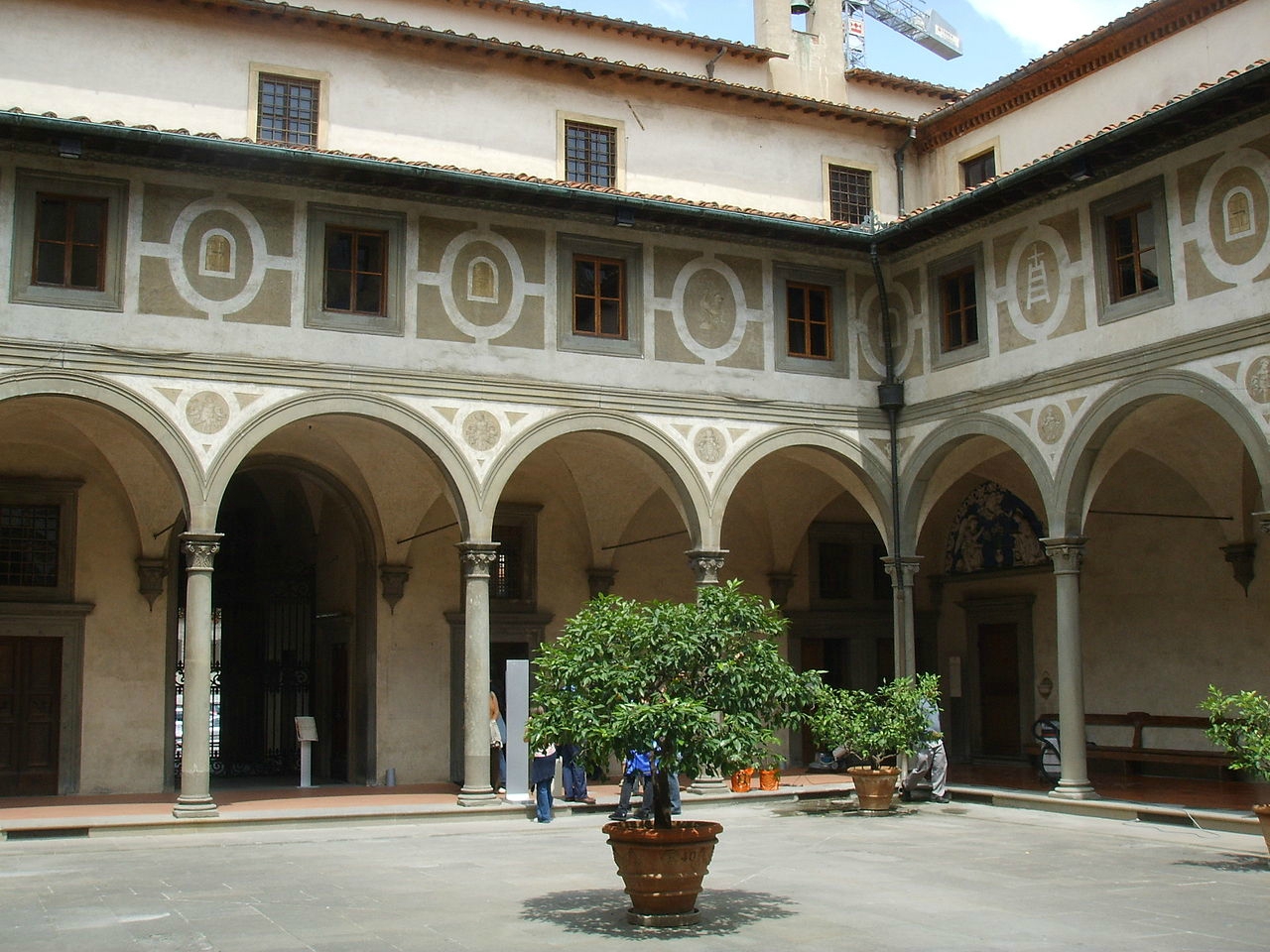
(View of it turning left from entrance.)
Scholars disagree about the dating of this scene of the Annunciation, some placing it in the 1470's and indebted to Leonardo's Annunciation (previous blog), some arguing for a date of 1493 and a commission of Francesco del Pugliese. I tend to side with the earlier dating, in the 1470's, when Andrea della Robbia is starting out in the workshop of his uncle, Luca della Robbia.         
WHAT qualities make this ANNUNCIATION EXQUISITE?
1)BALANCE of COMPOSITION
Angel Gabriel and the Virgin face each other as they kneel with their heads at the same height. They present a nearly symmetrical arrangement of two figures whose backs (in one case wings) curve in imitation of the curve of the lunette.


In the center sits an urn filled with lilies:

The symmetry is broken up by the arrival in DEUS EX-MACHINA of DEUS (God) (accompanied by angels) who puts his hands out to release the dove of the HOLY SPIRIT in flight towards Mary.

Even this group is balanced in a triangular arrangement with the lilies held by the Angel and the lectern supporting the Bible read by the Virgin.
Framing the whole are winged cherubs (appropriate for the setting) with sweet innocent faces.
2) GRACEFUL MOVEMENTS AND TOUCHES:
Andrea's handling of heads and hands gives us a sense of gentle, courtly movement. The smooth skin on the faces of the angels and of Gabriel and Mary contributes to a feeling of calm. Gabriel's hands address the Virgin in restrained fashion, as do God's hands above.


The Virgin's hands respond with one hand on her book and one on her chest, placed as if accepting a dance. All the gestures are gracefully rendered to tell the story. 


EVEN THE DOVE of the holy spirit flies gracefully in with a MINIATURE HALO that matches his size!


3) CLARITY OF DRAMA and COLOR
The story told follows the text in the BOOK OF LUKE:
The eyes of Gabriel and parted lips indicate that he is speaking to Mary:
GABRIEL: "Hail, thou that art highly favoured, blessed art thou among women."
Mary replies without speaking, in the REFLECTION STAGE OF THE ANNUNCIATION, with eyes cast downward and with hand on book. Her gestures mirror the text of her thinking:
MARY "cast in her mind what manner of salutation this should be."
The white drapery of all the figures set against the blue of the sky emphasizes the main characters in the drama and makes their gestures clear. Andrea has tried to give some clouds to the sky behind to make this mystical event more naturalistic, and he adds green for the stems of the flowers for the same reason.
The Angel and Virgin appear on a stage with realistic bodies under their drapery. The sculptor captures an intense moment in their communication with the salutation of the angel in his hand and flowers, in the reply of the Virgin in her right hand gesture. The natural fluidity appears in the gestures of God's hands, too, as they contribute to the conception (in two senses.) The message that she will become pregnant even though she is a virgin arcs over the vase of flowers that are symbols of her purity and her fertility. 
         It is in the sweetness of the Angel's face and the sweetness of the Virgin's that Andrea conveys with exquisite artistry the magic of this moment.


How reassuringly harmonic these graceful, young figures must have seemed to the youths without parents in the Hospital of the Innocents, a foundling hospital!  In Andrea's hands God's plan is a beautiful drama being played out. Anything is possible in a realm where God may fly in at any moment to touch your life.


Monday, November 23, 2015

LEONARDO's ANNUNCIATION

LEONARDO'S ANNUNCIATION

Sometime in the 1470's Leonardo da Vinci painted an Annunciation for a nunnery in Florence; it is now in the Uffizi Gallery:
This rectangular painting is said to have come from the church of San Bartolommeo connected to a Benedictine nunnery on the other side of the Arno from the Duomo in Florence.


The nunnery was up on a hill above Porta San Frediano, the hill called Monte Oliveto because it was full of olive trees. (Monte Oliveto and the church still exist in Florence; from the Via Pisana follow the Via Monte Oliveto up the hill; it will wind around a grove of olive trees.)
 

But back to our painting. Throughout the Middle Ages and Renaissance Mary is known as the "porta clausa," the "closed door" and as the "hortus conclusus," the "enclosed garden." 
Visual references to both those Latin metaphors can be found in Leonardo's painting. Where is the "porta clausa?" The door next to Mary on the right is "open" to reveal her bedroom, complete with bed, a domestic place of conception. The image of the red bed evokes the emotional intensity of her moment of pregnancy, but the open door there is not "closed."
 
Behind her body, though, are two impenetrable walls with quoins that come together to form a "porta clausa" for the phrase that refers to Mary's virginity. She sits at the juncture of those walls, enclosed by them. She is a closed door in this corner.
The Angel Gabriel, who arrives on uplifted wings and bended knees to announce to Mary that she will be pregnant with Christ by God, alights on a garden carpeted with botanically-correct flowers and plants which are in full bloom. (A recent book on Leonardo's flowers (2013, Aracne) by Giovanni Gestri - I Fiori di Leonardo details the accuracy of the artist as botanical observer.)
Mary and the Angel appear together in this "enclosed garden," "hortus conclusus." Behind the angel and Madonna is a low gray parapet which "encloses" the "garden." That the enclosure is only broken where the Angel holds forth lilies in bloom may suggest to the viewer that she is impenetrable except by God. 
Lilies are signs of purity because they are white flowers, but the lilies held by the Angel are open and full, signs of fertility and ripeness. The coming together of fertility and inviolability as expressed by Leonardo happens in the most natural of scenes, outdoors in the enclosed garden.
           Normally 15th-century Annunciation scenes have either God the Father flying in with angels in the sky or the dove of the Holy Spirit flying in as Mary hears the words of the Angel. It was said that as soon as the Angel's words reached her ear that she was impregnated. (See blog entry on Simone Martini's Annunciation, also in the Uffizi.) In Leonardo's Annunciation the only thing to appear above the heads of the main protagonists is a cloud with edges touched with light. But are we meant to see the face of God in the shadows of that cloud? are we meant to see an angel? or is the cloud the dove with outstretched wings? Leonardo makes the cloud deliberately mysterious and indefinite and yet part of Nature.

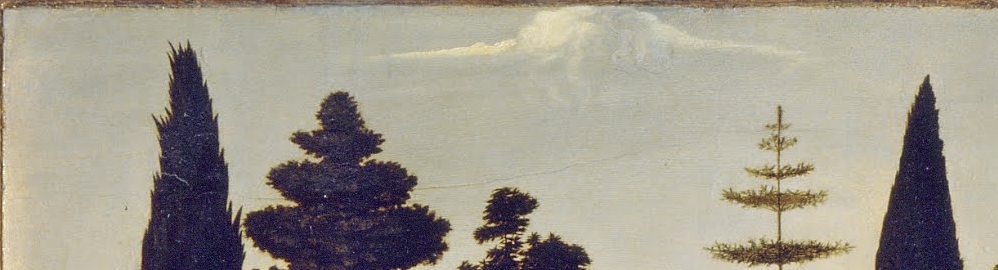
In his notebooks Leonardo studies nature in drawings and comments. God was present everywhere for him, in the cypresses behind the wall, in the lake beyond the garden, in the clouds that block our view of the mountain in the background and in the cloud which may form the shapes of the Deity.
The artist respects the tradition that maintains that Angel Gabriel had wings, but his wings are based on drawings Leonardo made himself of actual birds which he recorded. 


Since Nature was his Deity (we rarely see him speak of holy figures in his writings), we see the divinity rendered by the artist here in the natural forms he observed. But the more he studied Nature, the more he realized how much of it was unfathomable, mysterious. In the background is the smoky atmosphere, the "sfumato" for which he is famous, the indefinite contours of things in the distance, especially the outlines of the mountain at the back. Leonardo chooses to represent this great divine mystery as the interaction of human beings with the Deity in Nature. His botanically-correct flowers, then, don't reduce the mystery, they add to it, because they make us question what is real and make us see the divine patterns in natural forms.
          The "Monte" at the back of the scene but exactly at the center of the panel and exactly halfway between the two protagonists is also meant to contribute to the mystery at the heart of the painting.
It is shrouded in cloud, but we still understand it to be another "Monte", the Monte Oliveto where the nunnery was and probably also the Mount of Olives at the end of Christ's life just before he is arrested and killed. The cypress tree and the sarcophagus painted directly beneath it, both symbols of death, are here to remind the viewer of the end of life in the middle of a painting about the beginning of life. "I am the beginning and the end," Christ said, and here the alpha and omega are explicitly rendered.             


The sarcophagus is a sculpted feast of animal claw feet, acanthus leaves, garland and shell. But did Leonardo or Verrochio paint this part of the painting?
Which brings us to four more things to note:
1) ATTRIBUTION of the ARTIST -Since Leonardo was still in Verrocchio's studio as a pupil during this period, it is possible that some of the painting is begun by Verrocchio, particularly the sarcophagus, while Leonardo is certainly responsible for other areas, such as the hair of the Madonna and the graceful figure and face of the Angel. The sarcophagus, as has been pointed out by other scholars, resembles the bronze sarcophagus tomb by Verrocchio in San Lorenzo in Florence.


2) DELICACY - Everything in this painting is handled with delicacy, but there are several sections where that delicacy is most evident. The way the Angel holds the lilies with one hand and blesses the Virgin with the other is painted with the greatest of delicacy. 
The Angel keeps a distance from the Virgin and lands with the gracefulness of a dancer kneeling to request a dance from the Virgin. The way the see-through veil falls over the lectern and under the Bible is treated with greatest delicacy; the see-through veil may be another visual reminder of the mysterious state of the Virgin; impenetrable and yet penetrated by God. 
The way the Virgin places her right hand on the page of the Bible where she has been reading, while lifting her left hand up as she faces the Angel directly is handled by the painter with another delicacy. The fingers of the right hand are drawn as separate elements and are placed in such a graceful, light touch, that she seems to be a ballerina placing her hands into the dance.
3) THE STAGE OF THE ANNUNCIATION  - the gesture of the Virgin's hands indicates the stage of the Annunciation narrative being played out here. (See Michael Baxandall for the 5 stages of the Annunciation linked to the biblical text.) She points to the place where she was reading and lifts her left hand to address the Angel directly; she also looks directly at the Angel.
This placement of hand and head clearly indicates the INQUIRY Stage of the Annunciation story. She is not afraid (FEAR STAGE), she is not reflecting by looking down (REFLECTION STAGE), she is not accepting with hands crossed over chest (ACCEPTANCE STAGE). She is asking him, "How shall this be, seeing I know not a man?" Her question hangs in the air between the Virgin and Angel.
Since Leonardo's entire life was consumed with INQUIRY, the choice of Annunciation stage is most likely his. He was greedy to know as much about life as he could during his own stay on earth. That he should paint this scene as a question rather than an answer is indicative of his attitude toward all of Nature. That some questions can never be answered fully, that life remains ultimately a mystery, is what, towards the end of his life, gives him frustration.
4) ANNUNCIATION for a NUNNERY - It might seem strange to hang a painting about pregnancy in a place where pregnancy is forbidden. Why would the subject of the Annunciation have been appropriate for a nunnery, in spite of the fact that it depicts the moment of conception for Mary? In the story told in Luke, at the very end Mary says, "Behold the handmaid of the Lord; be it unto me according to Thy word." Her submission to the will of God would have served as a model for the nuns in the Benedictine abbey church where it was originally.
        This particular Annunciation is most appropriate for a nunnery because she is asking how she could be pregnant if she hasn't ever slept with a man. Since the nuns were supposed to follow her example, their own sexual innocence could be expressed through the gesture of Leonardo's Virgin. Leonardo also makes the Virgin's penetration by God so beautiful that it would have appealed to the aesthetic sensitivities of cloistered nuns who devoted their lives to marrying God.
        The question posed here, then, in the figures of the Angel and the Virgin rendered by Leonardo, is more visually satisfying than any answer.

Monday, November 16, 2015

A second note on Michelangelo's face in the skin of Bartholomew (II)

An additional note on Michelangelo's face in the skin on the altar wall of the Sistine Chapel:

In reading about the confraternities which existed in Florence in the fifteenth century, it occurred to me that perhaps there might be yet another reference present in the hanging skin of St. Bartholomew that contains the self-portrait of Michelangelo on the altar wall of the Sistine Chapel (1541).


Bartholomew is the patron saint of tanners and, as such, was adopted by the parishioners of the Church of Santa Croce, as a model for a confraternity that held meetings within the confines of that church as early as 1439 (See J. Henderson, Piety and Charity in Late Medieval Florence (1994).  The confraternity was known as the Compagnia di San Bartolommeo detta della Capanna (the Confraternity of Saint Bartholomew known as the "Tent.")
         Michelangelo's house, now the Casa Buonarroti in Florence, on Via Ghibellina, 70, is in the parish district of Santa Croce, and Santa Croce is the place where Michelangelo's body is brought from Rome to be buried after he dies. That he chooses the Santa Croce district in which to settle in 1508, the year he buys the house, is probably because his family had originally had a house on Via dei Bentaccordi, also in the Santa Croce district, when they returned to Florence from Caprese near Arezzo, where Michelangelo was born. His later choice to paint himself as a skin held by the patron saint of tanners shows his attachment to the Santa Croce district even near the end of his life.
         The vats for the treating and dyeing of cloth, including leather, were in the Santa Croce district, some of them on Corso dei Tintori (whose name contains still a reference to the colors used by the dyers, Road of the Tinters.) St. Bartholomew would be the saint of choice for tinters and tanners to pray to, since he died by being skinned alive. 
         Was Michelangelo as a youth a member of the Compagnia di San Bartolommeo della Capanna? Was he remembering his youth and the activities of Santa Croce which he engaged in as part of that Compagnia by painting himself as the skin of St. Bartholomew in the Last Judgment? He does not paint his face in the face of St. Bartholomew himself but rather puts his facial features in the skin. Is he thus identifying with the poorer people of his parish who were the tanners and dyers who handled "skin"in their work? and who used colors as he does on the wall? Is the image of the artist held out for the viewer by St. Bartholomew, then, a reminder
that Michelangelo came from Florence and the district of the tanners, of Santa Croce?


As a member of that parish in his youth he may have seen the altarpiece by Andrea Della Robbia where Bartholomew features prominently in the center as the model for youths in the compagnia to follow. (now in the Museo di Santa Croce.)      

In the image so intimately attached to that saint and his death, could he not be remembering the Latin phrase underneath the saint there, "Saint and Father Bartholomew, PRAY FOR US?
       
In painting a wall of Last Judgment that includes his own death and afterlife, the artist

perhaps thinks back to his childhood and the models available to him artistically in the parish of his youth. From the viewer's point of view, his painted Bartholomew turns left with his right hand holding the knife, exactly as the sculpted Bartholomew does in Della Robbia's bas-relief altarpiece. The turn of the head, the beard, the knife held out as the symbol of his identity are the same in both images. The face of the artist is suspended between early life and the end of life in his remembrance of the Santa Croce of his youth. "Pray for us, Saint Bartholomew," the skin says, "in the hour of our need."