Sunday, August 4, 2013

WHAT PIERO SAW (E)

E) WHAT FLORENTINE ART WORKS  INFLUENCE PIERO LATER?

ARCHITECTURE:
1) SANTA MARIA NOVELLA OR SAN MINIATO?

Alberti's facade design for Santa Maria Novella is executed in 1470, almost 30 years after Piero has left Florence.  Piero designs a similar church, however, in the fresco cycle in San Francesco in Arezzo (1452-66) in the scene of the Finding of the True Cross and Resurrection of the Dead Man.


Piero creates a church that resembles a faux-marble temple front, with pediment, atop a tripartite rectangle. Within the pediment he paints a circle and places three prominent circles above three arches outlined in white. Santa Maria Novella has a temple front for a facade and Alberti places another temple front within the larger one. The pediment in Santa Maria Novella also has a circle and there are three large circles inscribed in the area below it:  one for the rose window and the other two made of green and white inlaid marble; below those appear rounded inlay arches outlined in white marble.


Who's zooming who here?  Did Piero know about Alberti's commission when he painted the fictive church in the 1460's? Or did Alberti see Piero's design before completing Santa Maria Novella? They are not identical by any means and one might suppose that because each of these men is writing treatises about perspective and math in art, that their creations would reflect a period interest in symmetry and perfect mathematical shapes in church facades. But when you compare the landscape painted behind the fictive church by Piero with the actual landscape to be seen behind Santa Maria Novella from some angles, the resemblance is uncanny.


Another consideration is that they were both following a church design already in place in the hills above Florence, that of San Miniato al Monte. San Miniato is a Tuscan Romanesque church of the 11th century and it, too, adopts large swaths of marble in geometric formations arranged symmetrically on a temple front:
Two large circles are there, the pedimental structure at the top, and the arches below outlined in white marble. San Miniato's date is 1063 and both artists would have been familiar with its smooth aesthetic as they looked up from the river in Florence in the fifteenth century.
San Miniato's namesake was a hermit said to have been martyred in the Roman amphitheater of Florence by having his head cut off. He is also said to have picked up his head and miraculously carried it up the hill to his cave, the spot where the church was founded. The church facade that Piero chooses to create forms the background for the miracle of the testing of the true cross. After Helena finds the true cross in Jerusalem, she wishes to make sure it is the right one; one of her followers holds the cross over dead people until one sits up in his grave, sure sign of the power of the cross:
 
Is Piero relying on his own remembrance of San Miniato and the miracle that took place on the spot where the church was built in creating his own scene of a miraculous resurrection?

Is he showing Alberti that he could be as fine an architect as the Florentine?


2) PALAZZO SPINI FERRONI
One other piece of architecture that appears in Piero's fresco cycle has its source in Florence as well. The lunette painting of the Exaltation of the Cross on the top left side of the chapel in Arezzo has two reddish towers on the right that form part of the wall of Piero's fictive Jerusalem:
The crenellations in groups of four, surmounting corbel arches with armory windows beneath, are particular 13th-century features that at first glance appear to resemble Palazzo Vecchio (1294-1314) in Florence:
But then it becomes clear that Piero may have another Florentine building in mind, Palazzo Spini-Ferroni, a medieval house (1289) that still exists on the river. Palazzo Spini-Ferroni has the corbel arches close to the crenellations just as Piero has painted them in his red towers. The archery windows are also slightly below the corbel arches as in the fresco towers.

Palazzo Spini-Ferroni was the site of a famous Franciscan miracle, the story of a boy who falls out of the building and is presumed dead, only to be resurrected by Francis posthumously.  It is a story told by another fresco painter, Ghirlandaio in his Sassetti Chapel in Santa Trinita,Florence, in 1485:
In Ghirlandaio's painting the Palazzo is only shown in the left background three stories up and from the side away from the river, but the sitting boy and Francis in the sky are prominent in the foreground. Does Piero wish to please his Franciscan patrons by the reference to a more recent miracle than that of San Miniato in the body of the building that shapes his Jerusalem, site of the miraculous return of the true cross in his fresco story? He doesn't want us to miss the towers; he sets the white hat between the two and directs the lines of the wall and the cross towards them.


He also doubles the towers in presenting Jerusalem's wall. The repeated towers are common in ramparts of city-states in the fifteenth century for defense. For Piero, in this painting, is the tower and its echo a way of remembering the walls of another city beyond Arezzo, the city of Piero's own transformation, resurrection, and site of a desirous return? Porta San Niccolo still stands as a remnant of the city wall Piero would have encountered in Florence in 1439:
The Exaltation Jerusalem is one way Piero pays homage to the artistic center that instructed and protected him.

One other way is in the images of reflection that appear in several of his works:
Constantine's battle in this fresco cycle:


The Baptism of Christ in London, 1450:


St. Jerome in Penitence (Berlin, Staatliche Museen, 1449-1451, overpainted then overcleaned, but the reflection still stands):
 Portraits of Federico da Montefeltro and his wife (1472, Uffizi):
and the Nativity (1470, National Gallery, London):
In all of these works Piero paints reflections of sky, clouds, trees, people, and buildings in a river that winds around in the background of the painting. In the 15th century often features placed in the back of painted scenes refer to the past: the further things are from the foreground, the further back in time. Here the reflections are repeated by the artist because his own artistic career is a reflection of what he has learned in his past about art, in the great city of art, Florence:

The reflections in his work are painted into rivers because his formative years are spent in the city of this river, the Arno:

His experiences in Florence provide for years of literal reflection in the whole body of his work.


Friday, August 2, 2013

WHAT PIERO SAW (D)

Florentine Influences on Piero della Francesca

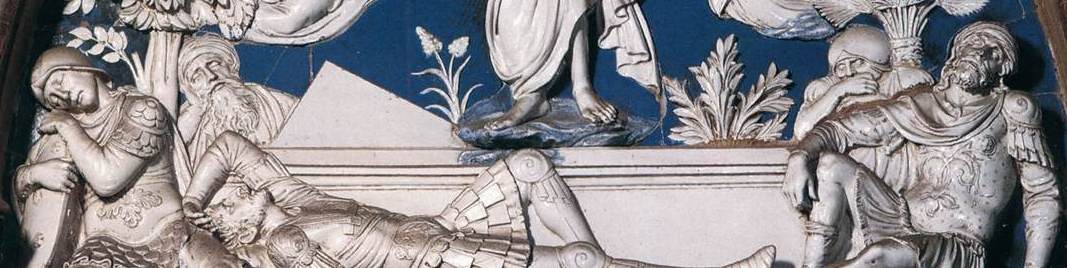
Sculpture:  Luca Della Robbia's Resurrection, a large blue and white bas-relief lunette made for the Florentine Duomo sacristy door, must have been in the works when Piero was in Florence between 1439 and 1441.The commission is officially documented in 1442, right after Luca proves his artistic merit in completing the sculpted Cantoria for the same Duomo in 1438. The glazed terracotta Resurrection is put together in pieces for a scene of Christ rising out of his tomb while five Roman soldiers sleep below him and four angels (two on each side) fly next to him: 

Piero's Resurrection of 1455, a fresco painted for the town hall of Borgo San Sepolcro, has so many similarities to Luca's image that he must have been aware of it, even though Luca's bas-relief is installed in the Florentine Duomo by 1446, five years after Piero leaves Florence to return to Borgo.The upright figure of Christ holds his right arm aloft in both while the left hand gathers the death-wrappings near the center of the torso. They both hold flags, though Luca's is kept in place by the left hand and Piero has it in the right.The left knee protrudes in both, though Piero's Christ is lifting his to step onto the sarcophagus while Luca's remains standing straight.
Both artists try to convey landscape in their works, but Piero has thought more carefully about the change in Christ from death to life by echoing that change in the dead trees on the left and the trees full of leaf on the right, while Luca maintains all his trees in full leaf to emphasize the excitement of new life. Luca's intent is to keep the focus on the rising - even the lid of his sarcophagus points upward, as do the elbow and knee of the lying soldier and the knee of another. He prefers to show the change from death to life by sculpting one soldier completely horizontal, in a near-death position, right below the horizontal sarcophagus, and directly under the strong vertical of Christ. In both Luca's and Piero's image the contrast between the horizontal and the vertical expresses the miraculous and sharp conversion from death to life.
     Both depict plain sarcophagi, although Piero makes his larger in proportion to Christ because his fresco is for the citizens of Borgo San Sepolcro (the town of the Holy Sepulchre).  Piero paints only 4 Roman soldiers rather than 5, but their sitting positions and modes of sleeping resemble the soldiers nestled around the coffin in Luca's bas-relief. The plate-armor of the soldiers is given texture in both. Luca has the far left soldier lean on his armor while one soldier stretches the length of the sarcophagus as he slumbers. Piero combines those two figures into his far right soldier who leans on armor and is nearly prone.  The two soldiers in the background of Luca's scene rest their heads on their hands; Piero's far left figure buries his head in his.
     And do they both include a self-portrait?   Could Luca be the middle-aged soldier on the far right whose body is most prominent? (The artist would have been in his late forties when completing the scene.) Most scholars agree that Piero has painted himself into the soldier with brown cuirass second from left. If so, he is also in his forties, fully frontal with closed eyes, a portrait very like and older than that of the Hercules hanging in his home originally.


Both artists are relying on certain conventions commonly found in images of the Resurrection in the 15th century; witness Ghiberti's bronze Resurrection scene created between 1403 and 1425:
Both Piero and Ghiberti eliminate the angels who fill up the space in Della Robbia's version, and probably all three artists eliminate soldiers' legs when it best serves the composition. Piero imitates Ghiberti's soldier on the far left in his far right figure while Della Robbia repeats on the left side of his relief Ghiberti's far right soldier with the shield. Piero would have seen both Ghiberti's version and the Della Robbia while in Florence. Since Piero's is the later work, 1455 or later, but closer to Luca's creation in time (1446 or earlier), it seems likely that Piero regarded Luca's Resurrection as more up-to-date. Once he leaves the city in 1441 to return to Borgo, one wonders if he came back to see Luca's version after it was in place in the Cathedral? Borgo San Sepolcro is beyond Arezzo an hour by car and Arezzo is an hour by train from Florence today. So a day's journey is not impossible to imagine for the 15th century but the only documentation of such a journey might be the images themselves. 
           The last thing we should notice is the shadow produced by Piero for Piero/soldier on the sarcophagus. The painted shadow sends the head immediately into sculptural relief. The sleeping figure suddenly seems alive, and we feel the presence of the painter in the scene, in the painting, in the room still. He could not be a sculptor like Ghiberti or Luca, but he knew that his skills as a painter lay in resurrecting life in paint.                                                                                                                                                     

Monday, July 29, 2013

WHAT PIERO SAW (C)


C) Florentine Influences on Piero della Francesca's work

Brunelleschi's Hospital of the Innocents (Ospedale degli Innocenti) is begun in 1419; by the time Piero della Francesca comes to Florence in 1439, the building is complete except for the bas-reliefs meant for the roundels on the facade.


Certainly Piero is favorably impressed by Brunelleschi's ideas of one-point perspective and classical proportions for architecture, because when he comes to paint an Annunciation in the gable of an altarpiece for nuns in Perugia, at the convent of Sant'Antonio da Padova  in 1462, he uses one-point perspective in a dramatic way, and he imitates the columns, Corinthian capitals, and rounded arches he would have seen on the portico of Brunelleschi's Ospedale.  (The altarpiece is now in the Pinacoteca Nazionale dell'Umbria in Perugia.)While he could have looked at similar columnar progressions in San Lorenzo and for Santo Spirito, the columns in this Annunciation resemble most closely those of the Hospital.
For a considerably larger
Annunciation that Piero paints into the altar wall of his San Francesco cycle in Arezzo around 1455, he remembers earlier Florentine Annunciations, either painted or sculpted:
Piero's half-figure of God the Father sending down the dove of the Holy Spirit in his Arezzo Annunciation is very close to the figure of God in a Della Robbia Annunciation made for the church of the Innocenti and now in the cloister of the Innocenti. The Della Robbia may be dated after Piero left Florence, but early drawings and colored molds may have been viewable by Piero.(Ghiberti includes a half-God the Father in the sky in several of his East door panels, but the hand gesture is different.)
 

The most exquisite use of the Della Robbia image, though, shows up in Piero's Baptism (now in the  London National Gallery). 
The position of the dove above Christ is very much like the foreshortened dove hovering over Christ in Ghiberti's Florentine Baptistery panel from the North door of 1403-25:
 

But the color of the dove of the holy spirit, white against blue sky, must surely have been inspired by the Della Robbia dove in the Innocenti Annunciation or another earlier Madonna relief (in Peretola now, originally in Santa Maria Nuova, 1441).


Piero's bird is viewed slightly more head on, but the colors of stark white against deep blue pay homage to the colors of tin-glazed terracotta he would have seen in Florence. The spirit hovering over Christ reflects the spirit hovering over Piero's creative process. The beauty of the white flight in air holds captive the viewer of both scenes. As we watch, both birds suspend belief.

WHAT PIERO SAW (B)

(B) FLORENTINE ARTISTIC INFLUENCES ON PIERO'S WORK

Piero della Francesca was not just looking at painters while he was in Florence. In the two years he worked there, 1439-1441, he absorbed visual stimuli from sculpture, architecture, and painting. He is never documented in Florence again, at least to produce works of art, but  he carries with him through the whole of his artistic life, in Borgo San Sepolcro, Arezzo, Urbino, Rimini, Monterchi, the seeds of what art was as it was created in the great excitement nest of 1440 Florence. Even if he never documents in his treatises or elsewhere the art he was exposed to in that period, we know he saw things just by their inclusion in his own paintings.
What did he see, then?
SCULPTURE:

Donatello's tomb of Pope John the XXIII (the Antipope) provided the open curtained tent for three of Piero's works:

Madonna della Misericordia, 1445-1462, Borgo San Sepolcro
Dream of Constantine, 1450's, San Francesco, Arezzo
Madonna del Parto, after 1457, orig. Santa Maria di Momentana,   
                                                            Monterchi 


The literal protection over the dead body of the pope in Donatello's design is transformed by Piero into painted cloth-covered protection in death provided by Christian belief. Piero even includes in all three works Donatello's symmetrical bas-relief angels on the sarcophagus below the pope's body, and his virtue figures below them.

 
In the Misericordia the virtues are changed to the kneeling members of the Confraternity of the Misericordia who commissioned the painting, members who include the artist himself looking up next to the figure wearing the black hood (worn by Misericordia members even today).
In the Constantine scene, the angels and virtues are changed to soldiers guarding Constantine while he is visited by the angel with cross who converts him to Christianity.


In the Madonna del Parto, the symmetrical angels stand up and hold the curtain on either side of the Madonna (they are identical twins but reversed, probably from a pounced drawing that was just turned over for reuse.)
                     
The Donatello tomb sculpture is also one of the sources for the shell niche in Piero's Brera Madonna of 1472-74.

The head of the Madonna is moved below the shell niche and the stretched-out body of the pope becomes the body of the Christ child lying on his mother's lap. Piero's shell is deeper than that of Donatello's, though, and more clearly a scallop shell. Other sources for the Brera shell are Brunelleschi's sculptural green and white marble shells in the tribune niches of the Florentine Duomo


and the shells in the niches of the intarsia of the North Sacristy:
 
Piero turns Brunelleschi's shell upside down to make it his own creation. His ideas, though, are guided by what is au courant in Florence around 1440. Donatello and Brunelleschi are only two of the shapers of his consciousness. Blog C for What Piero Saw will give other examples of Florentine influence in Piero's work.